
Original briefings. Zero spin.
Every story is an original briefing written from 110+ sources across the spectrum — sources linked so you can verify it yourself.
 economy
Major Story (7/10)
September 10, 2026 at 07:10 PM
economy
Major Story (7/10)
September 10, 2026 at 07:10 PM
Startup Raises $75 Million to Spray Chemicals Into the Sky and Cool the Planet, No Regulator Has Signed Off
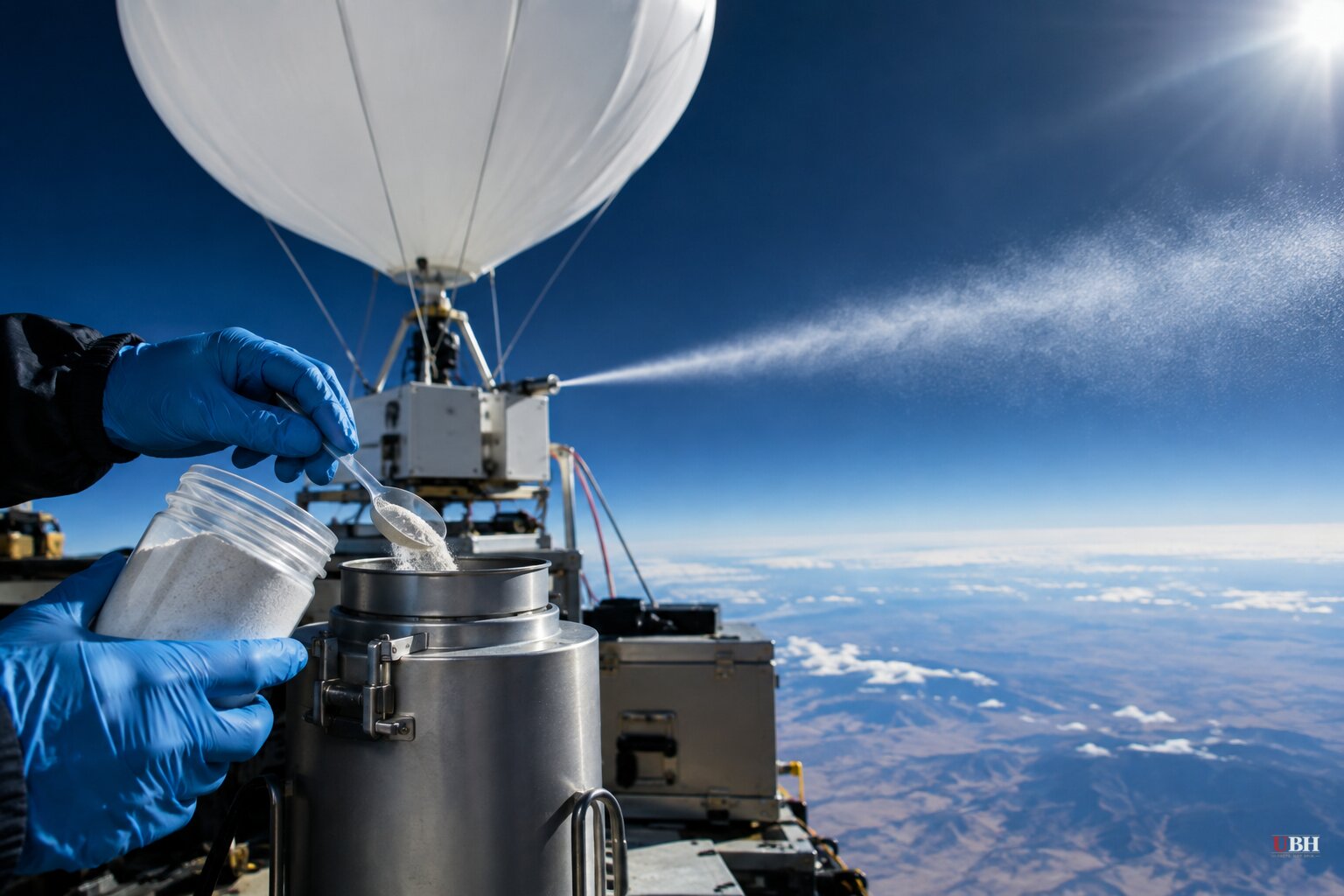
A company backed by $75 million in venture money says it can help cool the Earth by spraying particles into the stratosphere. A separate nonprofit says the world doesn't yet have enough science to know if that's a good idea. Both plans are moving forward at the same time, and no government agency is running point on either one.
Stardust Solutions, founded in 2023 and led by two former Israeli government nuclear physicists, CEO Yanai Yedvab and co-founder Amyad Spector, wants to fly aircraft and balloons into the stratosphere and release particles made from calcium carbonate, according to CNN. That's a food additive and the same mineral that makes eggshells hard. The idea is to reflect sunlight back into space and bring global temperatures down, the same effect a big volcanic eruption produces naturally. CNN reports the 1991 eruption of Mount Pinatubo in the Philippines pumped enough sulfur dioxide into the atmosphere to cool the planet by 0.9 degrees Fahrenheit (0.5 Celsius) for more than a year.
Most solar geoengineering research has focused on sulfur dioxide, the volcanic route. Stardust picked calcium carbonate specifically to dodge sulfur dioxide's known downsides, including acid rain and ozone depletion, per CNN's reporting. Yedvab calls the technology a "critical tool" governments should have on the table, but he's also on record saying it's not a silver bullet and doesn't replace cutting emissions.
Stardust says a real, planet-scale operation would run about $10 billion a year. That's not a government line item anywhere. It's a private company's own cost estimate for something that would alter weather patterns for every country on Earth, whether they agreed to it or not.
Raymond Pierrehumbert, a professor of planetary physics at Oxford, told CNN exactly why that bothers him. "When the whole world is at stake, satisfying the needs of venture capitalists for profits should not enter at all into decisions about what, if anything, should be deployed," he said. A company with investors to answer to has a financial incentive to get to deployment, not just to get the science right.
The road map says slow down
While Stardust moves toward hardware, a San Francisco nonprofit called Reflective has published a detailed road map for how the world should actually study this before anyone flips a switch, according to MIT Technology Review. The plan runs through phases: computer models, lab work, progressively larger outdoor sulfur dioxide release tests, and finally full monitoring if deployment ever happens.
Done in a coordinated way, Reflective says the whole research program would take about a decade and cost roughly $370 million. Done piecemeal and uncoordinated, which is basically what's happening right now with companies like Stardust moving on their own timeline, it could take 20 years and $1.4 billion, per MIT Technology Review.
Supporters of the road map, including former ARIA CEO Ilan Gur and Imperial College London's Sebastian Eastham, argue outdoor experiments are necessary to resolve real scientific uncertainty responsibly. Scientists have studied stratospheric aerosol injection for roughly 50 years without ever running a real-world test at meaningful scale, according to MIT Technology Review, so nobody actually knows how well it works or what side effects show up at scale.
But critics, including signatories of the International Non-Use Agreement, argue the road map is aimed at the wrong problem. They say the core issue was never technical uncertainty. It's governance and equity: who gets to decide, who bears the risk, and who's accountable if it goes wrong. They also point to "termination shock," the risk that if a spraying program ever stopped abruptly, warming could snap back fast and hard, potentially worse than if nothing had been done at all.
If a private company or even a well-funded nonprofit starts a program and then loses funding, gets sued, or just walks away, there's no clean off-switch for the planet.
Nobody's in charge
Strip away the science and you're left with a governance vacuum. There's no international treaty regulating stratospheric spraying experiments. There's no U.S. agency with clear authority to approve or block a private company's outdoor test flights. Reflective's road map is a proposal, not a binding framework. Stardust's $75 million came from private investors, not a government contract, which means it answers to shareholders, not voters.
That cuts both ways. It means taxpayers aren't on the hook for this, which is how private risk capital is supposed to work. But it also means a handful of investors and two physicists in Israel could end up making decisions with global atmospheric consequences before any government, court, or international body has weighed in on the rules.
The open question nobody in these reports answers: who has to say yes before Stardust or any other company runs its first large-scale outdoor test, and what happens if they don't ask first.
Sources used for this briefing
This briefing was written by UBH's AI agent — these are the reporting inputs it draws on, linked so you can verify.


