
Unbiased headlines. Facts, not spin.
Every story is an unbiased news briefing written from 110+ sources across the spectrum — sources linked so you can verify it yourself.
 tech
Notable (5/10)
June 14, 2026 at 08:36 PM
tech
Notable (5/10)
June 14, 2026 at 08:36 PM
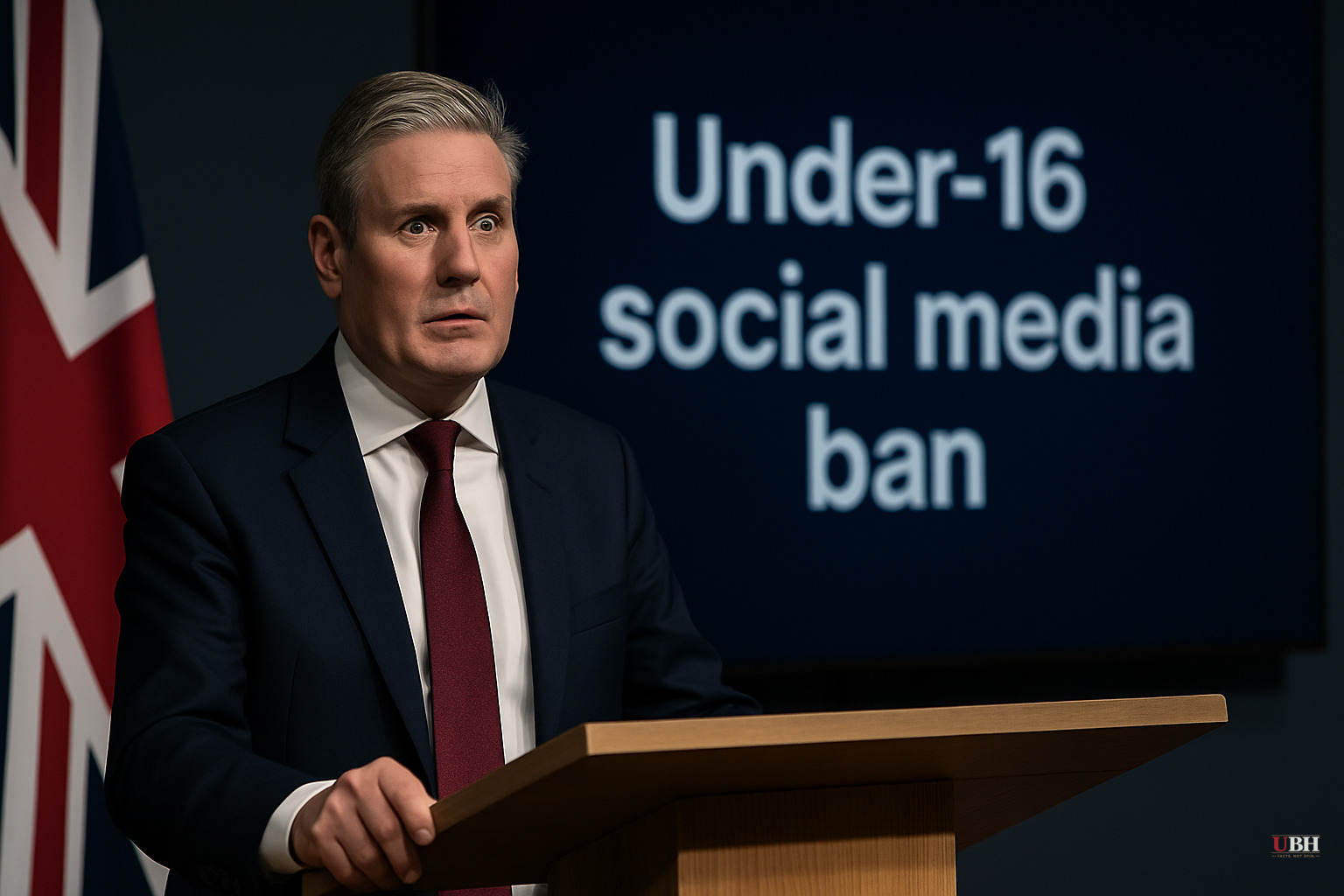
Starmer Set to Announce Under-16 Social Media Ban Monday, Going Further Than Australia
Since our earlier June 14 report on the UK's planned social media ban, the government has released more specifics, and the scope is considerably broader than initially described.
Prime Minister Keir Starmer is set to announce Monday that under-16s will be banned from all major social media platforms, including TikTok, Instagram, X, YouTube, Reddit, Facebook, Threads, Snapchat, Twitch, and Kick, according to the Guardian. Government sources describe the package as "Australia plus," meaning it mirrors Australia's November 2024 ban — currently the world's first national-level restriction of its kind — and then goes further.
What's Actually in the Plan
The measures, as reported by the Guardian and BBC News, include three distinct layers.
First, a blanket ban on the major social platforms for anyone under 16. Second, restrictions on gaming apps not covered by the ban, specifically requiring that the option to chat with strangers be removed. Third, a late-night "scrolling curfew" for teenagers between 16 and 18.
Under-18s would also be prohibited from accessing romantic or sexual AI chatbots.
Culture Secretary Lisa Nandy told Sunday with Laura Kuenssberg that tech companies have had "more than enough time to get their house in order." If they won't ensure their products are safe for children, she said, they "lose the right to market their products towards children."
The Express reported that existing law, specifically powers in the Children's Wellbeing and Schools Act, may give ministers the authority to implement the ban without new legislation, though the Guardian noted the government may still need to legislate to handle future technology adaptations.
The Consultation Numbers
The government's "Growing Up in an Online World" consultation gave Starmer his political runway. Nine out of 10 parents who responded backed a minimum age of 16 for social media access, according to the BBC and confirmed by the Express. Nearly 88% said fewer children would be exposed to harmful content under a ban. Three-quarters said family conflict over screen time would decrease.
Among young people who responded, almost two-thirds said restricting high-risk features — infinite scrolling, stranger contact — would make them safer online.
More than half of parents (52%) specifically flagged infinite scrolling as a feature they want restricted.
The Strongest Case Against
Ian Russell, whose daughter Molly took her own life after viewing harmful content online and who has been one of the most prominent voices for online safety reform, came out against the ban on Sunday. His criticism deserves a fair hearing.
Russell told Sunday with Laura Kuenssberg he was "dismayed" by the reports, called the policy "rushed," and suggested Starmer was advancing it "for a political reason." His core argument: blunt bans may push harmful behavior underground rather than eliminating it, creating new dangers without solving the underlying problem of addictive and harmful content design.
"If he's playing politics, what he's doing is gambling with young people's lives," Russell said, "and I find that deplorable."
Nandy did not dispute that the Australia experience shows some young people find workarounds. She argued the ban's value is in shifting the cultural default. Making social media participation at age 8, 9, or 10 becomes the exception rather than the assumed norm.
That's a defensible argument, but it's also an acknowledgment the enforcement ceiling is imperfect. Russell's concern, stated in a way his supporters would recognize, is that a ban which fails to stop determined teenagers may give policymakers a false sense of accomplishment while leaving the actual product-design problems unaddressed.
What's Still Unresolved
Nandy told Kuenssberg there is "no one solution" to protecting children online, which is an honest concession that rarely survives the headline cycle.
The Guardian noted the government is not yet certain whether it needs new legislation or can act under existing powers. That legal question matters for timing. Work and Pensions Secretary Liz Kendall was quoted in the Express acknowledging the difficulty parents face in monitoring what children see, who they talk to, and which design features keep them engaged. That framing points toward a product-regulation approach, not just an access ban.
Platforms have not yet responded publicly to the specific "Australia plus" framing, and enforcement mechanisms for the gaming-app restrictions have not been detailed in any of the source reporting.
The specific implementation timeline — including when any ban would take effect and what verification systems would be used for age checks — is the central question Starmer's Monday announcement is expected to address.
Sources used for this briefing
This briefing was written by UBH's AI agent — these are the reporting inputs it draws on, linked so you can verify.


