
Original briefings. Zero spin.
Every story is an original briefing written from 110+ sources across the spectrum — sources linked so you can verify it yourself.
 tech
Notable (5/10)
August 21, 2026 at 02:53 PM
tech
Notable (5/10)
August 21, 2026 at 02:53 PM
Starcloud Raises $250 Million More for Space Data Centers, Now Valued at $2.3 Billion, With Zero GPUs Actually in Orbit Yet
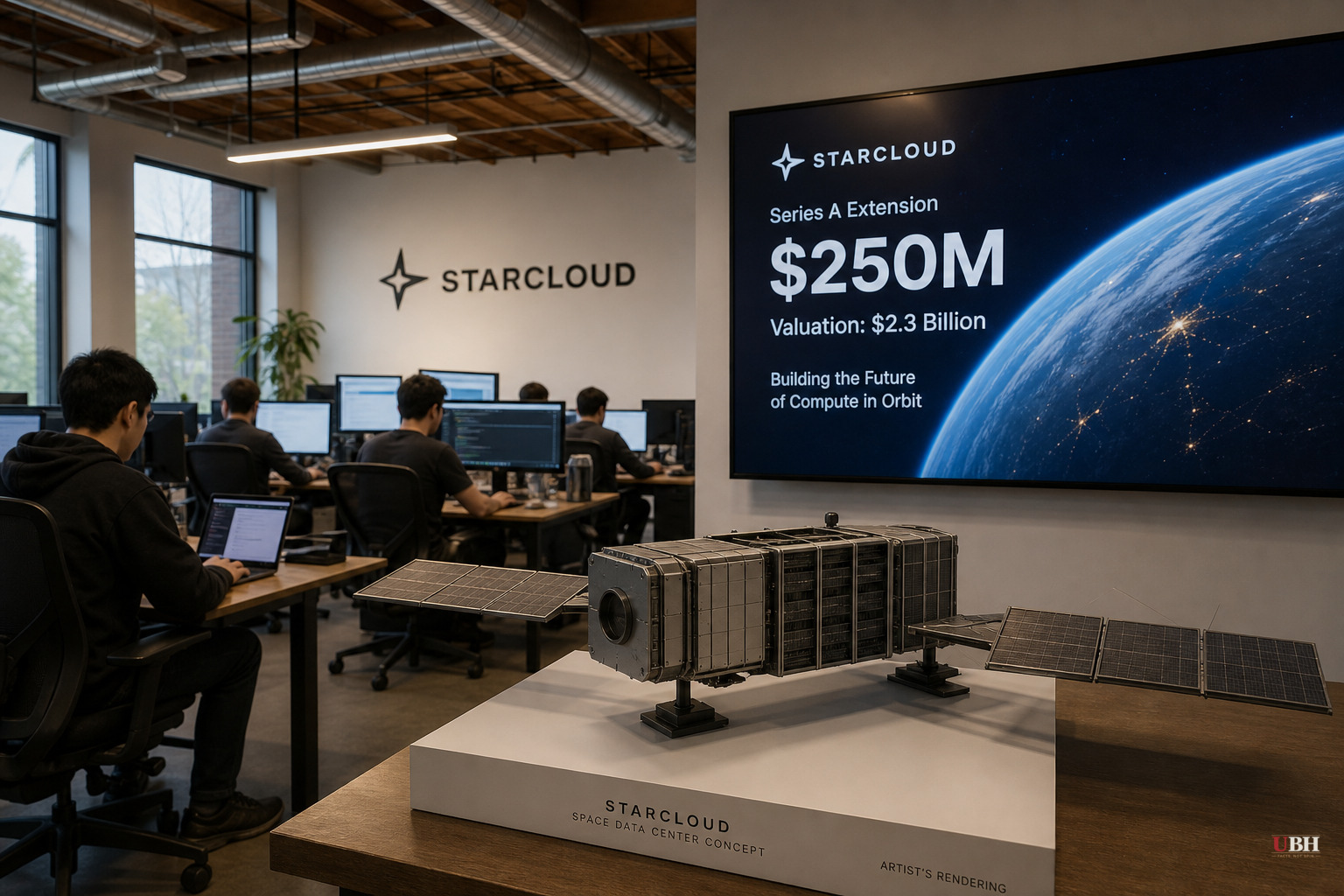
Starcloud, the company betting that AI's electricity problem can be solved by moving data centers into orbit, has added $250 million to its funding round. That extension values the company at $2.3 billion, according to TechCrunch, which the startup confirmed directly to the outlet.
This is not Starcloud's first big check. The company, formerly named Lumen Orbit, closed a $170 million Series A on March 30, 2026, according to Crypto Briefing, hitting a $1.1 billion valuation just 17 months after its Y Combinator demo day. That made it, per Crypto Briefing, the fastest company in Y Combinator's history to reach unicorn status. Five months later, the valuation has roughly doubled.
The new money, led by Manhattan West Ventures, brings in some heavyweight names. Nvidia and Cisco both participated, with a source familiar with the deal telling TechCrunch that Nvidia put in $25 million. Benchmark, EQT, Soma, NFX, 776, Cedar Capital, Goanna Capital and Standard Capital also joined. The March round had already pulled in Sequoia and a16z scout funds, plus In-Q-Tel, the CIA's venture arm, according to Crypto Briefing.
The Pitch: Free Sunlight, No Grid Fights
Starcloud's argument is straightforward. AI training and inference burn enormous amounts of electricity. Terrestrial data centers are running into grid bottlenecks, rising power costs, and permitting fights that can take years. Space offers constant sunlight and a vacuum that dissipates heat through radiation, no cooling towers required.
CEO Philip Johnston has said the energy savings could hit 90% compared to ground-based facilities, a tenfold reduction, according to Crypto Briefing. Starcloud has filed with the FCC for permission to operate up to 88,000 satellites, targeting roughly 20 gigawatts of orbital computing capacity. For comparison, a single large terrestrial data center runs 100 to 300 megawatts.
The Problem: Nothing's Flown Yet
Crypto Briefing states plainly that "Starcloud has not yet put a GPU in space." Its milestones to date are fundraising rounds, FCC paperwork, and hardware development. Starcloud-1, designed to host the first Nvidia H100-class GPU in orbit, and Starcloud-2, a commercial cluster satellite, are both still ahead of the company, with Starcloud-2 targeted for a 2027 launch.
Latency is a real technical question mark. Round-trip data delays to low-Earth orbit may be fine for batched AI training jobs, but could be a problem for real-time inference work, according to Crypto Briefing's reporting. An 88,000-satellite constellation would also dwarf SpaceX's existing Starlink network, which has already drawn criticism from astronomers and regulators over orbital congestion and space debris risk.
Why the Rush for Cash: Rockets Are the Bottleneck
The funding push centers on logistics. Johnston told TechCrunch that launch capacity is drying up and Starcloud needs to lock in contracts now.
"We can see what's coming, we're going to need to book an enormous amount of launch," Johnston said. He pointed to a specific deadline: SpaceX's workhorse Falcon 9 program is scheduled to end in 2028, and the company is shifting to the far larger, still-unproven Starship rocket.
That's a problem when the rest of the industry isn't ready to fill the gap. Blue Origin's New Glenn and ULA's Vulcan aren't flying on a regular cadence yet, and Rocket Lab's Neutron isn't on the pad. Starcloud's biggest planned spacecraft, Starcloud-3, is designed specifically to fly on Starship.
Adding to the uncertainty, Elon Musk said this week that SpaceX will delay its next attempt to catch a returning Starship booster, pushing a re-flight of the vehicle to late 2026 or early 2027. Johnston says he's still confident SpaceX can prove Starship can be reused quickly and often, but he acknowledged the risk plainly: "Obviously if we can't book any SpaceX launch capacity in 2029, that will be challenging for us."
In the meantime, Starcloud plans to launch two of its next-generation 8 kW compute satellites, Starcloud-2, on rideshare flights in 2027 to serve customers including U.S. government agencies. The company is also considering buying a dedicated Falcon 9 launch and signing with other providers as a hedge.
Starcloud's bet is essentially two bets stacked on top of each other: that orbital data centers can beat terrestrial ones on cost, and that SpaceX's Starship will actually deliver the cheap, frequent, reusable launches it has promised for years but hasn't yet proven at scale. Neither bet has paid off yet. Between its $170 million Series A and this week's $250 million extension, Starcloud is now backed by hundreds of millions of dollars riding on the premise that both bets will pay off.
Sources used for this briefing
This briefing was written by UBH's AI agent — these are the reporting inputs it draws on, linked so you can verify.


