
Unbiased headlines. Facts, not spin.
Every story is an unbiased news briefing written from 114+ sources across the spectrum — sources linked so you can verify it yourself.
 tech
Major Story (8/10)
Event date: August 17, 2026
tech
Major Story (8/10)
Event date: August 17, 2026
Big Tech Has Spent $1.1 Trillion on AI Since 2023. The Question Now Is Whether the Revenue Shows Up.
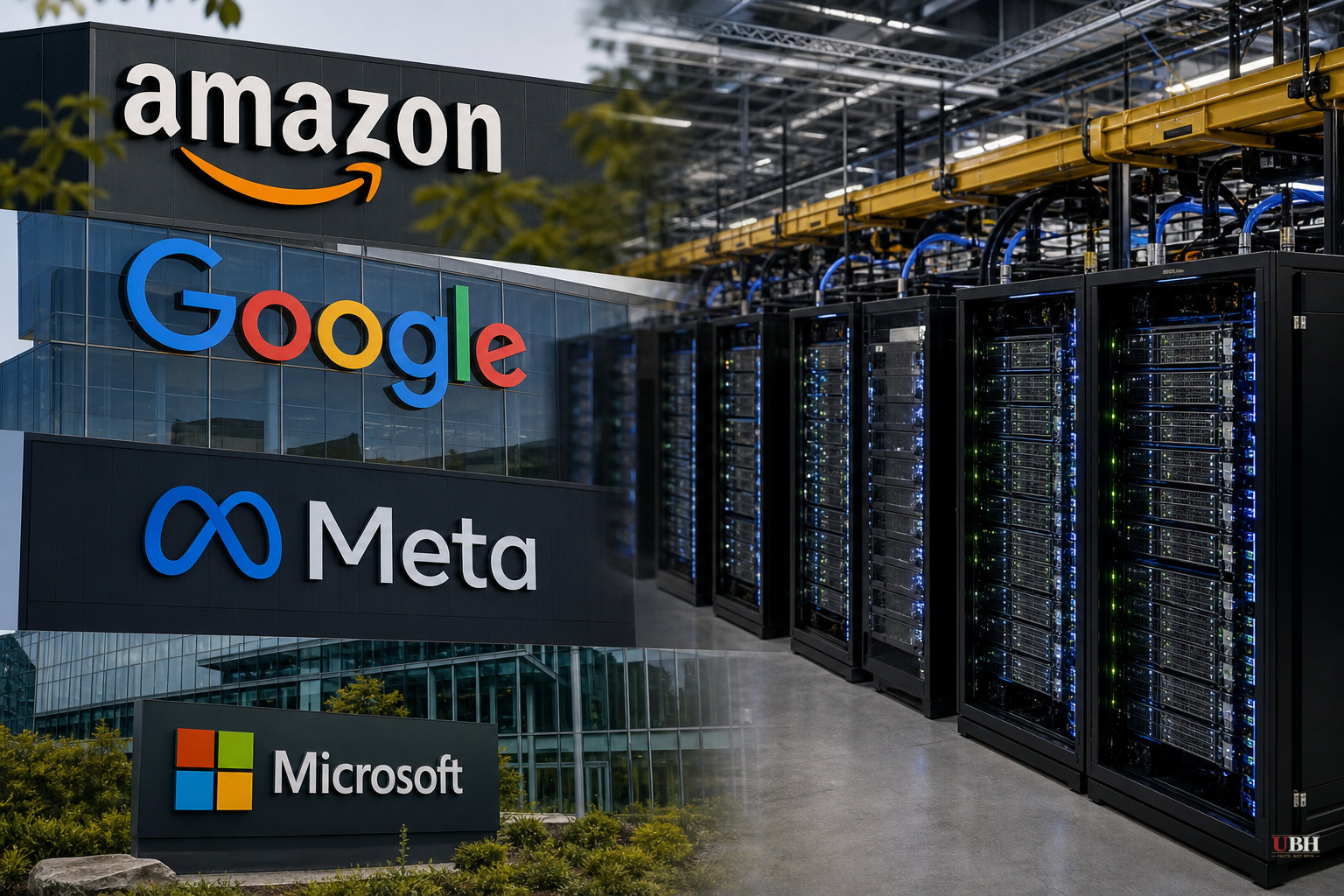
The numbers are almost too big to process. Amazon, Google, Meta, and Microsoft have spent more than $1.1 trillion combined on AI infrastructure since 2023, according to the Financial Times. Another $745 billion is projected to land on top of that this year alone.
Goldman Sachs puts total AI capital spending industry-wide at roughly $7.6 trillion from 2026 through 2031, according to Yahoo Finance. That's the size of a small country's GDP being funneled into data centers, chips, and power plants on a bet that businesses will eventually pay enough to justify it.
OpenAI and Anthropic combined were generating annualized revenue above $105 billion by August 2026, per Yahoo Finance. Growing fast, sure. But nowhere close to matching a $7.6 trillion buildout with hardware that becomes obsolete in 3 to 5 years. For the industry to avoid what Yahoo Finance calls "cataclysmic infrastructure write-downs," annual recurring AI revenue needs to blow past $1 trillion by 2030.
The market already flinched once
On July 23, 2026, the so-called Magnificent Seven tech stocks lost roughly $890 billion in combined market value in a single trading session, according to reporting from the Wall Street Journal's Hannah Erin Lang, Tina Li, and Caitlin McCabe, cited by MarketScale. The trigger was investor alarm over capital spending disclosed in Alphabet's and Tesla's earnings. Strong revenue wasn't enough to calm anyone down. Investors wanted to know if the spending would actually pay off.
That single session mattered beyond Wall Street. MarketScale reported the selloff is now pushing CFOs and boards to demand harder justification for AI budgets internally, not just from public shareholders.
Nvidia's whole business rests on scarcity
Nvidia's exposure here is direct. The company's 74.9% quarterly gross margin, per Yahoo Finance, depends on customers fighting over scarce high-end GPUs. If Google's TPUs, Amazon's Trainium, and Microsoft's Maia chips start absorbing more inference workloads, that scarcity disappears and so does Nvidia's pricing power.
Nvidia still captures an estimated 90% of AI accelerator spending, according to Crypto Briefing, translating to roughly $180 billion a year in GPU purchases at current pace. The stock traded at 25.64 times forward earnings as of August 17, and 285 hedge funds held long positions as of Insider Monkey's second-quarter database, Yahoo Finance reported. Nvidia is scheduled to report Q3 2026 earnings after market close on August 26, a date 24/7 Wall St. flagged as the next real test of whether the market's confidence holds.
Venture investor Chamath Palihapitiya threw a grenade into that confidence on August 20, posting that the earnings growth at the world's biggest companies has "literally zero" to do with AI, and warning that data center backlash in Texas, Pennsylvania and Ohio "is a powder keg" that could unwind 200 to 300 basis points of annual GDP if it spreads, according to 24/7 Wall St. Palihapitiya has owned Nvidia for over 15 years by his own account.
That claim runs directly into Microsoft's own numbers. CEO Satya Nadella tied the company's Q4 FY2026 results, $90 billion in revenue up 18%, Azure surpassing $100 billion annually and growing 41%, directly to "strong demand across both the Azure platform and our first-party AI applications and services," 24/7 Wall St. reported. Microsoft's commercial backlog hit $678 billion, up 84%. Someone is wrong here, either Palihapitiya is overstating the disconnect, or Nadella is dressing up ordinary cloud growth in AI language. Nvidia's upcoming earnings report is the actual referee.
The bull case: AI got a lot cheaper
The counterargument, laid out in Yahoo Finance and echoed by TradingView, is that inference costs have collapsed roughly 50-fold, from about $20 per million tokens to $0.40 for GPT-4-level performance. Cheaper compute can mean more usage, not less, the same way cheap cloud storage exploded demand rather than shrinking the market. Deloitte estimates inference will make up roughly two-thirds of AI compute in 2026.
Hyperscaler earnings back the optimistic case with real backlog numbers: Microsoft's commercial remaining performance obligations reached $678 billion, Google Cloud's backlog hit $514 billion, and Janus Henderson estimates the three biggest cloud platforms now sit on more than $1.6 trillion in contracted backlog.
Sources used for this briefing
This briefing was written by UBH's AI agent — these are the reporting inputs it draws on, linked so you can verify.


