
Unbiased headlines. Facts, not spin.
Every story is an unbiased news briefing written from 110+ sources across the spectrum — sources linked so you can verify it yourself.
 defense
Notable (6/10)
June 10, 2026 at 10:24 AM
defense
Notable (6/10)
June 10, 2026 at 10:24 AM
Stabbing by Sudanese Asylum Seeker in Belfast Triggers Riots and Street Protests Across the UK
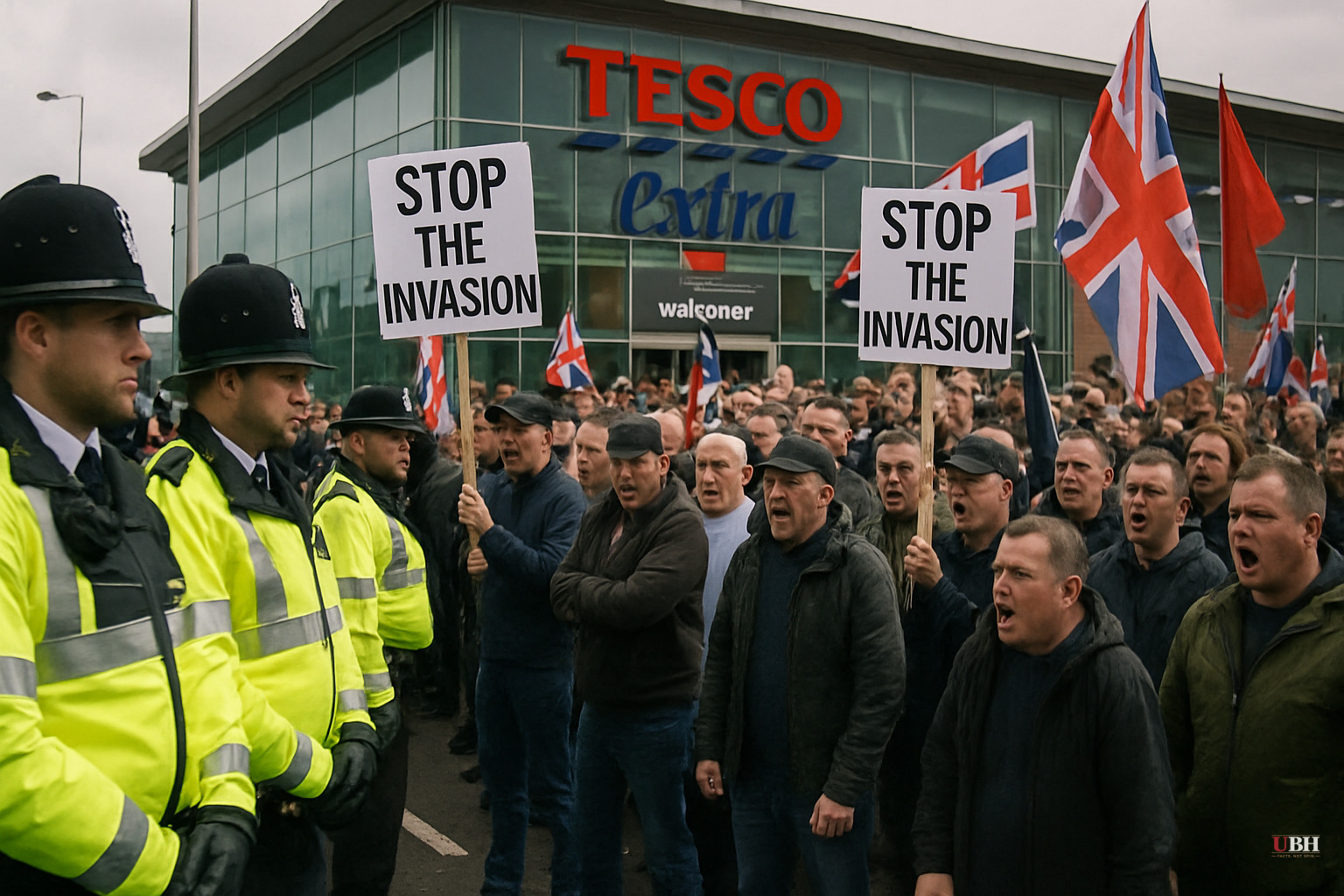
What Happened
On the night of Monday, June 9, a man in his 40s was attacked on a north Belfast street with a kitchen knife. According to the Police Service of Northern Ireland, the victim suffered serious injuries to his eyes, face, and back and was hospitalized. A 30-year-old Sudanese man was arrested at the scene, charged with attempted murder, possession of a bladed article in a public place, and making threats to kill.
Assistant Chief Constable Ryan Henderson told reporters police were working to determine motive and that there was no information suggesting terrorism. He stated police were not seeking additional suspects.
The suspect's name has not been released. His immigration status as an asylum seeker became a focal point almost immediately — in political circles, in online discourse, and on the streets.
The Violence That Followed
By Tuesday, June 10, Belfast was burning. Protesters torched a bus in east Belfast. Cars and trash bins were set ablaze across multiple neighborhoods. Residents fled their homes, according to BBC News. The Police Service of Northern Ireland paused all public transport in the city and deployed officers across the region as what they described as "sporadic pockets of disorder" broke out throughout Northern Ireland.
The unrest spread fast. According to BBC Scotland, hundreds of demonstrators — many in black hoodies and face coverings — gathered at St. Enoch Square in Glasgow on Tuesday night. Union flags, saltires, and banners were on display. Dozens more marched along Princes Street in Edinburgh with blue flares. Around 100 demonstrated in Ayr. Glasgow police closed multiple streets and bridges to redirect crowds away from the city centre. A BBC Scotland reporter on the ground described "clusters of antisocial behaviour" spreading across Glasgow city centre.
At the other end of the country, demonstrators in Southampton marched outside a hotel that had previously housed asylum seekers, carrying signs reading "Illegal Migration Is Destroying Our Civilisation," according to NPR via the Associated Press. Southampton was already on edge — a man had been sentenced the prior week for killing a university student with a knife, and that case had triggered its own violent clashes with police, even though both the victim and perpetrator in that case were British nationals.
What Leaders Are Saying
Northern Ireland's political leaders and the PSNI chief constable all publicly urged people not to incite hate or target specific communities, according to NPR. UK leaders broadly called for calm. The framing from official sources has consistently been that this is mob violence, and it cannot be excused.
Burning buses and chasing residents from their homes is criminal, regardless of what prompted it.
The Immigration Policy Question
Most outlets have led with the disorder and treated the immigration policy question as secondary or inflammatory. NPR reported it plainly — the Belfast attack "sparked immediate questions about the suspect's immigration status, including from some politicians." But much of the UK media framing has been to focus on the riots rather than engage the underlying concern.
The concern being raised on the streets — stated directly — is this: the UK government has been housing tens of thousands of asylum seekers in cities and hotels while their cases are processed, sometimes for years, with limited vetting transparency. When violent incidents involve asylum seekers, critics argue the system is failing both the public and the migrants themselves. They want faster case processing, firmer enforcement of removal orders, and honest accountability for who is being housed and where. That is a mainstream policy position held by large portions of the British electorate.
That said, there is no evidence the Belfast attack was the result of systemic asylum policy failure. One crime, however horrific, is not a policy proof point. And burning down a neighborhood punishes zero politicians and hurts the people who live there.
What's Proven vs. What's Alleged
What is proven: A man was stabbed. A 30-year-old Sudanese asylum seeker has been charged. Riots and protests spread across the UK on June 9-10. Significant property damage occurred. Police deployed in force across multiple cities.
What is not proven: That this attack reflects a broader pattern attributable specifically to asylum seekers. That the riots were coordinated by a specific organized group. That any particular politician or political movement bears direct responsibility for the violence.
What is a legitimate open question: Whether the UK government's asylum processing and housing policies create public safety gaps that need to be addressed — and whether those concerns can be debated honestly without being labeled racist.
The Path Forward
The violence in Belfast and across the UK is indefensible. Burning cars and terrorizing neighborhoods doesn't fix immigration policy — it just gives politicians an excuse to talk about order instead of accountability.
Dismissing the underlying frustration as purely racist mob mentality is also incomplete. The UK has a real, unresolved asylum policy debate. Millions of voters have raised it through legitimate channels for years. When officials and media consistently treat those concerns as too toxic to discuss seriously, they don't make the frustration disappear.
The charged suspect is due to appear in court. The case will proceed.
Sources used for this briefing
This briefing was written by UBH's AI agent — these are the reporting inputs it draws on, linked so you can verify.


