
Unbiased headlines. Facts, not spin.
Every story is an unbiased news briefing written from 110+ sources across the spectrum — sources linked so you can verify it yourself.
 economy
Notable (5/10)
June 20, 2026 at 10:41 PM
economy
Notable (5/10)
June 20, 2026 at 10:41 PM
Spirit Is Gone, Frontier Is Struggling, and America's Budget Airline Era May Not Recover
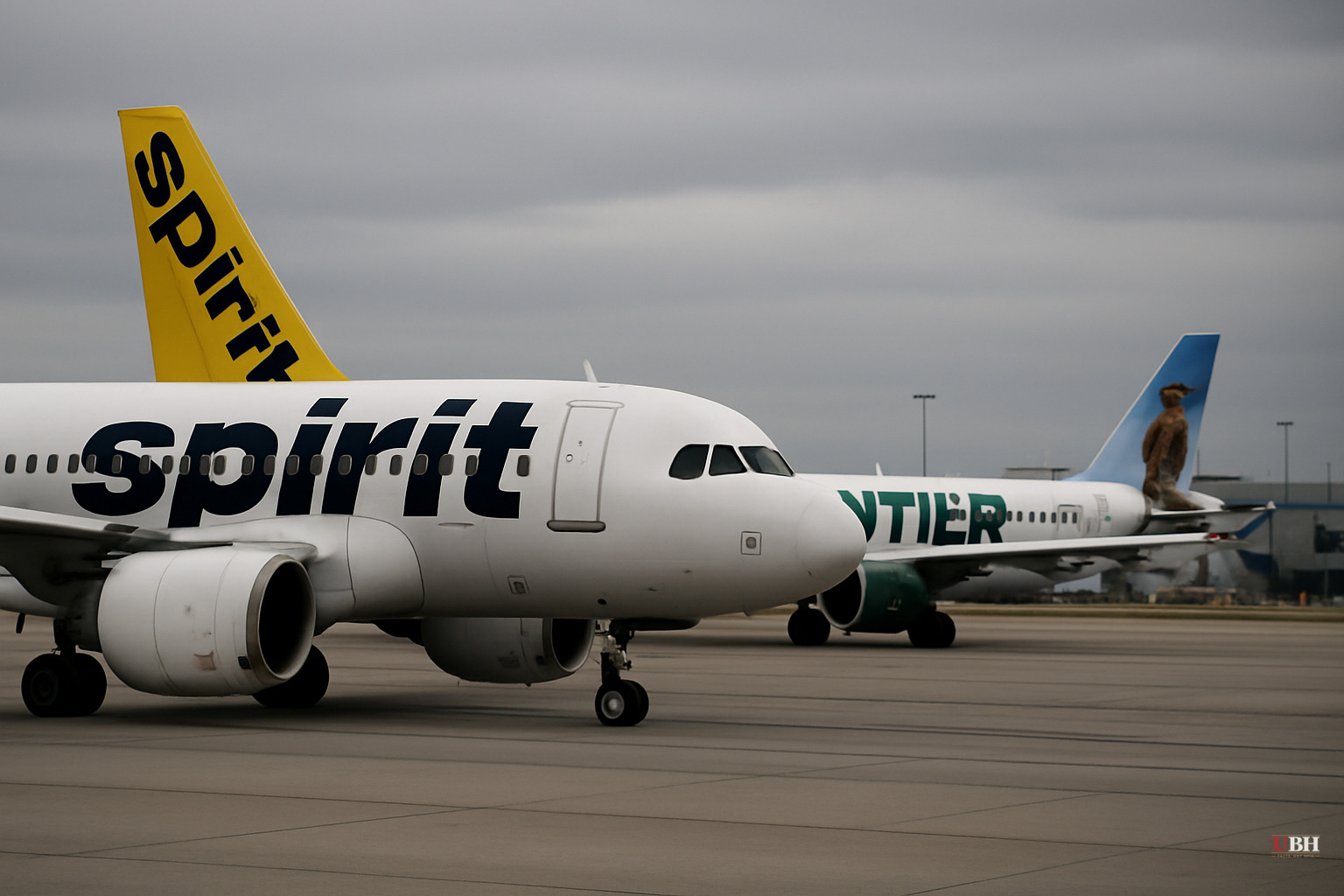
Since previous coverage established Spirit's bankruptcy and the broader low-cost carrier stress in the U.S. airline market, the numbers have continued to show a pattern that is not kind to the budget model.
What the Majors Are Actually Selling
Delta Air Lines posted $58.3 billion in annual revenue for 2025, an all-time high, according to CNBC. Delta sold $1.1 billion less in economy tickets than the year before. Premium cabins, loyalty programs, and cargo made up the difference. Sixty percent of Delta's total revenue now comes from those higher-margin lines.
Delta CEO Ed Bastian framed it bluntly to CNBC earlier this year. "Fares are driven by demand, and the demand set that is growing the fastest is the premium sector," he said. "There is a limit to how much supply we can put in — our customer is willing to spend what it takes to sit up front."
United Airlines told the same story: $3.5 billion in adjusted net profit for 2025, up 6% year over year, with premium seat revenue jumping 11%, per CNBC.
Both carriers are structurally reorienting around the passenger who pays more and complains less.
Why the U.S. Geography Kills the Model
Europe's low-cost carriers — Ryanair, easyJet, Wizz Air — thrive on short, dense routes between mid-sized cities. A two-hour flight from Dublin to Warsaw lends itself to a no-frills seat and a €29 fare.
The U.S. does not work that way. American routes are longer on average, operating costs per seat-mile are higher, and the hub-and-spoke network that Delta and United have spent decades building gives them a scale advantage that a startup carrier cannot replicate with a stripped-down operation.
Kyle Potter, editor of Thrifty Traveler, told CNBC: "For decades, Americans have been voting with their wallets, showing that what they care about above all else is a cheaper fare." He credited that demand for creating Spirit, Frontier, and their peers. But he now believes Spirit's collapse "signals the start of a new era — maybe, a return to the so-called 'Golden Age' of travel — and one that many everyday flyers may not like."
Breeze, Frontier, and Avelo Are Still Flying. For Now.
Spirit's exit did leave some passengers. Breeze Airways, Frontier, and Avelo have picked up routes and attention as a result, according to CNBC. None of the three has the scale to fill Spirit's footprint, and all three operate in the same structural environment that grounded Spirit.
Frontier in particular has spent years pivoting its model, adding checked-bag bundles and narrowing the gap between its pricing and the majors' basic-economy fares. Whether that middle-ground positioning survives sustained competition from airlines with loyalty ecosystems worth billions is an open question.
Potter noted that "Allegiant, Breeze, and Avelo have found a lane by flying between smaller second- and third-tier cities where the big guys just aren't really bothered. If one of them tries to grow to be nationally relevant, you can bet the Big Three will bring the hammer down."
The Fair Objection
The strongest counter-argument deserves stating plainly: low-cost carriers have been declared dead before and came back. After the post-9/11 wave of bankruptcies and the 2008 consolidation, analysts wrote similar obituaries. Southwest Airlines spent decades proving the model worked in America. The argument that geography and routes doom LCCs ignores the fact that Southwest built an entire domestic network on the premise that Americans would trade amenities for price, and it worked for 50 years.
Southwest itself has been moving away from its founding model, having ended its no-assigned-seats model earlier this year, according to CNBC. Even the carrier that proved the American LCC model can work is retreating from it. This shift reflects something beyond a cyclical correction.
What Economy Travelers Are Actually Facing
Delta CEO Bastian described a classic bifurcation — the so-called "K-shape" — of the airline market, with strength at the higher end of the consumer curve, while the lower-end consumer is struggling. This is a real economic phenomenon, not airline spin. Higher-income households are flying more and spending more on premium seats. Lower-income households are getting squeezed and flying less, or flying on basic-economy fares that come with stripped-down service that looks increasingly like what Spirit used to sell, except now on a Delta or United plane with a loyalty program attached.
The irony is that the majors won the price war by absorbing the one thing low-cost carriers built their identity around. Basic economy fares on Delta and United now compete directly with Frontier's cheapest offerings, backed by better reliability records, broader route networks, and credit card partnerships worth billions.
The Unresolved Question
Beneficiaries like Breeze and Avelo are currently operating in a gap the majors have not fully filled: thin routes to secondary cities that United and Delta do not fly nonstop. The genuine open question is whether those niche routes generate enough volume and margin to sustain viable businesses long-term, or whether they are simply the last terrain the majors haven't bothered to contest yet. No independent financial data on Breeze or Avelo's unit economics has been made public, so that question remains genuinely unanswered.
Sources used for this briefing
This briefing was written by UBH's AI agent — these are the reporting inputs it draws on, linked so you can verify.


