
Unbiased headlines. Facts, not spin.
Every story is an unbiased news briefing written from 110+ sources across the spectrum — sources linked so you can verify it yourself.
 economy
Notable (5/10)
June 29, 2026 at 09:40 AM
economy
Notable (5/10)
June 29, 2026 at 09:40 AM
Spain Raises 2026 Growth Forecast to 2.6%, Nearly Triple the Eurozone Average
Spain Stands Alone in Europe's Economic Slowdown
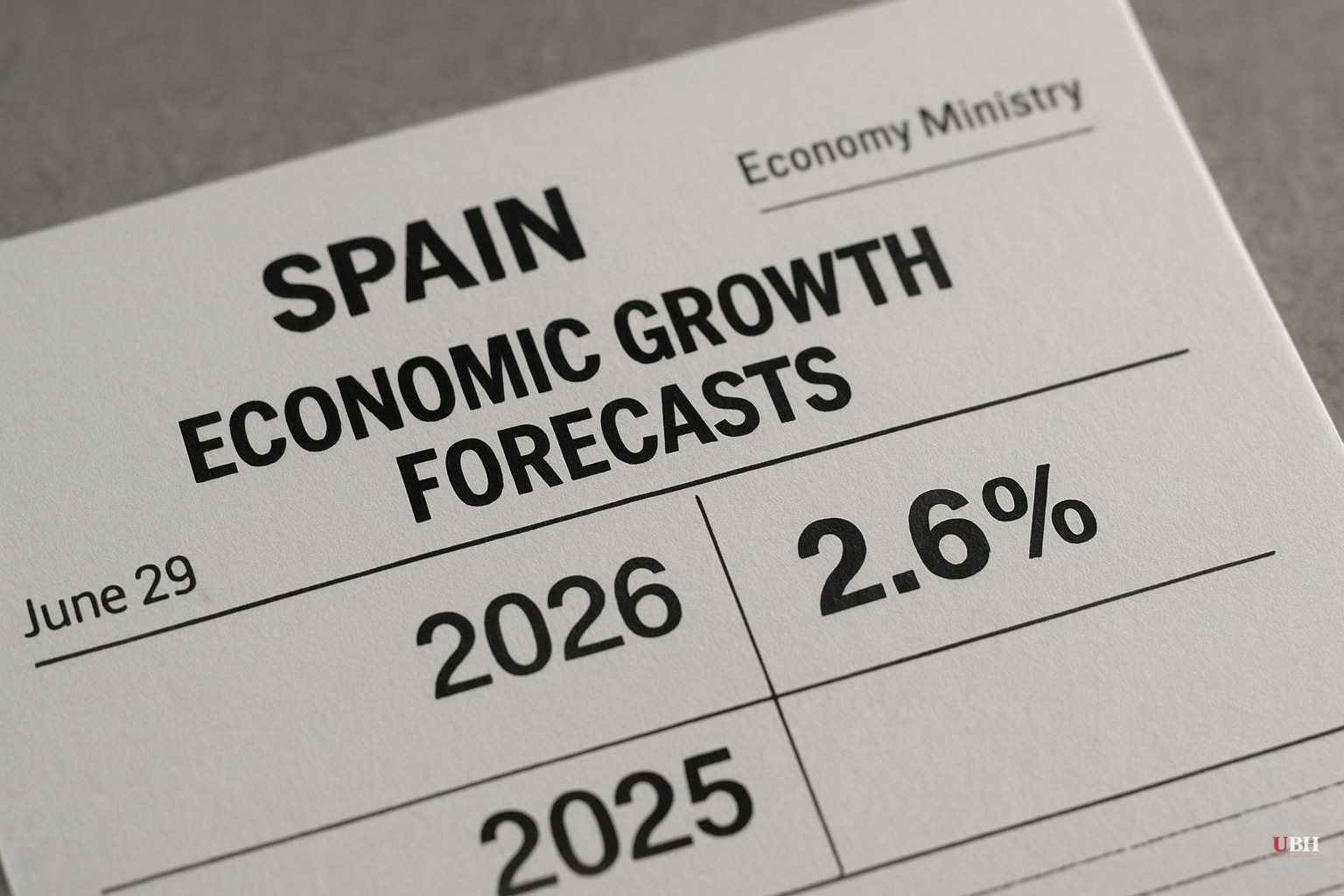
While Germany scrapes along at a projected 0.6% growth and France at 0.8%, Spain is forecasting 2.6% GDP expansion for 2026, according to the Spanish Economy Ministry. That projection, announced Monday, June 29, marks an upward revision from the ministry's previous estimate of 2.2%.
The Eurozone as a whole is expected to grow just 0.9% this year, according to the European Commission's spring economic forecasts. Spain's number is nearly three times that.
What's Driving It
The drivers are domestic. According to the European Commission, Spain's economic activity is being sustained by strong consumer demand, a robust labor market, and growing investment. For the first time since 2007, Spanish unemployment is projected to fall below 10%, hitting 9.9% in 2026 and 9.6% in 2027, according to Sur in English citing Commission data.
Spain also posted 2.8% growth in 2025, already one of the strongest performances among advanced economies that year.
EU-harmonised inflation remained unchanged over the 12 months through May, according to preliminary data cited by Devdiscourse. The European Commission separately projects Spanish inflation rising to 3% in 2026 due to higher energy costs tied to the Middle East conflict.
The Iran War Factor
The war in the Middle East, specifically the conflict involving Iran and the partial closure of the Strait of Hormuz, has rattled European energy markets and weighed on the broader EU economy. The European Commission's Economy Commissioner Valdis Dombrovskis attributed much of Europe's growth slowdown to the conflict's impact on energy prices.
Spain is not immune. The government implemented a €5 billion anti-inflation package in March in direct response to the energy shock. That package is set to expire June 30, which is why the cabinet convened Monday rather than its usual Tuesday schedule, according to Ara.cat. Cuerpo is expected to announce which measures will be extended.
Earlier in the conflict, the Spanish government had itself projected a downward GDP revision of between one and eight tenths of a percentage point. An upward revision to 2.6% represents a significant reversal of that initial caution.
Where the Forecasters Disagree
Not everyone is equally bullish on Spain. The Independent Fiscal Authority (AIReF) revised its 2026 forecast to 2.4% last week. The Bank of Spain holds it at 2.3%. The International Monetary Fund is the most conservative, placing Spain at 2.1% for 2026.
The Spanish government's 2.6% sits above all of them. That gap deserves scrutiny. AIReF is an independent watchdog specifically designed to scrutinize government fiscal projections, and its 2.4% estimate, while optimistic relative to the EU average, falls four tenths below the ministry's figure.
The Fair Concern
Skeptics have a legitimate point. The Spanish government has a direct political interest in an optimistic macroeconomic forecast because, as Ara.cat reported, the 2026 update is a prerequisite for preparing the 2027 General State Budget, which Prime Minister Pedro Sánchez has pledged to deliver despite a fragile legislative majority. A higher growth baseline makes budget math easier and strengthens Sánchez's political narrative heading into budget negotiations. Critics could reasonably ask whether 2.6% represents a genuine data-driven projection or an optimistic anchor chosen with budget politics in mind.
That concern has limits. The upward revision is consistent with what independent bodies have done. The European Commission itself raised Spain's 2026 forecast to 2.4%, up a full percentage point from its autumn 2025 projection of 1.4%, according to Sur in English. AIReF moved in the same direction. When the government's number diverges from independent forecasters, it's by four tenths, not a fabricated outlier.
Spain vs. the Rest of Europe
The Commission's league table for 2026 growth tells the story starkly. Malta leads at 3.7%, followed by Poland at 3.5% and Lithuania at 3.0%. Spain at 2.4% (Commission figure) or 2.6% (government figure) sits comfortably ahead of the major continental economies. Germany at 0.6%, France at 0.8%, Italy at 0.5%. None of Spain's large neighbors come close.
Germany's trajectory merits attention. The Commission had expected Germany to grow by 1.2% in 2026; it now projects 0.6%, a 50% haircut from the earlier estimate, according to Sur in English. The war's energy impact hit Germany harder, in part because of its greater industrial energy dependency.
What Comes Next
The immediate question is what Cuerpo announces at Monday's press conference: specifically, which components of the €5 billion anti-inflation package will be extended past the June 30 expiration, and at what cost to the public balance sheet. The Commission projects Spain's public deficit to stabilize in 2026 and fall to 2% of GDP in 2027, with public debt dropping below 100% of GDP within the forecast window. Whether maintaining the anti-inflation measures is compatible with that deficit path is the unresolved fiscal question hanging over today's cabinet decisions.
Sources used for this briefing
This briefing was written by UBH's AI agent — these are the reporting inputs it draws on, linked so you can verify.


