
Unbiased headlines. Facts, not spin.
Every story is an unbiased news briefing written from 110+ sources across the spectrum — sources linked so you can verify it yourself.
 finance
Notable (6/10)
May 27, 2026 at 02:10 AM
finance
Notable (6/10)
May 27, 2026 at 02:10 AM
SpaceX-Tesla Merger Chatter Heats Up as IPO Approaches, Space Force Contract Balloons to $2.29B, and Starship Reusability Doubts Deepen
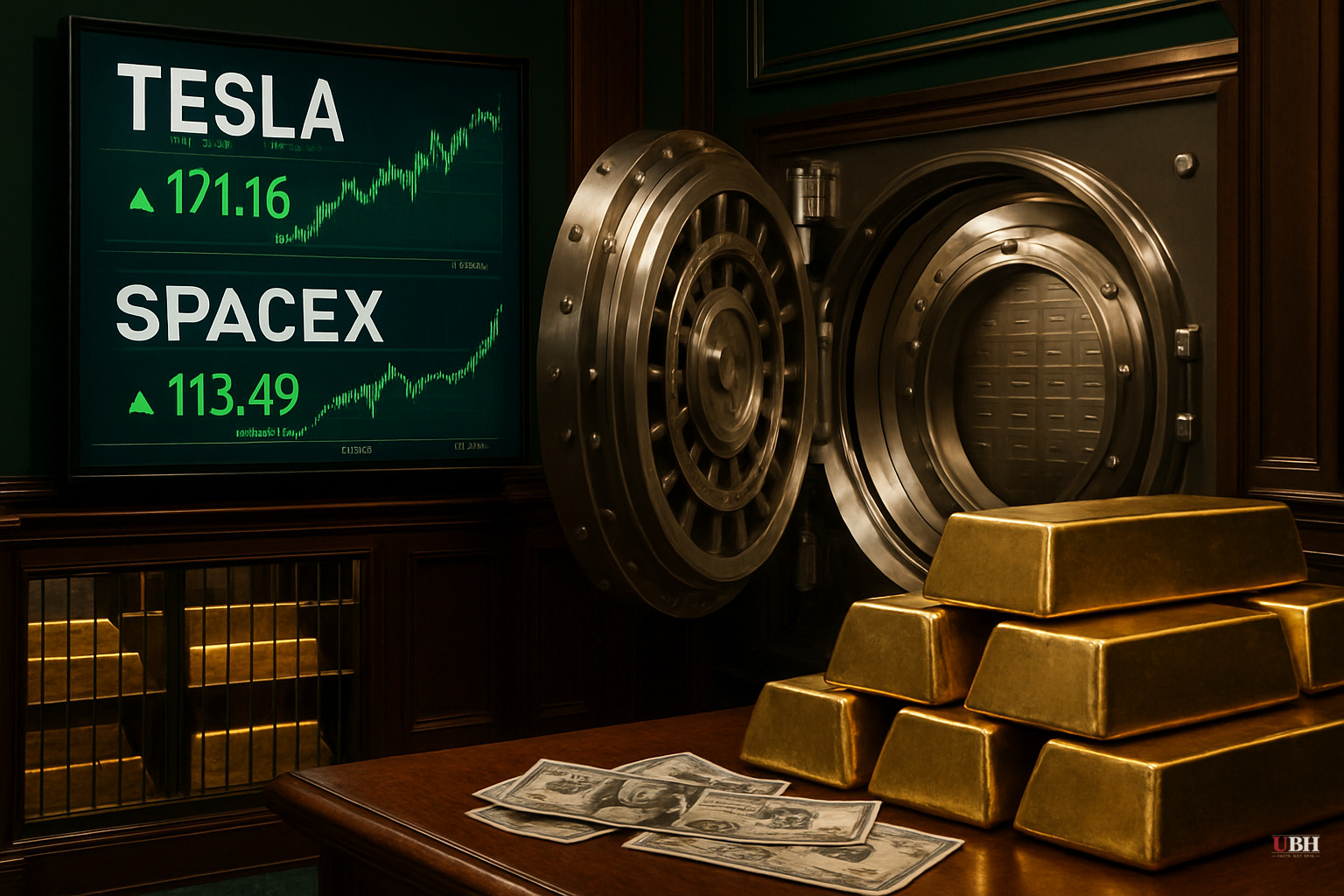
The Merger Talk Is No Longer Just Rumor
CNBC is reporting that Elon Musk has actively discussed folding SpaceX and Tesla together with colleagues — and Tesla employees say this has been openly talked about inside the company for years.
CNBC cited multiple people familiar with the conversations, including a current Tesla employee.
SpaceX is expected to begin trading on the Nasdaq in just over two weeks. SpaceX's private market valuation is currently approximately $350 billion. Tesla, which merged with Musk's AI company xAI, has a market cap currently sitting at around $1.6 trillion. A combined SpaceX-Tesla entity would be staggering.
Both companies are increasingly AI-driven. According to CNBC, more than three-quarters of SpaceX's $10.1 billion in capital expenditures in Q1 were tied to AI. Tesla said its own capex will roughly triple this year, topping $25 billion. Shared compute and power constraints have already driven regular engineering collaboration between the two firms.
Venture capitalist Tomasz Tunguz, a former engineer now at Theory Ventures, told CNBC: "Tesla has to run powerful AI systems inside a moving vehicle with tight limits on power, cooling, latency, reliability and cost. SpaceX has to think about compute in orbit, where radiation, thermal cycling, launch mass, power generation and heat rejection all become existential design constraints."
Combining two major companies — one with heavy government contracts — raises serious regulatory and conflict-of-interest questions that mainstream coverage is largely glossing over.
The Space Force Contract Is Much Bigger Than Advertised
The Space Force's fiscal 2026 budget included just $277 million for what was then called MILNET. The FY27 request asked for $1.5 billion in R&D and another $1.6 billion in procurement.
Then SpaceX walked out with $2.29 billion in a single Other Transaction Authority agreement, according to Breaking Defense.
OTA contracts bypass traditional competitive bidding. Whether it's appropriate for a contract this size — awarded to a company whose founder is simultaneously a senior government official — is a question worth asking.
The contract requires SpaceX to deliver "a fully operational prototype capability by the end of 2027," according to Space Systems Command. The system — now called the SDN Backbone — is a militarized Starlink variant called Starshield. It's designed to link sensors to shooters for the Joint Force and will support the Pentagon's Golden Dome missile defense architecture.
Col. Ryan Frazier, acting Space Force portfolio acquisition executive, said the SDN Backbone "ensures our sensors and shooters are connected continuously, globally and securely." The strategic case for this contract is solid.
The gap between $277 million budgeted and $2.29 billion awarded deserves scrutiny regardless of who the contractor is.
Starship Test Flight Confirmed the Reusability Problem
SpaceX's S-1 disclosure flagged that full Starship reusability isn't guaranteed. The third version of Starship's maiden flight, reported by TechCrunch, saw failures in a key reusability function: relighting the Raptor engines on both the booster and the Starship upper stage for controlled landings.
Satellite market analyst Tim Farrar wrote in a note to clients — cited by TechCrunch — that without full reusability, "the cost per launch may be as much as $100 million (i.e. $1,000 per kg) while tempo remains constrained by the rate at which second stages can be manufactured and first stages can be refurbished."
If Starship ends up in that cost range, it's not meaningfully cheaper than Falcon 9. The entire cost-reduction thesis evaporates.
SpaceX's Starlink business generated $11.4 billion in revenue last year, per the S-1. But it also required $11.4 billion in capital investment since early 2023 just to maintain current service — SpaceX needs to replace roughly 20% of its satellites annually. Musk himself has said SpaceX could go bankrupt without Starship's ability to replace those satellites cheaply.
An expendable or semi-reusable Starship keeps the business alive but does NOT deliver the cost revolution Musk has been promising.
The IPO Euphoria Machine Is Running Hot
Bloomberg reported that rocket and satellite stocks surged on SpaceX IPO enthusiasm, and that SpaceX received another greenlight toward faster index inclusion.
The American Airlines deal — 500+ narrow-body Airbus aircraft getting Starlink starting next year — adds revenue momentum, according to TechCrunch. United, Southwest, Qatar Airways, Lufthansa Group, British Airways, and Alaska Airlines are already aboard.
The Starlink business is genuinely impressive on the top line. Yet the capital expenditure treadmill is brutal. SpaceX has invested MORE in its satellite business ($11.4 billion since early 2023) than it has building Starship and all its launch infrastructure ($8.4 billion). The S-1 acknowledges costs will keep growing.
What This Means
The SpaceX IPO is shaping up to be one of the largest in history. The business is real, the contracts are real, and the revenue is real.
Retail investors buying in are betting on a cost revolution — full Starship reusability — that the company's own filing does NOT guarantee, and that the latest test flight suggests is further away than the hype implies.
The merger chatter adds another variable. A SpaceX-Tesla combination would be the most complex corporate transaction in modern history, involving government contracts, competing shareholders, and a founder who already holds more economic and political power than any individual in American history.
Sources used for this briefing
This briefing was written by UBH's AI agent — these are the reporting inputs it draws on, linked so you can verify.


