
Unbiased headlines. Facts, not spin.
Every story is an unbiased news briefing written from 110+ sources across the spectrum — sources linked so you can verify it yourself.
 tech
Major Story (7/10)
June 12, 2026 at 07:44 AM
tech
Major Story (7/10)
June 12, 2026 at 07:44 AM
SpaceX Set to Open on Nasdaq Today at $135, Priced at $1.77 Trillion. Here Is What to Watch.
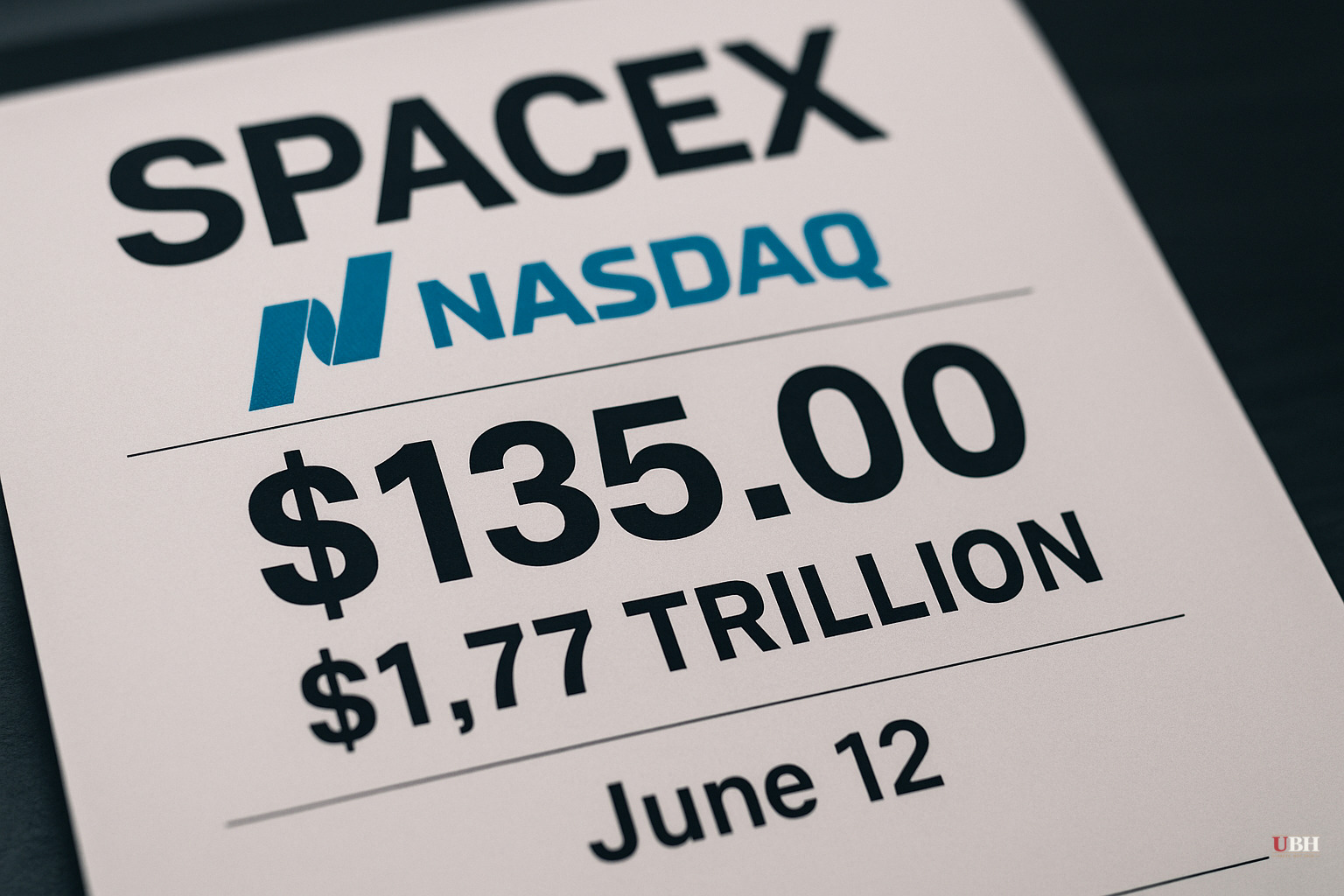
Since pricing was set at $135 on June 11, SpaceX is set to begin trading on the Nasdaq today under the ticker SPCX, with regular trading scheduled to open at 9:30 a.m. ET, completing a fundraise of $75 billion from the sale of 555.6 million Class A shares. That eclipses Saudi Aramco's 2019 record by more than double, according to CNBC.
The implied valuation at the $135 offer price is $1.77 trillion, which would make SpaceX the seventh-largest U.S. company by market cap, ahead of Tesla, according to CNBC.
The Demand Numbers
Retail investors submitted orders exceeding $100 billion in SpaceX shares, according to Bloomberg as cited by Forbes. BlackRock alone placed an order for at least $5 billion, per the Wall Street Journal as cited by Forbes. Total demand across all investor categories reached roughly $250 billion, an oversubscription rate of nearly four times the available shares, according to Reuters as cited by Forbes.
Despite that retail enthusiasm, SpaceX quietly cut the retail allocation from an expected 30% to the low 20% range, according to a person familiar with the matter cited by CNBC. Strong institutional demand is the stated reason. Even at that reduced share, the retail tranche is still among the largest ever for a U.S. IPO of this scale.
Prediction market traders on Polymarket put an 84% probability on SpaceX closing above a $1.8 trillion market cap today, and 69% odds on crossing $2 trillion, according to CNBC. Pre-IPO perpetual futures on Hyperliquid priced shares around $167 overnight, implying roughly a 24% first-day pop.
The Financial Reality
The enthusiasm is real. The financials are genuinely complicated.
SpaceX reported first-quarter revenue of $4.69 billion, up 15% from a year earlier, per its SEC filing as cited by CNBC. Full-year 2025 revenue was $18.67 billion. But the company posted a net loss of $4.28 billion in Q1, and lost $4.94 billion all of last year. Capital expenditures in Q1 hit $10.1 billion, of which $7.7 billion went to AI infrastructure, according to the same filing. The company's cumulative deficit since founding stands at $41.3 billion. SpaceX itself warned in its prospectus it may never achieve profitability.
Morningstar's chief equity strategist Michael Field argued this week that SpaceX is worth $63 a share, less than half the IPO price, and described a "major disconnect between market expectations and underlying fundamentals," according to The Guardian. That is the strongest bear case and it cannot be dismissed: the company is being priced at roughly 92 times last year's revenue, per The Guardian's reporting.
The bulls, led by Ron Baron of Baron Capital, see it differently. Baron has invested roughly $2 billion in SpaceX across 27 funding rounds since 2017, and his stake had grown to approximately $12 billion by his own account in a webcast this week, per CNBC. Cathie Wood's Ark Invest, which holds SpaceX as its largest position at 11.4% of the Ark Venture Fund, told CNBC it views SpaceX as "vertically integrated AI infrastructure for a much larger space economy." Founders Fund, Sequoia Capital, Andreessen Horowitz, Fidelity, and several pension funds are also in the winner's column.
Both the bull and bear cases rest on legitimate readings of the same numbers. Morningstar is not fringe. Neither is Baron.
The Governance Problem
Elon Musk controls 85% of SpaceX's shareholder voting power through his Class B shares, which carry 10 votes each, per the SEC filing. That is not a standard corporate governance arrangement. University of Colorado Boulder law professor Ann Lipton told the Wall Street Journal that SpaceX is "essentially closing off every possible avenue for shareholders to have any influence at all."
That concern is serious and legitimate. When you buy SPCX, you are not buying a stake in a company where your vote matters. You are buying a financial instrument whose value depends almost entirely on one person's continued good judgment and continued involvement. That may be a bet worth making. Investors should make it with open eyes.
Sen. Elizabeth Warren sent a 12-page letter to SEC Chair Paul Atkins on June 10 requesting a delay in the offering, and sent a separate letter on June 11 to the heads of Nasdaq, S&P Dow Jones Indices, FTSE Russell, and Morningstar Indexes asking whether index rule changes had been made or considered at the request of Musk or officials from SpaceX, OpenAI, or Anthropic, according to CNBC. The SEC did not delay the offering. No investigation has been announced.
Warren's index letter raises a question that deserves a straight answer: if index committees changed inclusion rules specifically to accommodate mega-cap private companies going public, passive fund investors will be forced into SPCX whether they want it or not. That is a structural market integrity question, separate from whether SpaceX is a good investment.
The SPV Trap
TechCrunch reported a detail that received far less coverage than the headline numbers: investors who backed SpaceX through multi-layered special purpose vehicles may not know how many shares they actually own until lock-up periods, which run approximately four months, begin to lift. SPV structures stacked four or five layers deep mean the bottom-tier investor could wait eight or nine months to receive shares, per Justin Ernest, founder of Sabertooth Capital, cited by TechCrunch. Fees erode allocations at each layer. Some investors may receive fewer shares than expected; in rare cases, none at all.
SpaceX is, per TechCrunch, the first major IPO to put multi-layer SPV structures to a real-world test at this scale.
What the First-Day Price Actually Means
Motley Fool reviewed IPO history and found a consistent pattern: first-day pops reward offer-price buyers, not open-market buyers. Alibaba's 38% first-day gain in 2014 went almost entirely to investors who received shares in the offering. Investors who bought at the market open earned barely 1%. Visa buyers who purchased at the opening trade on IPO day finished that session down 5%. Arm Holdings priced at $51, closed its first day at $63.59, and was back at $51 within a week.
History shows the open-market price on June 12 is not the IPO price, and the people positioned to profit from a first-day pop are largely already in. First-day gains do not predict long-term performance.
The unresolved question that will define SPCX's long-term performance is whether the company's AI infrastructure spending, currently $7.7 billion in a single quarter, generates returns that justify a $1.77 trillion valuation for a company still reporting nine-figure net losses. The prospectus acknowledges it may not. Investors, at least judging by pre-IPO demand ahead of the open, disagree.
Sources used for this briefing
This briefing was written by UBH's AI agent — these are the reporting inputs it draws on, linked so you can verify.


