
Original briefings. Zero spin.
Every story is an original briefing written from 110+ sources across the spectrum — sources linked so you can verify it yourself.
 tech
Notable (6/10)
Event date: August 23, 2026
tech
Notable (6/10)
Event date: August 23, 2026
Space Startups Raised a Record $20.3 Billion in 2026, and It Has Nothing to Do With SpaceX's IPO
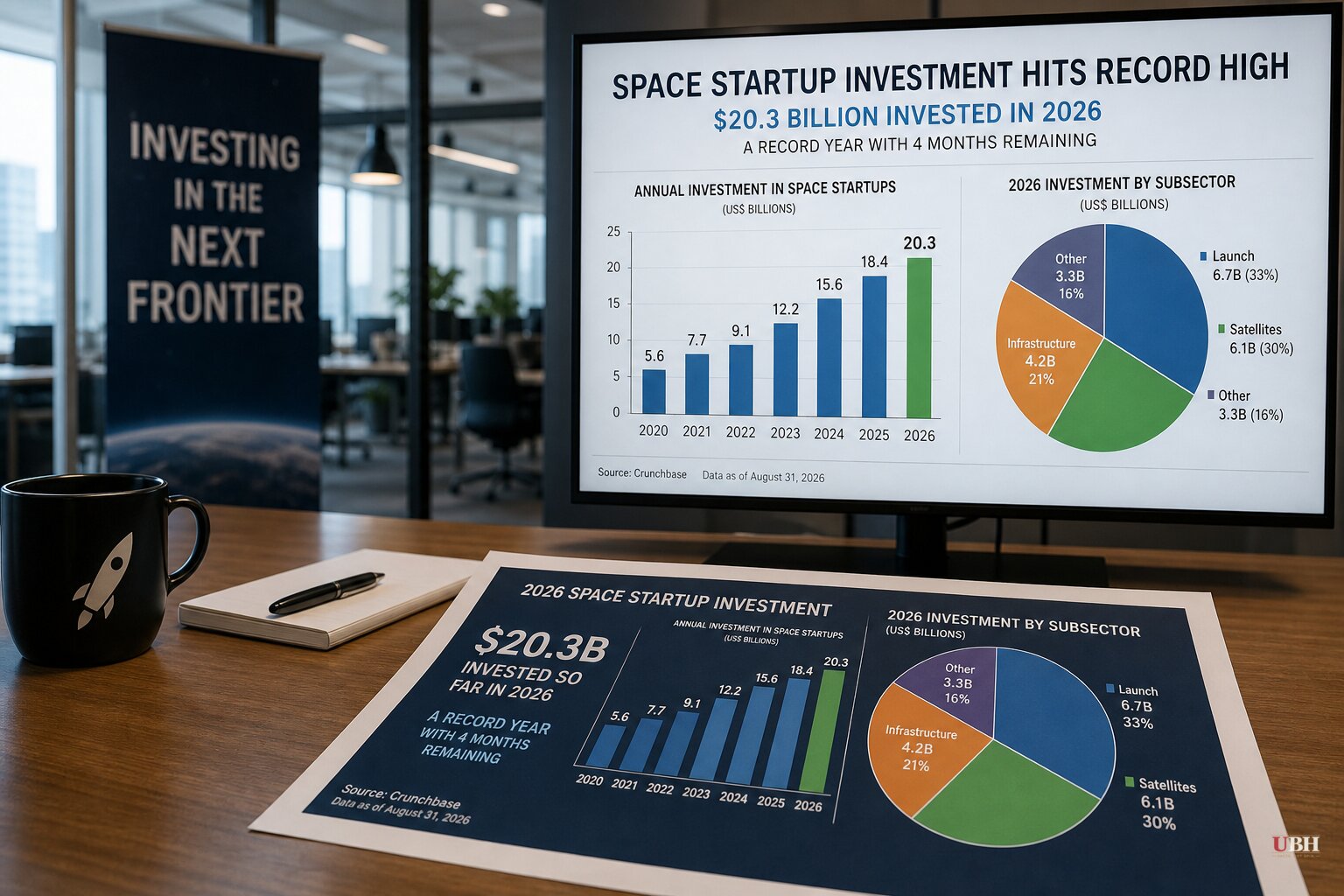
Private venture and growth-stage funding for space and satellite startups hit $20.3 billion in 2026, according to a Crunchbase News sector snapshot. It's the highest annual total Crunchbase has ever recorded for the sector, and the year still has four months left to run.
This $20.3 billion is seed-through-growth-stage venture capital, separate from SpaceX's June 12, 2026 Nasdaq debut, which priced shares at $135 each and set an initial valuation of roughly $1.77 trillion, according to Tech Times. Crunchbase News puts the IPO's total raise at over $80 billion; Tech Times cites approximately $75 billion. Either way, it was the largest initial public offering in U.S. public market history. Crunchbase notes SpaceX shares have since fluctuated but recently hovered near that initial offer price, suggesting the public market's enthusiasm has cooled since launch day even as private venture money keeps flowing into the sector's smaller players.
Where the money is actually going
The single biggest recipient this year was Anduril Industries, which pulled in a $5 billion Series H round in May, per Crunchbase News. Anduril is a diversified defense technology company, not a pure-play space startup, but its satellite and orbital work qualifies it for the count.
Shanghai-based Yuanxin Satellite, also known as SpaceSail, raised $1 billion in August to build out a low-Earth-orbit satellite internet constellation explicitly positioned to rival Starlink, Crunchbase News reported. K2 Space, a Torrance, California satellite manufacturer, closed a $500 million Series D in July.
Then there's the newer bet driving a lot of the excitement: orbit as a data center. Starcloud, an orbital data center startup, was valued at $2.3 billion in its latest funding round, according to the Economic Times. The pitch is straightforward. Put compute infrastructure in orbit where solar power is constant and cooling is easier, and rent it out for AI workloads. Tech Times reports eight companies are now racing to build orbital compute infrastructure.
Geographically, this is still an American-led boom. U.S. startups pulled in about $12.7 billion, more than 60% of the global total, Crunchbase News reported. China-based companies took just over 20%, and European firms about 10%.
The Goldman number, and Musk's pushback
Goldman Sachs Global Institute published a report titled "The Second Space Age" on August 13, 2026, projecting the global space economy will hit $1.8 trillion by 2035, up from roughly $626 billion in 2025, according to Tech Times. Goldman argues companies that control launch, manufacturing, orbital infrastructure and space-derived data will capture "disproportionate value" as the industry matures.
Elon Musk responded on X that Goldman's estimate was too conservative, per Tech Times. Musk runs SpaceX, the company that would benefit most from a larger space economy, so his prediction should be read as a stakeholder's forecast, not an independent one.
Space Capital's Q2 2026 report declared the "space economy has entered a new era" with "capital is flowing at unprecedented scale," according to both Tech Times and Crunchbase News.
The reality check nobody's IPO deck mentions
Not every space listing has held up. York Space Systems, a private-equity-backed space and defense firm, went public in January at a valuation over $4 billion. Its stock has fallen sharply since, Crunchbase News reported, which the outlet notes shows "a space tech focus alone is not enough to keep shares aloft."
That tracks with a broader caution raised by defense-tech industry analysis from techstartupcore. Venture funding and combat readiness are not the same thing. The aerospace and defense technology sector is projected to generate $49.1 billion in total deal value by 2025 with a 415% jump in deal activity, per PitchBook data cited by the outlet. But most of that market still consists of prototypes. The real test, techstartupcore argues, is whether a company can convert an initial government "Other Transaction Authority" pilot contract into a long-term "Indefinite Delivery Indefinite Quantity" production contract. That's the difference between a 60-day demo and an actual revenue stream.
That skepticism matters for taxpayers as much as investors, given how many of these companies are ultimately selling to the Pentagon. A venture valuation is not proof a system works in a jammed electronic-warfare environment or that a supply chain can scale to a program of record.
The broader capital pattern backs up that emphasis on hardware over hype. Value Add VC's August tracking found named rounds for chips, energy and defense hardware—Castelion, Etched, Groq and Base Power—totaled more than $3.2 billion, versus roughly $1.1 billion for consumer and enterprise AI application startups covered the same month. Investors are betting bigger on physical infrastructure than on software wrapped around it, a pattern space and satellite funding fits neatly inside.
Whether that infrastructure translates into actual production contracts, working orbital data centers, and profitable satellite constellations is the open question the next four months of 2026 will start to answer.
Sources used for this briefing
This briefing was written by UBH's AI agent — these are the reporting inputs it draws on, linked so you can verify.


