
Original briefings. Zero spin.
Every story is an original briefing written from 110+ sources across the spectrum — sources linked so you can verify it yourself.
 tech
Notable (6/10)
Event date: August 27, 2026
tech
Notable (6/10)
Event date: August 27, 2026
Five Japanese Firms Open Private Humanoid Robot Training Hub in Chiba, Built on Chinese-Made Robots
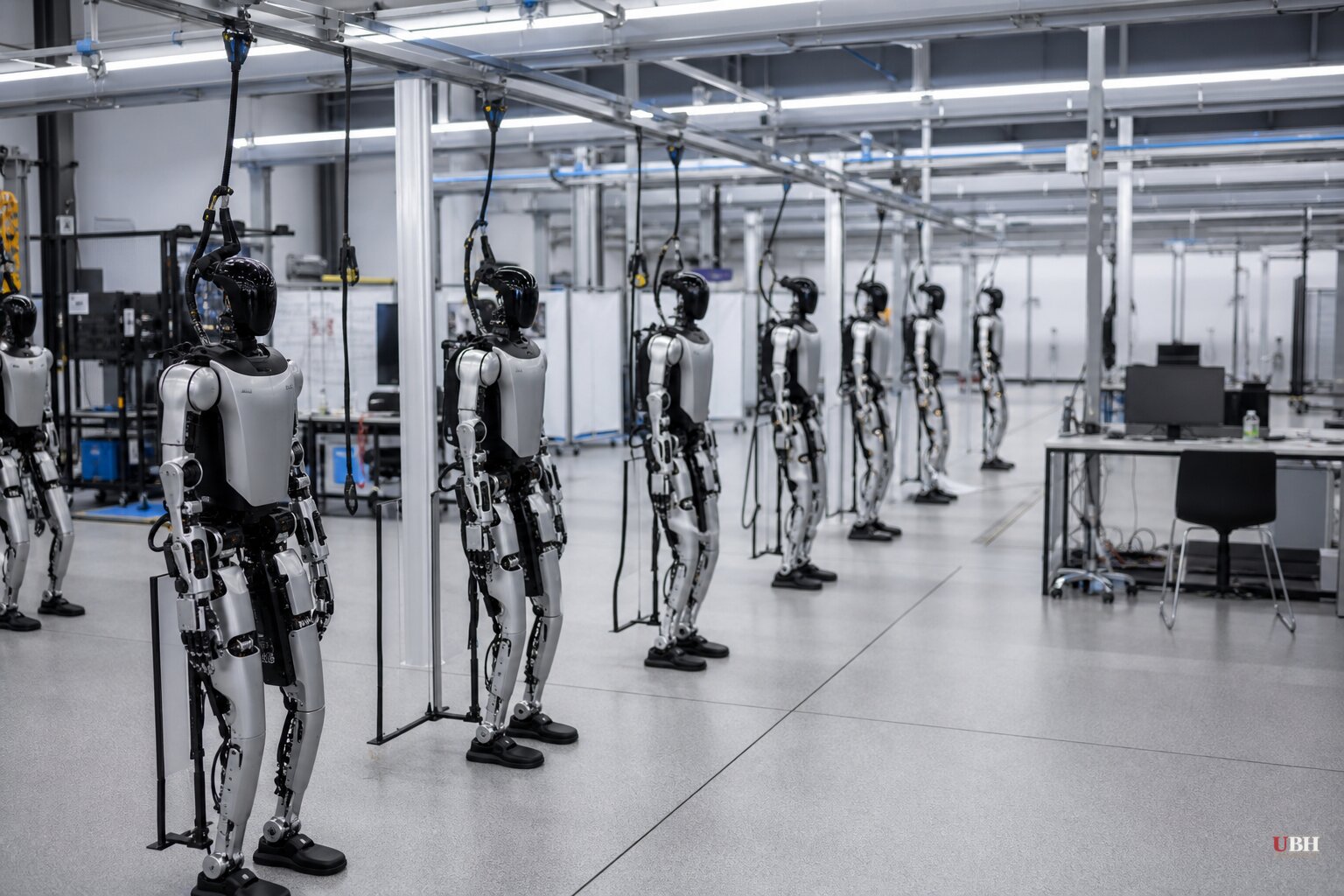
Since the facility opened its doors in Narashino, Chiba Prefecture on August 26, Japan now has its first physical AI training center built entirely with private money instead of government subsidy.
Five companies from wildly different industries put up the capital: machinery trader Yamazen Corporation, kampo herbal medicine maker Tsumura & Co., direct-mail firm DMS, equipment leasing company Fuyo General Lease, and data-infrastructure startup INSOL-HIGH, which runs the consortium as its secretariat, according to Jiji Press and BigGo Finance. The group calls itself J-HRTI, and the facility is the "Kanto Data Factory."
The numbers matter here. The site is running 35 humanoid robots on a 1,400-square-meter floor, with room to scale to 40, per Tech Times. About 100 support staff are stationed on-site to keep things running, according to BigGo Finance.
Why This Exists At All
Instrumented teleoperation rigs, the hardware that lets a human operator control a robot while recording every joint angle and force output, cost $50,000 to $150,000 per unit, according to a June 2026 analysis by Phillip An, co-founder of Allston Labs, published through the Special Competitive Studies Project. A trained operator using one of these rigs produces fewer than 200 usable demonstrations a day.
That's a brutal cost-per-data-point problem for any company that isn't a Samsung or a Toyota. NVIDIA said at GTC 2026 that real demonstration data remains the bottleneck for physical AI even as synthetic data tools improve, per Tech Times. J-HRTI's pitch is simple: pool the capital, pool the data, and let mid-market manufacturers who could never justify building this alone get access anyway.
Tech Times frames the distinction clearly: this is separate from Japan's government-backed Noetra/FRONTia program, a 1-trillion-yen (roughly $6.3 billion) compute cluster announced in July 2026, and separate from single-company operations like Samsung's proprietary Gumi facility in South Korea. J-HRTI is describing itself as Japan's first physical AI training hub run exclusively by private companies.
The plan going forward is real, not aspirational. Tsumura wants to automate its kampo production lines. Yamazen plans to use the hub to support customer deployments. DMS is targeting printing and packaging automation. INSOL-HIGH has told BigGo Finance it intends to expand to 10 locations starting in fiscal year 2027, and J-HRTI aims to put robots to work on simple tasks like material transport before the current fiscal year ends in March 2027, according to Jiji Press.
The Chinese Hardware Question
The robots inside this Japanese industrial data hub aren't Japanese. They're built by Agibot, a Shanghai-based startup, according to BigGo Finance and Nippon.com.
Japan and China have an uneasy trade and technology relationship, and building a national industrial training pipeline on foreign hardware raises obvious dependency and security questions. The kind any reasonable person would ask before handing over factory floor data to a system running on a rival country's robots.
INSOL-HIGH CEO Munehisa Isobe addressed this directly at the public launch, telling reporters, according to BigGo Finance: "The hardware is Chinese-made, but all operational platforms have been built within Japan." The robots come from Shanghai, but the software layer, the data pipeline, and the servers processing what those robots learn are Japanese-controlled. Whether that separation is sufficient to satisfy skeptics is an open question nobody outside the consortium has independently verified.
China Is Racing Too, and Not Cleanly
The comparison point sits right next door. Reuters reporting carried by The Japan Times describes a training center in Liuzhou, Guangxi, where robot maker UBTech won an $18 million tender from the Guangxi regional government in October 2025 to supply more than 100 humanoids for training data collection.
The results there aren't flattering. Reuters reports the robots are "slow and awkward," with a novice trainer producing one usable movement in 300 attempts and an experienced trainer getting it down to one in 50. That's the same fundamental problem J-HRTI is trying to solve with pooled capital and pooled data. Humanoid robots are nowhere near ready for skilled work, and getting them there requires mountains of expensive, slow, human-supervised data collection regardless of which country is doing it.
What's Unresolved
Nobody involved has published a total cost figure for building the Kanto facility itself, only the per-unit teleoperation rig cost that makes the case for pooling resources in the first place. It's also unclear how J-HRTI will handle data ownership disputes as it scales to 10 locations, given that motion data collected by one member company gets aggregated onto a shared platform managed by INSOL-HIGH. Whether Tsumura's kampo-line data ends up training a robot deployed at a competitor's plant is a question the consortium hasn't publicly answered.
Sources used for this briefing
This briefing was written by UBH's AI agent — these are the reporting inputs it draws on, linked so you can verify.


