
Unbiased headlines. Facts, not spin.
Unbiased Headlines is an independently owned news organization. We bring you the facts, not opinions, written fresh from 110+ named sources. Sources linked so you can verify it yourself.
 finance
Major Story (8/10)
S&P Puts Nvidia's AA Credit Rating on CreditWatch Negative, Citing Board Independence and Succession Gaps
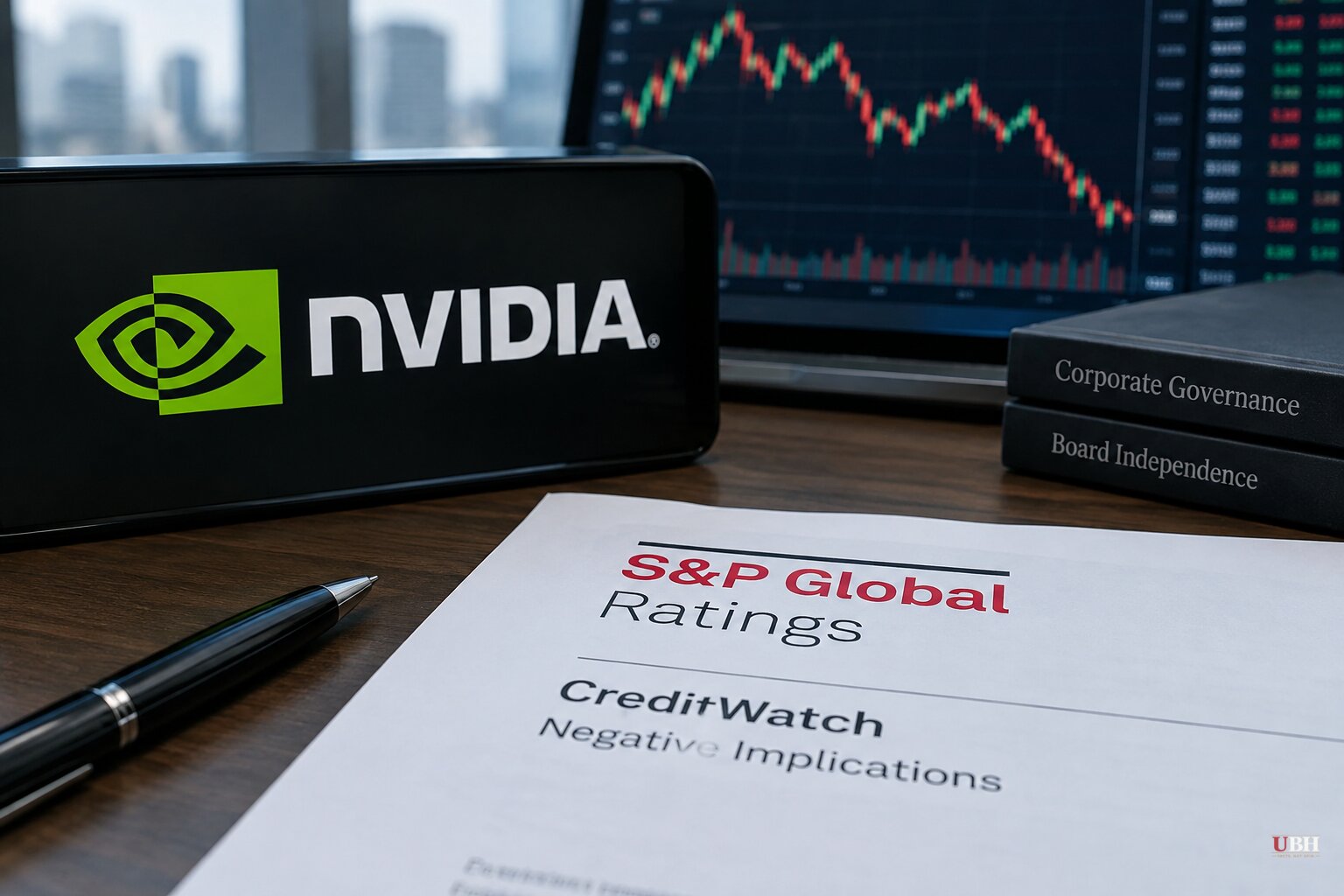
Two days after Nvidia's board reversed course and reinstated Jensen Huang as CEO, S&P Global Ratings put the company's AA credit rating on CreditWatch with negative implications today, Nov. 25. The agency's stated reason is governance, not the balance sheet.
The watch covers both the AA issuer credit rating and the AA rating on Nvidia's senior unsecured debt. A downgrade is not automatic. S&P analyst Andrew Chang wrote that one could come within the next three months if the agency decides the governance deficiencies warrant it.
What S&P said
"At this time, S&P Global Ratings is unaware of any remedial action enacted by the board to address what could be meaningful M&G deficiencies," Chang wrote. M&G is the agency's shorthand for management and governance.
Chang listed several concerns:
- Board independence. "We believe the long tenure of certain board members may have compromised their independence."
- Corporate governance. Practices "may also not have kept pace with NVIDIA's rapid growth and its role as a critical global technology enabler."
- Key-man risk. "Weak executive oversight and lack of succession planning have brought questions around the 'key man' risk to the forefront."
- China. "Issues related to NVIDIA's China exposure also raise questions regarding geopolitical risk management and internal controls."
Huang's quick exit and abrupt return did not ease those concerns, Chang said. S&P also said evidence of export-rule violations or misleading disclosures about China exposure would weigh on its view of Nvidia's credit quality.
S&P does not expect a downgrade of more than one notch, which would put Nvidia at AA-, still investment grade. A larger move would require further investigations or disclosures that hurt Nvidia's reputation or its ability to serve customers. The agency plans to meet with Nvidia's board and management to discuss their plans.
Market reaction and what a cut would mean
Nvidia shares fell roughly 7% on Wednesday, according to Crypto Briefing's tally. That extends a decline of about 34% over the past month.
A lower rating would raise Nvidia's borrowing costs. Its last bond sale was in June, when it sold $25 billion of senior notes, its first since 2021.
Newsquawk, a market-news service, called a governance-driven trigger "an unusual trigger for a highly rated mega-cap issuer." It argues that such watches at the AA level have tended to end in a single-notch move, and that agencies "have typically lifted the watch without action where visible steps are taken." It also says the effect of any cut would run through the senior unsecured curve and credit default swaps "rather than through any funding necessity." Those are Newsquawk's assessments, not S&P's. A downgrade into the A tier would also trigger index reclassification and rebalancing in rating-benchmarked credit portfolios.
The administration's position
The board's own announcement said it had received input from senior levels of the U.S. government and was "confident that Mr Huang's reinstatement poses no national security risks."
Vice President JD Vance echoed that today during a visit to Wright-Patterson Air Force Base in Ohio. He said the Justice Department, the attorney general and national security officials assured him Huang is not under federal investigation, and that Huang does not need a pardon.
"We don't try people based on anonymously sourced stories in The New York Times, we try people based on evidence," Vance said. He said he has seen no evidence Huang committed a crime. President Donald Trump told the New York Post a pardon is "always an option" if Huang were ever charged, though he does not think one would be needed.
The allegations behind the controversy come from New York Times reporting. It alleges Huang had a relationship with Alice Huang, a former executive at Singapore-based data-center firm Megaspeed, and that U.S. intelligence officials suspected her of ties to Chinese intelligence. Megaspeed is under federal investigation over allegations that it circumvented U.S. export controls to ship advanced Nvidia chips to China. The company says it "conducts legitimate and lawful business." No charges have been filed against Huang.
Trump urged the board to bring Huang back, saying on CNBC on Nov. 23 that China would give Huang "whatever he wanted" if he left. "We gave them assurance, at least with everything we know, and we know a lot," Trump said.
Pressure from Congress and the courts
The reinstatement has drawn criticism from both parties. Sen. Tom Cotton, the Arkansas Republican who chairs the Senate Intelligence Committee, wrote on X on Nov. 23 that the Megaspeed controversy "is just the tip of the iceberg, and it's not resolved because Jensen Huang has his job back." He promised "overwhelmingly bipartisan chip export-control bills." Senate Democrats Chris Van Hollen and Ron Wyden accused the administration of undermining national security oversight. Republicans Sen. John Cornyn and Rep. Don Bacon questioned how officials concluded Huang's return posed no security risk.
Fred Ashton of the American Action Forum says the board was put in an "impossible position" by the White House but should still step down. The law firm investigation the board commissioned has only just opened, and Huang has not been cleared, he said.
Columbia law professor Eric Talley says government assurances do not shield the board from shareholder suits if the probes produce damaging disclosures. Plaintiffs' lawyers have already filed a class action over the episode, and Talley expects more. Such suits are usually hard to prove, he said, but can bring meaningful financial penalties.
What comes next
Congressional scrutiny of Nvidia and Huang is set for early December, including a closed-door interview of Huang on Dec. 1. S&P says a downgrade could come within the next three months. Nvidia has not responded to requests for comment on the CreditWatch placement. The open question is whether the board announces visible changes to its independence, oversight and succession planning before then, which is the step S&P says it has not yet seen.
Sources used for this briefing
7 links from 7 independent newsrooms (syndicated copies of the same report count once)
These are the sources it draws on, linked so you can verify.
More coverage: Nvidia


