
Unbiased headlines. Facts, not spin.
Unbiased Headlines is an independently owned news organization. We bring you the facts, not opinions, written fresh from 110+ named sources. Sources linked so you can verify it yourself.
 finance
Major Story (7/10)
Event date: November 21, 2026 ·
Nasdaq Logged Worst Week in Six Years as AI Stocks Sold Off Through Nvidia CEO Exit and Anthropic Debut
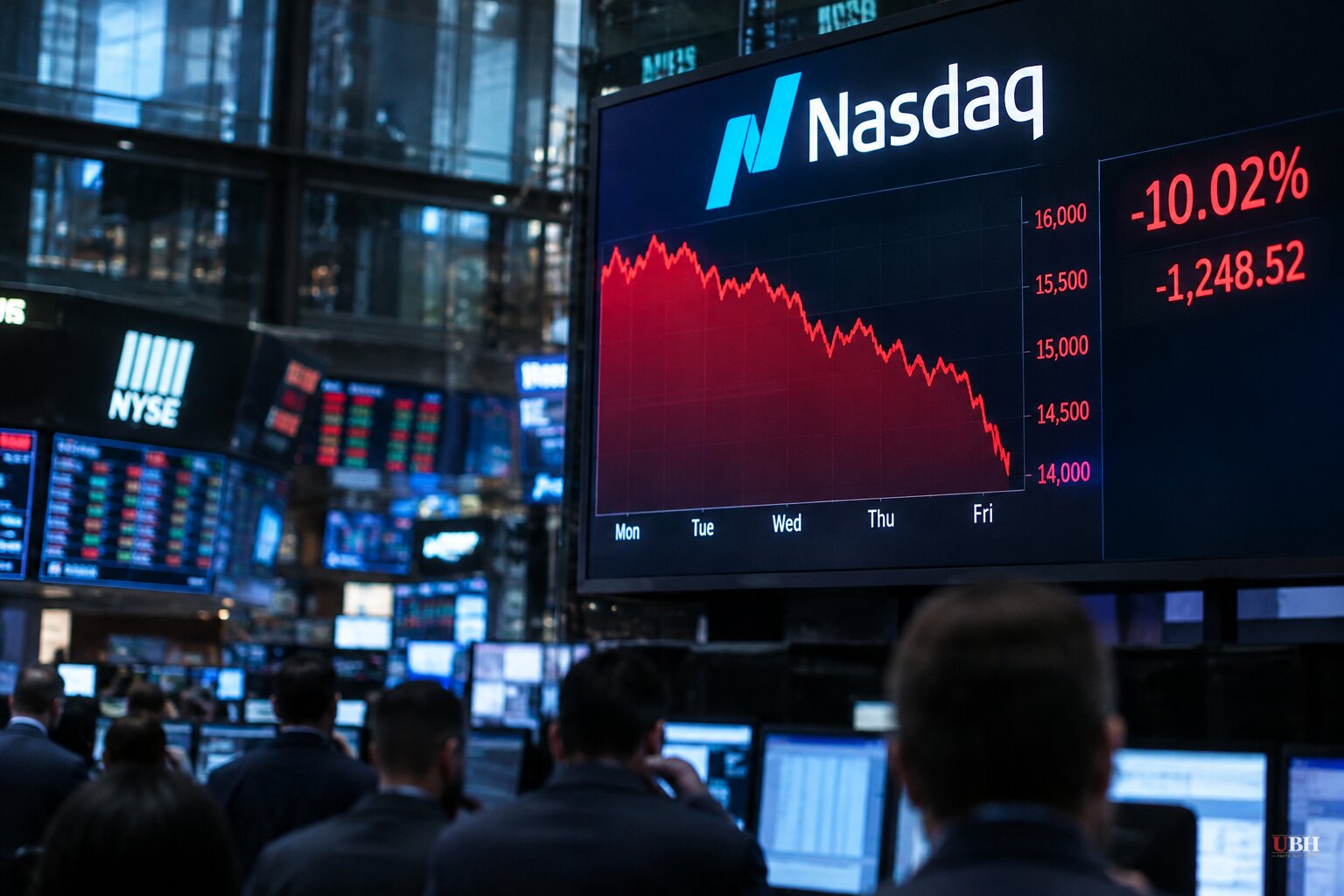
Since the Thursday after Election Day, when the Nasdaq fell 5.5% in a single session, the AI selloff has stretched across three weeks. Today's trading on Nov. 25 lands on top of a slide that was already deep before the latest inflation and tariff news.
The numbers from that first post-election session were enormous. The S&P 500 dropped 4.36% to 7,353.73 and lost a record $2.9 trillion in market value. The Nasdaq sank 5.52% to 24,315, and the Dow gave up 1,833 points, or 3.44%, erasing all of the prior day's 1,500-point rally.
All 11 S&P 500 sectors closed lower. Information technology fell 7.30%, its worst day since March 16, 2020. The Magnificent Seven lost more than $1 trillion combined, and Nvidia slid about 9%.
Three weeks, no floor
The damage kept building. In the week ended Nov. 20, the Nasdaq fell 10.02% to 22,617.73, its largest weekly percentage decline in more than six years. The S&P 500 dropped 8.61% to 6,910.39. The Dow lost 8.02% to 48,147.33, and the Russell 2000 shed 7.48%.
The CBOE volatility index surged 85.96% to 35.89. On Friday, Nov. 20, the Nasdaq fell 5.28% and the S&P 500 fell 3.70%. The iShares Semiconductor ETF dropped 10.55% that day.
Anthropic's initial public offering, the first major large-language-model IPO in the United States, did not stop the bleeding. The stock closed down 8.5% on Nov. 20. Rebecca Walser, chief investment officer of Walser Wealth Management, called the IPO "the show me moment for the AI story" and argued it was what markets needed to revive sentiment. A report circulating on Musk's finances put Anthropic's valuation at $1.18 trillion on its second day of trading.
Nvidia's leadership shock
Jensen Huang's departure as Nvidia chief executive hit the market's most important AI name. CNN reported that Nvidia's stock plunged 28% in the days after his resignation, and that the Trump administration came to view Huang as too big to fire. CNN also reported that Trump helped orchestrate Huang's return, expecting it to spark a rebound. The rebound lasted one day.
The New York Times reported Sunday, Nov. 22, citing multiple people familiar with U.S. intelligence assessments, that a woman romantically involved with Huang, Alice Huang, was in contact with an officer of China's Ministry of State Security from spring 2025 through fall 2026. The Times also reported that U.S. intelligence found evidence that her business partner, Kang Wei, worked with the Chinese spy agency. The Times said the contacts overlapped with efforts by their company, Megaspeed, to acquire advanced Nvidia chips, some of which allegedly reached networks suspected of evading U.S. export controls. The Times said officials are investigating. These are unproven allegations from anonymous sources, and none of the named people has been quoted in response.
Why the market says it is selling
Trump blamed Democrats for the first post-election drop. "It took so much work to get us to a level that no one has ever seen before, and then this. Your 401(k)s have, therefore, dropped," he said Thursday evening.
The Democratic agenda on AI is real. Sen. Bernie Sanders demanded a "national data center moratorium now." Rep. Ted Lieu of California promised public hearings and new AI "guardrails." Democratic Rep. Greg Casar of Texas and others want to halt new construction outright. Democratic leaders want tech CEOs to testify under oath. The party is split on how far to go, and a sweeping crackdown would likely meet a Trump veto.
Strategists point to other drivers as well. Richard Saperstein, chief investment officer at Treasury Partners, described "an AI repricing" reflecting "slowing data center buildouts, reduced funding sources for AI-related projects and a slower trajectory of technology-related earnings growth."
Tech bull Dan Ives warned the buildout will slow sharply through 2028. UBS estimated roughly 30% of planned data center capacity could be affected.
Local voters had already moved. Breitbart News counted 40 of 41 local AI or data center restrictions passing on Election Day, including at least 14 Ohio municipalities and eight Maine towns with temporary moratoriums. Texas, home to roughly a quarter of planned U.S. data center capacity, elected Democrat Gina Hinojosa governor after she campaigned on pausing new projects.
The economy leans on the top
CNN laid out the broader exposure. The five biggest AI companies, Nvidia, Microsoft, Google, Amazon and Meta, make up about 25% of the S&P 500's value. Consumer spending grew at a 3.8% annualized pace in the third quarter, according to the Bureau of Economic Analysis.
Economists at RSM US found the top 40% of earners spent $15.7 trillion through September, versus $6.7 trillion for everyone else. That puts the wealthy at about 70% of consumer spending, up from 61% last year. A prolonged equity slump hits that group's confidence first.
Elon Musk's fortune took a hit too. Figures cited from KuCoin put the loss at roughly $64 billion in one session, with SpaceX shares at $127 against a $225 record and Tesla at $345 against an October peak of $413. Musk said at the DealBook Summit on Nov. 18 that combining Tesla and SpaceX was "probably yes," though he said it would need Tesla shareholder approval. No exchange ratio or timetable has been announced.
The next concrete test is Washington. Democrats have promised AI hearings and CEO testimony, and whether anything survives a Trump veto will decide how much of the 30% capacity risk UBS flagged becomes real.
Sources used for this briefing
6 links from 6 independent newsrooms (syndicated copies of the same report count once)
These are the sources it draws on, linked so you can verify.


