
Unbiased headlines. Facts, not spin.
Unbiased Headlines is an independently owned news organization. We bring you the facts, not opinions, written fresh from 110+ named sources. Sources linked so you can verify it yourself.
 finance
Breaking / Critical (9/10)
Nasdaq 100 Falls to 20% Below October Record in Wednesday Trading, Testing Bear-Market Line
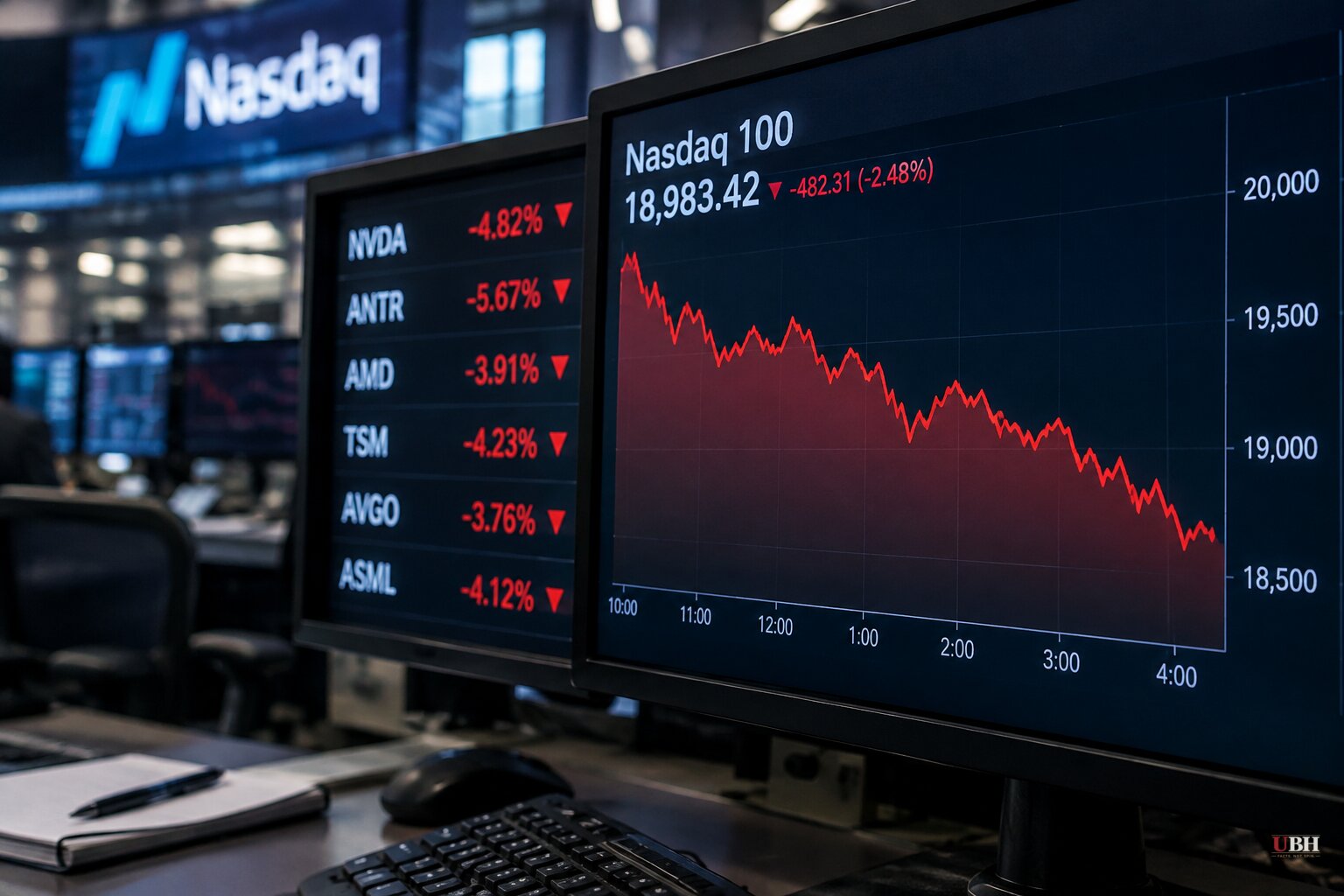
Since the Nasdaq 100 set a record close of about 31,224 on Oct. 6, the index has lost roughly a fifth of its value, and early trading today, Nov. 25, put it right on the bear-market line.
The index fell 4.7% in early trading, which took the decline from its early-October record to 20%. That reading came at 9:50 a.m. ET, per Bloomberg. It is an intraday figure, not a close.
Bloomberg put the cumulative damage since the peak at more than $8.5 trillion in market value across Nasdaq 100 companies. That is the total since October, not a one-morning loss.
The 20% line has been touched before
This is not the first brush with the threshold. On Friday, Nov. 20, the Nasdaq 100 dropped 5.6% and slid as much as 20.2% below its record at the session low. It finished about 19.8% below the peak.
That 0.2-point gap is the entire argument over whether a bear market has formally arrived. By the conventional definition, a bear market is a 20% decline from a recent high. Whether intraday or closing levels should count is still unresolved.
The week ending Nov. 20 cost the index about 10.5%, its worst week since March 2020.
How broad the damage is
The index-level number understates the damage underneath. By Nov. 20, 71 of the 101 stocks in the Nasdaq 100 were already 20% or more below their own highs. Of the 22 chip names in the index, 20 were down at least that much.
The rest of the market had been dragged along. On Nov. 20, the Dow fell 949.73 points to 48,147.33 and the S&P 500 dropped 3.7% to 6,910.39. Both closed more than 10% below their recent highs, which meets the correction threshold. The Nasdaq Composite fell 5.28% to 22,617.73, wiping out its gains for 2026 and leaving it down 2.7% on the year.
Nvidia fell 14% that day. AMD dropped more than 13% and Broadcom more than 14%, and Micron fell nearly 14%.
Wednesday's early moves
At the opening bell, the Nasdaq Composite was down 3.31% and the S&P 500 was off 1.95%, per Reuters.
Nvidia dropped more than 8% after the open, according to Forbes. That followed Monday's surge on the reinstatement of Jensen Huang as chief executive. The comeback rally has not held.
Anthropic shares fell about 9% to just under $75, the Financial Times reported. The stock had already slipped below its $83 listing price on Tuesday. The company's market debut was last Thursday, when shares rose 17%. They gave back 8.5% on Friday.
Asia had already taken the hit before the U.S. open. SoftBank Group fell 14.83% in Tokyo. Advantest lost 12.94% and Tokyo Electron dropped 12.53%, per CNBC. In South Korea, Samsung Electronics fell 9.87% and SK Hynix lost 11.05%. Both supply high-bandwidth memory used in AI accelerators.
Why analysts say it is happening
Richard Saperstein, chief investment officer at Treasury Partners, called Friday's rout "an AI repricing," pointing to slowing data center buildouts, reduced funding sources for AI projects and a slower trajectory of tech earnings growth.
Rolf Bulk, an analyst at The Futurum Group, told CNBC the renewed selling mostly reflects doubts about AI spending beyond 2027. "There are still concerns on the sustainability of AI demand, ability of the sector to finance the build-out, and questions around power supply," he said. In his assessment, Huang's return did little to change that.
Politics entered the picture earlier this month. On Nov. 5, the Nasdaq Composite fell 5.52% to 24,315, a correction, and the Dow lost more than 1,800 points. President Trump blamed the midterm results on Truth Social: "Such a sad thing to watch! ... Your 401(k)s have, therefore, dropped."
Chris Zaccarelli, chief investment officer for Northlight Asset Management, described the narrative as having shifted from "AI changes everything" to "Blue wave means data centers will never be built again in this country." The Epoch Times reported that lawmakers have called for more AI regulation, and some have called for a moratorium on data-center construction. The Epoch Times also noted that the Nov. 5 drop came despite a solid third-quarter earnings season.
The case against panic
Not everyone reads the slide as the start of something deeper. Axel Rudolph, chief technical analyst at IG, wrote today that there are reasons to think the AI bubble has at least partially burst, and also reasons to think that calling the end of the wider U.S. bull market would be premature.
The precedent worth watching is April 2025. A tariff-driven selloff took the Nasdaq 100 down about 22.9% from its high at the low point. The index went on to post new highs by October 2026.
There is one difference. The 2025 selloff had a clear trade-policy trigger. This one is centered on the AI trade itself.
What decides it
The next question is mechanical. A confirmed close below the 20% line would formally mark a bear market. Anything above it leaves the index where it ended Nov. 20, a hair short.
Breadth is the other test. With 71 of 101 members already 20% or more below their peaks, a rebound that lifts only a few heavyweights like Nvidia would leave most of the index still in bear territory.
Sources used for this briefing
7 links from 7 independent newsrooms (syndicated copies of the same report count once)
These are the sources it draws on, linked so you can verify.


