
Unbiased headlines. Facts, not spin.
Unbiased Headlines is an independently owned news organization. We bring you the facts, not opinions, written fresh from 110+ named sources. Sources linked so you can verify it yourself.
 finance
Breaking / Critical (9/10)
Nvidia Added $952 Billion in One Day on Huang's Return. State, SEC and Congressional Questions Remain
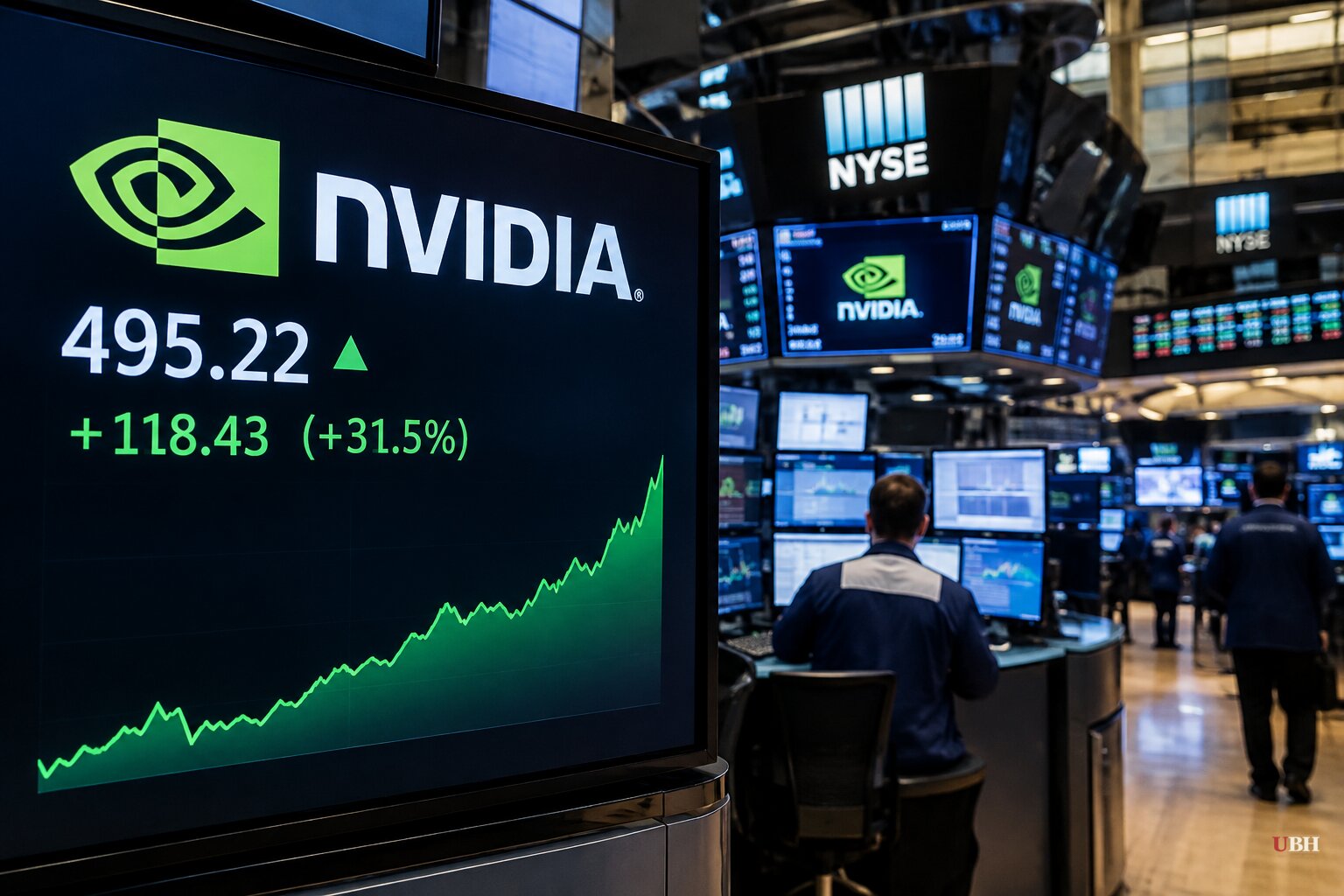
Since Nvidia's board reversed itself on Monday, Nov. 23 and restored Jensen Huang as CEO, 11 days after his Nov. 12 resignation, the focus has moved from the boardroom to the scoreboard and the investigators.
The scoreboard first. Nvidia shares closed up 31.5% at $165.05, their biggest one-day gain since 2003. The move added roughly $952 billion in market value, the largest single-day increase recorded by any company, according to Bloomberg. That put Nvidia's market cap at about $4 trillion.
Shares were about 5% lower in premarket trading Tuesday, Nov. 24.
The rally followed a brutal stretch. Nvidia fell 23% the week before, its worst week since 2008. The S&P 500 and Dow both entered correction territory Friday.
The market and the man
Monday's gains were not confined to one stock. The S&P 500 rose 4.7%, its best day since April 2025, ending a seven-session losing streak. The Nasdaq 100 jumped 6.9%. The Magnificent Seven rose 7.5% as a group, with Nvidia the largest single contributor.
Fortune noted that S&P 500 futures already pointed to a rebound before the Huang news landed. The Nasdaq 100 still sits about 14% below its record close.
Huang personally gained $33.7 billion on the day, according to Forbes. His net worth rose to $143.8 billion, which ranks him 13th on Forbes' real-time list. He owns more than 3.5% of the company.
What is still open
The investigations did not end when the stock rose.
Nvidia said Monday that its board's independent inquiry into whether Huang was the target of a foreign intelligence effort will continue. Directors restored him before it finished. In their statement, they said they were satisfied with his candor and ability to lead, and that input from senior U.S. officials led them to conclude his return posed no national security risk.
California's Department of Justice is examining whether Nvidia's advanced chips or confidential information reached China, and whether the company misled investors and the public, CNBC reported. Reuters reported Friday that the SEC is looking into Nvidia's accounting practices. The SEC declined to comment. Nvidia had not responded to CNBC's request for comment.
Reuters also reported that Huang misled Nvidia's own general counsel about the nature of the relationship at the center of the scandal. Huang has not been charged with anything, and no charges have been announced against the company.
Congress is next. Huang is expected to appear before lawmakers twice in December to answer questions on China's access to advanced Nvidia chips and on U.S. export controls.
Washington's mixed signals
President Trump told CNBC he personally spoke with the board about bringing Huang back. On Truth Social he wrote that the government has "no reason to believe" Huang's return poses a national security risk and "does not possess evidence that he has engaged in any unlawful conduct." He also told CNBC that a "very thorough investigation" found Huang "did nothing wrong." The findings of that review have not been made public. A Trump spokesman told Fortune, "we have to protect our geniuses."
Other administration voices have been less settled. Attorney General Todd Blanche said earlier this month that the Justice Department had reached no conclusion on whether the woman was a spy and that the FBI was investigating. On Sunday, Treasury Secretary Scott Bessent said the administration was still seeking answers about Nvidia's chip sales to China and who was in charge of export compliance.
China's Foreign Ministry has dismissed the spying allegations as a smear campaign against Beijing.
How analysts and executives read it
Analysts split on whether the stock should care. Sebastien Naji of William Blair wrote that Huang's return "clears some of the uncertainty" but that recent weeks exposed "deeper questions around corporate governance, leadership succession, and regulatory oversight." Cody Acree of StoneX called the board's investigation the "key risk."
David O'Connor of Piper Sandler took the other side. Congress will "likely want their answers," he wrote, but given the government's national security assurances, "we don't think this will translate into anything meaningful to the stock."
Fortune surveyed 14 Fortune 500 and Global 500 executives, who spoke anonymously. One called the episode "an embarrassment for our country to see how far we've dropped as a role model in leadership." Another said Trump's involvement gave Americans more proof of the crony capitalism they "just voted against." A leader in the AI sector, though, argued that the investor panic over Huang's exit showed how critical he is to Nvidia and to the U.S. race against China. "Without him, we're in a bad place," that executive said.
Elon Musk wrote that "the mistake has been corrected." An online petition for Huang's return drew more than 206,000 signatures.
The open question is sequencing. Huang goes before Congress in December while the board's inquiry is still running. Bessent's question about who was responsible for export compliance at Nvidia has not been answered publicly.
Sources used for this briefing
8 links from 8 independent newsrooms (syndicated copies of the same report count once)
These are the sources it draws on, linked so you can verify.
More coverage: Nvidia


