
Unbiased headlines. Facts, not spin.
Unbiased Headlines is an independently owned news organization. We bring you the facts, not opinions, written fresh from 110+ named sources. Sources linked so you can verify it yourself.
 finance
Major Story (7/10)
Event date: November 20, 2026 ·
Nasdaq Drops More Than 4% and Dow Sheds 1,000 Points in Wednesday Trading After PCE Data and Tariff Announcement
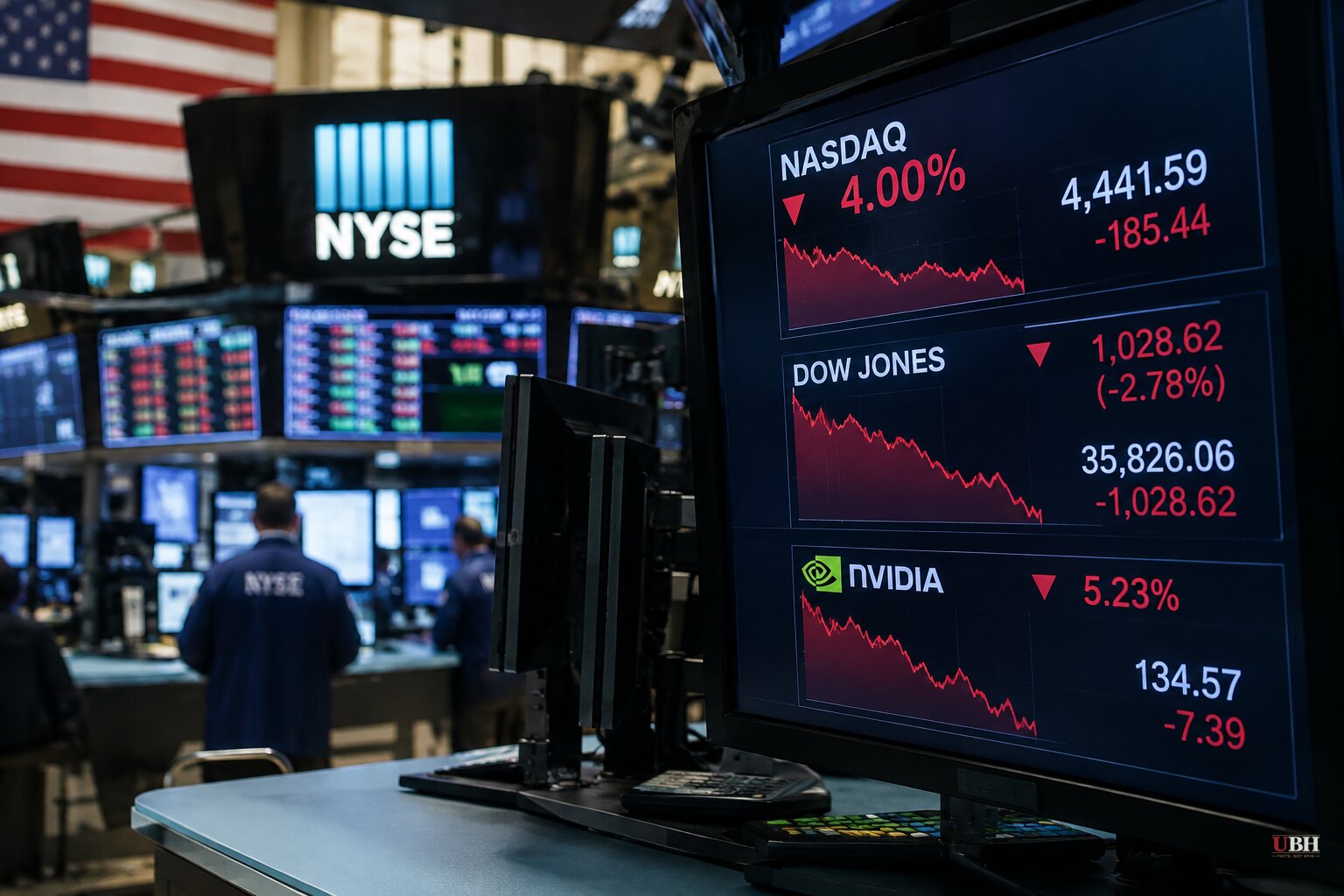
Since futures pointed sharply lower before the open, the selling has carried into regular trading on Wednesday, Nov. 25, and the damage is large.
The Nasdaq Composite was down 4.4% in morning trading, according to CNBC's tally. At 9:40 a.m. ET, CBS News had it off 945 points, or 4%. The S&P 500 was down between 2.6% and 3.1% depending on the moment, and the Dow Jones Industrial Average had dropped 1,039 points, or 2.1%, at its low point in the morning.
All three indexes opened in the red.
Nvidia and Anthropic lead the slide
Nvidia slid nearly 9%. Anthropic fell about 8%, and CBS put the stock at $75.66, well under its $83 IPO price. The AI lab staged what CBS described as the largest initial stock offering in history last week.
Oracle dropped more than 8% and Alphabet shed more than 5%. The State Street Technology Select Sector ETF (XLK) traded more than 5% lower.
Dell Technologies fell 7% even though it reported strong third-quarter earnings and gave fourth-quarter guidance. Ambarella plunged more than 25% after its current-quarter forecast came in light and its third-quarter earnings and revenue missed expectations.
The CBOE Volatility Index was at 33.70 in morning trading, back above 30. It settled at 26.36 on Tuesday.
Inflation data and tariffs
The October personal consumption expenditures price index showed headline inflation rising 0.3% for the month, putting the annual rate at 3.8%, up from 3.7% in September. Both figures matched expectations. Core PCE, which excludes food and energy, rose 3.3% from a year earlier, slightly above the Dow Jones forecast.
The data reinforced expectations that the Federal Reserve will raise interest rates in December and January. CBS notes higher borrowing costs would make it harder for businesses, AI companies included, to finance growth.
The White House also unveiled new tariffs on more than a dozen major trading partners, China and the European Union among them.
"At this point, between the AI angst and the newly announced tariffs, it doesn't look like the Santa Claus rally is in store for us this year," said Chris Zaccarelli, chief investment officer at Northlight Asset Management.
A volatile month
The slide follows a losing Tuesday for the S&P 500 and Nasdaq, when Nvidia sank and Anthropic fell below its IPO price. Monday's rally came after the ouster and reinstatement of Nvidia's Jensen Huang, according to CNBC. CBS says that rally is now being erased. CBS also reports that questions about Nvidia's corporate governance, and about the influence of a U.S. president who owns millions of dollars' worth of its shares, have added to concerns about the AI sector.
The pressure predates this week. On Friday, Nov. 20, the Dow and S&P 500 closed in correction territory, more than 10% below their peaks, and the Nasdaq closed negative for 2026, according to Yahoo Finance's market data. For that week, the S&P 500 lost 8.6%, the Dow 8% and the Nasdaq 10%. Nvidia's 23% weekly drop was its worst since October 2008.
Capital Economics says Democrats set to control Congress next year, along with their gains in state-level races, could bring AI companies more headwinds as lawmakers push back against data center construction. The firm adds that investors were already questioning AI companies' finances before the midterms.
Not everyone reads it as a rout
Deutsche Bank's Jim Reid described a "risk-off tone" that has returned over the last 24 hours. "It's pretty wild out there," he wrote in a Wednesday note.
He also pointed to a silver lining. "If you're looking for good news, we're back to the rotation trade rather than the indiscriminate sell-off we saw towards the end of last week," Reid said, citing rallies in defensive sectors such as healthcare and consumer staples.
What comes next
The morning figures are intraday and will move before the close. The next scheduled test for the market is the Federal Reserve's decision in December, where traders are positioned for a rate hike, followed by another expected in January. If core inflation keeps running at 3.3% and tariffs add to price pressure, that path gets harder to unwind, and the AI names that depend on cheap financing sit directly in its way.
Sources used for this briefing
7 links from 7 independent newsrooms (syndicated copies of the same report count once)
These are the sources it draws on, linked so you can verify.


