
Unbiased headlines. Facts, not spin.
Unbiased Headlines is an independently owned news organization. We bring you the facts, not opinions, written fresh from 110+ named sources. Sources linked so you can verify it yourself.
 finance
Breaking / Critical (9/10)
S&P 500 Falls 4.36%, Nasdaq Enters Correction a Day After Post-Election Rally
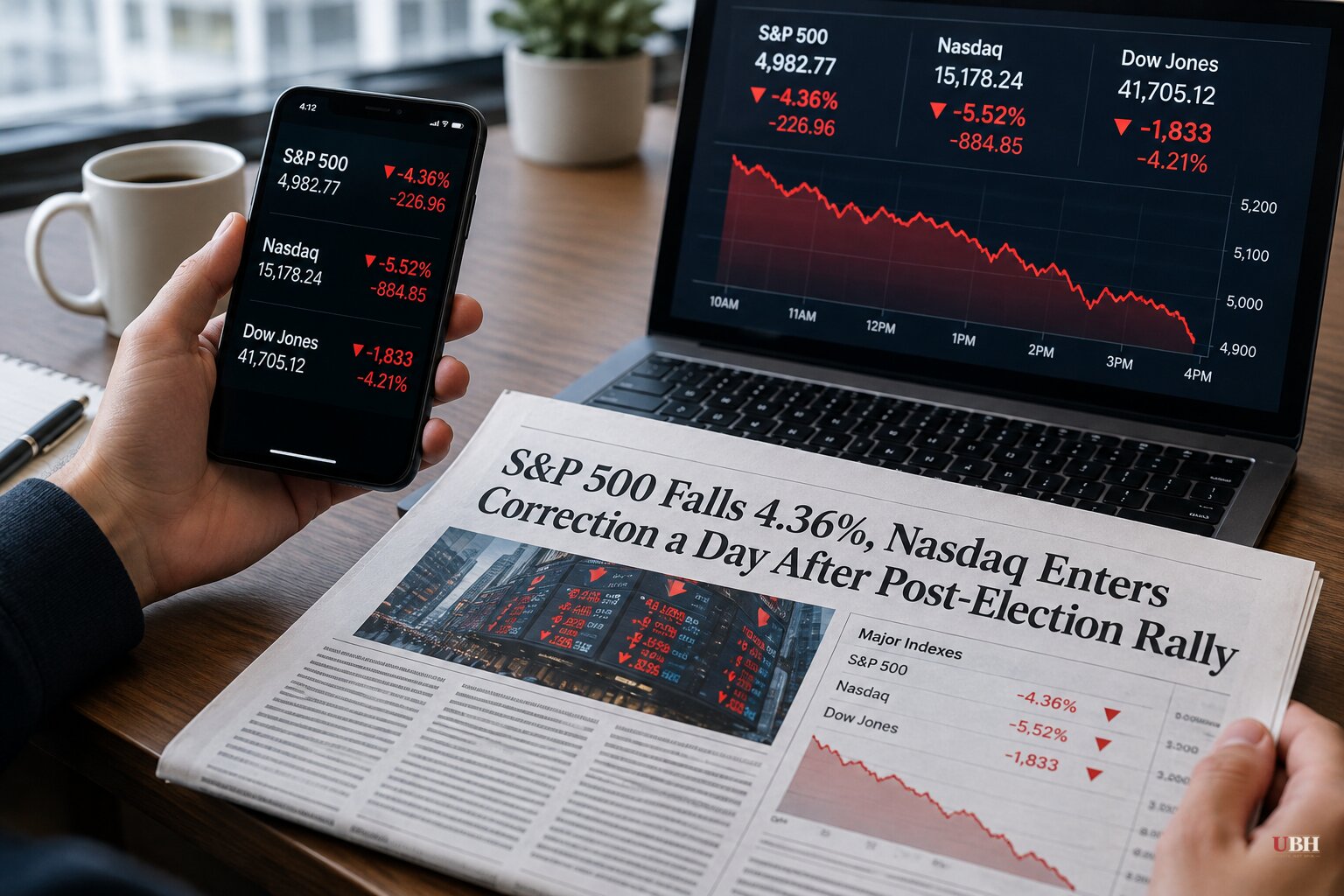
The U.S. stock market had one of its ugliest sessions in years on Thursday, Nov. 5, one day after a post-election rally that lifted the Dow by more than 1,500 points.
The S&P 500 fell 4.36% to 7,353.73. The Nasdaq Composite dropped 5.52% to 24,315, which leaves it more than 10% below the record close it set last month. That meets Wall Street's definition of a correction. The Dow Jones Industrial Average lost 1,833 points, or 3.44%, to close at 51,523.06, giving back all of Wednesday's gain. That gain was its best day since April 2025.
The Russell 2000 small-cap index fell more than 4%.
Where the damage landed
Artificial intelligence names took the worst of it. Nvidia fell 9%, a loss of about $374 billion in market value. Broadcom dropped 10% and Oracle fell 7%. Qualcomm slid 9% on a weak forecast, even though it beat earnings estimates.
The so-called neocloud companies that rent out AI computing power fared worst. Nebius plunged 15% and CoreWeave fell 10%. A Daily Wire tally put the S&P 500's one-day loss in market value at a record $2.9 trillion and the Nasdaq's at $2.5 trillion.
Other sectors, including consumer staples, energy, healthcare and utilities, held steady, according to The Epoch Times.
Banks and brokers fell with the tape. Morgan Stanley and Goldman Sachs each dropped about 6%, Citigroup about 5% and JPMorgan Chase about 4%, according to Tikr. None had company-specific news. Robinhood fell about 10%.
Options traders piled in. Clearing data showed U.S. options volume averaged more than 112 million contracts on Nov. 5, the busiest day ever and 53% above the October average. Just over half the contracts were puts, which are bought as bearish bets.
Competing explanations
President Trump blamed Democrats. "It took so much work to get us to a level that no one has ever seen before, and then this. Your 401(k)s have, therefore, dropped," he said, adding: "Remember, it wasn't Republicans, it was Dumocrats."
The market's own logic is less tidy. Democrats won both chambers of Congress, and stocks rallied on Wednesday. Kathleen Brooks, research director at XTB, said at the time that "gridlock might be bad for politics, but it is good for markets," and that midterm years usually bring a strong rally. Patrick O'Hare of Briefing.com said markets took comfort that Trump congratulated Democrats and signaled the result would not be contested.
Peter Schiff of Euro Pacific Asset Management took the opposite view. "Yesterday's stock market rally in the face of the Democratic landslide made no sense," he wrote on X. "In contrast, today's sell-off makes perfect sense. Expect more days like today."
AI stocks were also already under pressure before the election. The Nasdaq had been falling since last week, and Wednesday's 1.6% gain only partly offset that. The backdrop includes surging gas prices, tariffs, the Iran war and eurozone inflation at a three-year high of 4.0% in October.
The data-center fear
The explanation most commonly offered for Thursday's tech rout is that a Democratic Congress will slow the data-center buildout.
Sen. Bernie Sanders has demanded a "national data center moratorium now." Rep. Greg Casar, D-Texas, and other progressives want to halt new construction. Rep. Ted Lieu, D-Calif., has promised public hearings and new AI guardrails. Party leaders want tech CEOs to testify under oath.
Texas is a particular exposure. The state holds roughly a quarter of the nation's planned data-center capacity. Democrat Gina Hinojosa ousted Gov. Greg Abbott after campaigning on a pause for new projects, and Democrats flipped a Texas Senate seat.
Dan Ives, the Wedbush tech analyst, warned the buildout will slow sharply through 2028. UBS estimated that about 30% of planned capacity could be affected. Local ballot measures in communities across the country have also gone heavily against new data centers.
The Democratic caucus is split on how far to go. Any sweeping federal crackdown would likely meet a Trump veto, and Trump had already promised to be "Mr. Veto."
What the numbers still show
Despite the drop, the major indexes are still up for 2026. The Nasdaq is up about 5% year to date, and the Dow and S&P 500 are up about 7% and 7.4%, according to The Epoch Times.
Nasdaq and S&P futures bounced slightly Friday morning, while Dow futures stayed lower.
The next hard data point on the financial side comes in mid-January. Morgan Stanley's fourth-quarter results will show whether trading volumes cooled, a question CEO Ted Pick raised on the third-quarter call when he said volumes slowed across asset classes after Labor Day. The harder question for AI stocks is whether the new Congress moves a data-center bill past a veto, or whether the decisions land with governors and local regulators.
Sources used for this briefing
7 links from 7 independent newsrooms (syndicated copies of the same report count once)
These are the sources it draws on, linked so you can verify.


