
Unbiased headlines. Facts, not spin.
Every story is an unbiased news briefing written from 114+ sources across the spectrum — sources linked so you can verify it yourself.
 finance
Major Story (7/10)
Event date: October 7, 2026
finance
Major Story (7/10)
Event date: October 7, 2026
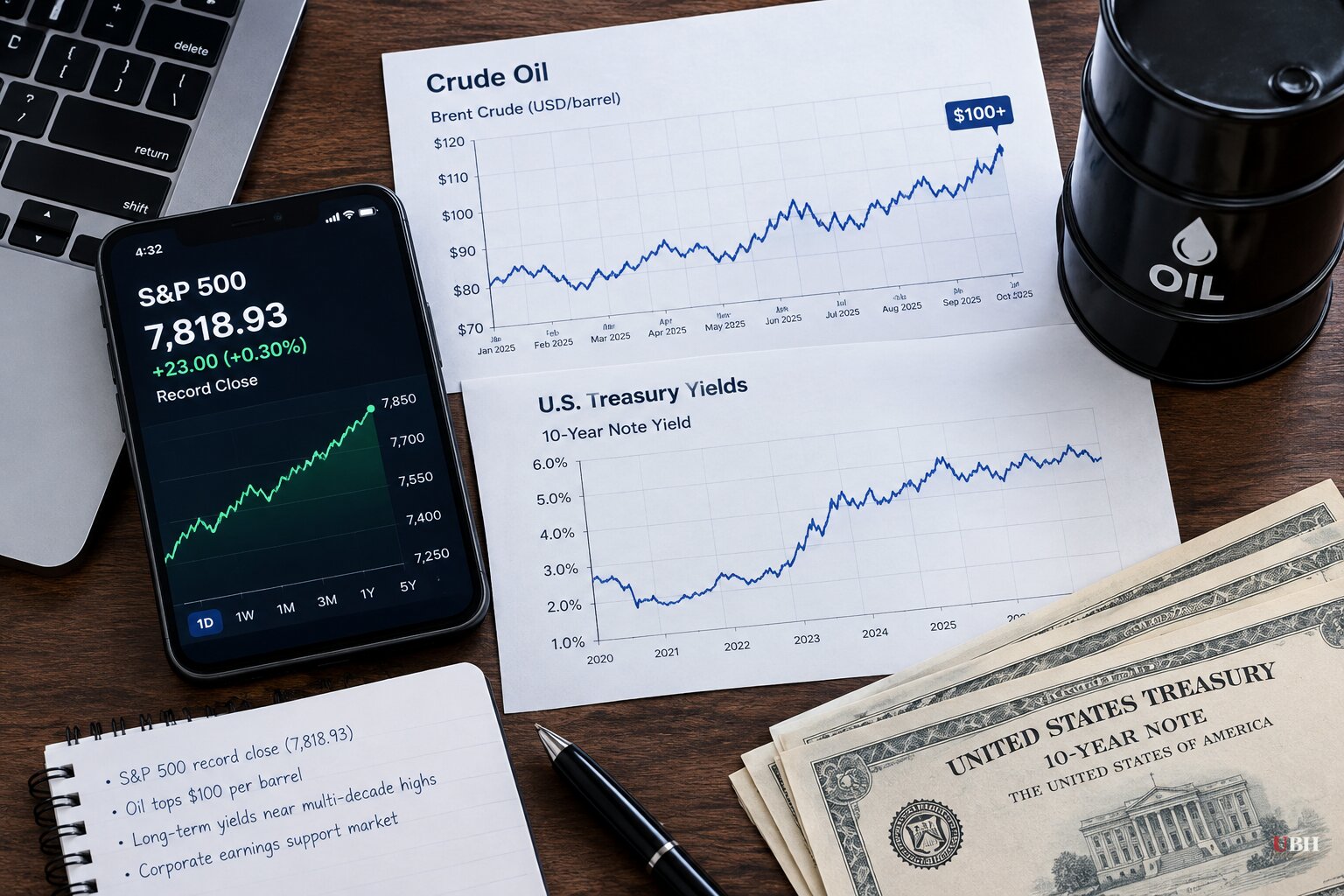
S&P 500 Closes at Record 7,818.93 While Oil Tops $100 and Long-Term Yields Stay Near Multi-Decade Highs
The stock market is at an all-time high. Almost everything else in the economy is pointing the other way.
The S&P 500 climbed 0.6% on Tuesday, Oct. 6, to a record close of 7,818.93, topping its previous high from August. The index is up 23% from its trough in late March. The Dow Jones Industrial Average rose 0.5% to 51,521.28. The Nasdaq composite added 0.4% to 27,599.79, a record that followed another one set the day before.
Earnings are doing the lifting
The fear that drove the March selloff has largely come true. Oil is high because of the war with Iran. That has made inflation worse. Bond yields have climbed, which makes borrowing more expensive for everyone. Americans broadly say they are more pessimistic about the economy.
Corporate profits have held up anyway. Lamb Weston, the frozen potato maker, said Tuesday that quarterly profit and revenue beat its own projections and Wall Street's expectations. Its stock rallied 7.5%. Constellation Energy was another leader after announcing a long-term deal to supply electricity to Google.
Analysts expect S&P 500 companies to post earnings-per-share growth of nearly 30% for the July through September quarter compared with a year earlier. Delta Air Lines reports its third-quarter results Friday, Oct. 9. Several of the biggest U.S. banks follow next week.
Ng Jing Wen of Mizuho Bank said the rally "reflected confidence that corporate earnings, particularly across technology and AI-related sectors, can withstand elevated energy costs and restrictive interest rates." She added that investors "continue to prioritize earnings momentum over near-term inflation risks."
Overseas, markets did not follow. On Wednesday, Oct. 7, the Nikkei 225 fell 0.9% to 70,035.71. The Kospi in South Korea dropped 2% to 6,803.90. The DAX lost 0.4% to 25,338.97, and the CAC 40 lost 0.4% to 7,836.77. Shanghai was closed for a national holiday.
Samsung Electronics shares fell about 2.4% in Seoul even though the company's preliminary third-quarter operating profit hit a record 107.4 trillion won, about $80 billion.
The bond market is the problem
The 10-year Treasury yield touched 5.15% on Thursday, Sept. 24, its highest level since 2007. The 30-year yield climbed above 5.44% that week, a level not seen since 2004.
The pressure has been hardest on small companies. The Russell 2000 fell 0.8% in the week ended Sept. 25, while the Nasdaq gained 2.06% on strength in Meta, AMD and Microsoft. AMD crossed $1 trillion in market value.
That is a tale of two markets. Large technology firms with AI revenue are rising, while companies that depend on cheap credit are not.
Oil keeps swinging
Brent crude has been volatile on shifting signals from the Iran standoff. In the week ended Sept. 25 it fell below $90 on hopes for a diplomatic deal, then rose above $103 and briefly touched $108 after both sides took hard lines at the United Nations. It settled near $104.
Freedom Broker's Mikhail Denislamov wrote in a morning market note that Brent remains above $100. He pointed to reports that the White House has asked the Pentagon for plans for new strikes against Iran, with no final decision made. He also cited ongoing attacks on tankers in the Strait of Hormuz. Denislamov warned that a continued oil rally could push long-term yields higher still.
The Fed is not done
The Federal Reserve is not signaling relief. At an economic forum in Istanbul, Fed Governor Christopher Waller said additional rate hikes will likely be needed to bring inflation back to 2%. He said the timing is flexible and the Fed need not tighten at consecutive meetings, leaving open a pause in October.
Waller cited a strengthening economy, the energy shock from the Iran conflict and added demand tied to AI development. Denislamov's base case is one more 25-basis-point hike in 2026.
Denislamov rated the risk balance for the session as negative. He said weak demand at a $22 billion auction of 30-year Treasuries could push that yield above 5.7%, a new multi-year high. That would limit how much stock valuations can expand, especially among small caps.
That is the same bond market that has been pushing up borrowing costs for households, businesses and the federal government itself.
What comes next
The next test is earnings. Delta reports Friday, and the big banks follow next week. If profits come in near the roughly 30% growth analysts expect, the rally has its support. If they disappoint, stocks will have to face oil above $100, yields above 5% and a Fed that has not ruled out another hike.
The Fed's October decision will show whether Waller's pause option gets used.
Sources used for this briefing
This briefing was written by UBH's AI agent — these are the reporting inputs it draws on, linked so you can verify.


