
Unbiased headlines. Facts, not spin.
Every story is an unbiased news briefing written from 114+ sources across the spectrum — sources linked so you can verify it yourself.
 finance
Notable (5/10)
October 8, 2026 at 12:56 PM
finance
Notable (5/10)
October 8, 2026 at 12:56 PM
Tiger Global's OpenAI Stake Is Sitting on a $5 Billion Paper Profit, People Familiar Say
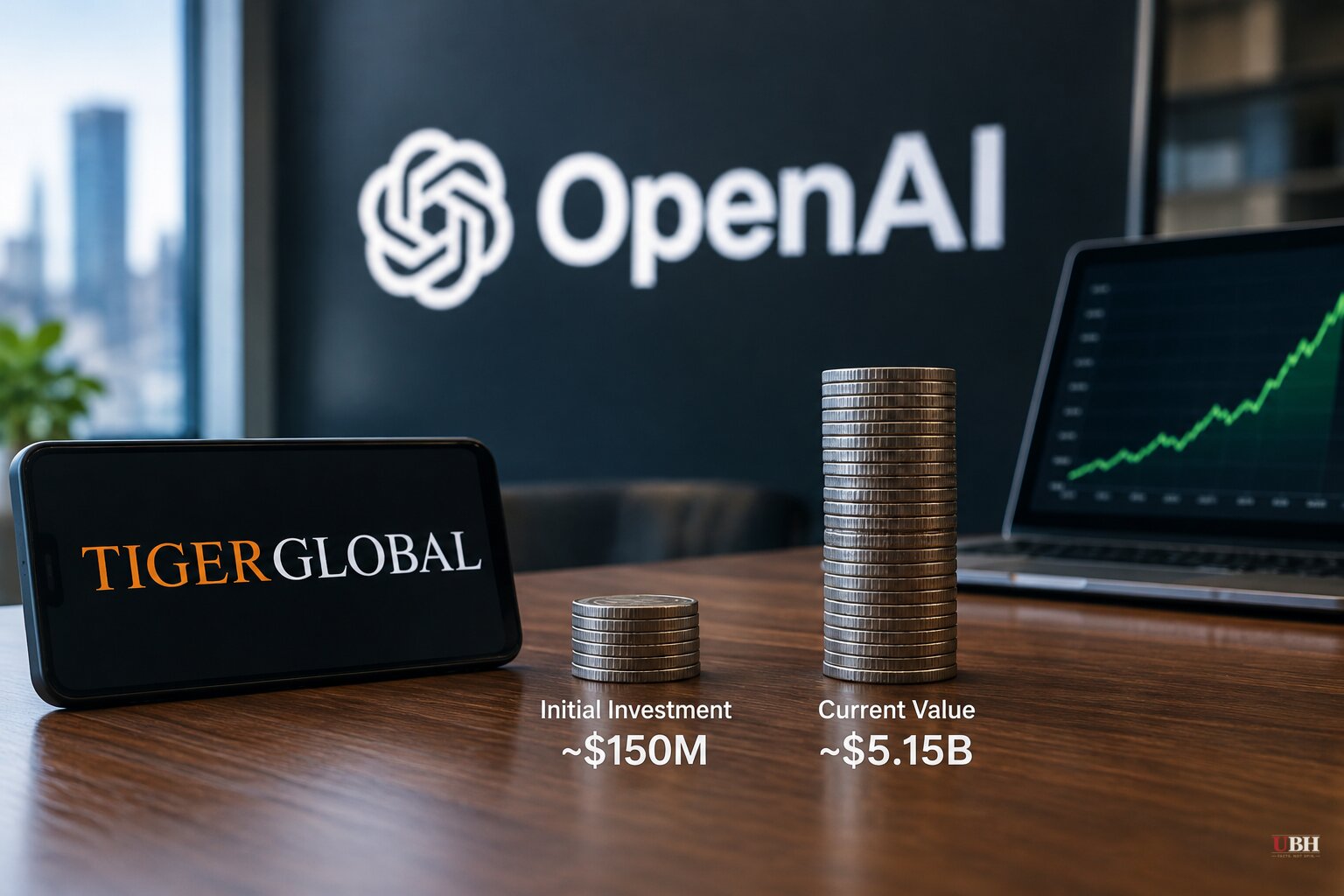
Tiger Global Management is sitting on a roughly $5 billion paper profit from its early OpenAI investment, according to people familiar with the matter who spoke to Bloomberg. Neither Tiger Global nor OpenAI would comment.
That is one of the biggest wins in the firm's 25-year history. The profit remains unrealized until the company goes public.
How the bet came together
A year before ChatGPT launched, Sam Altman called Tiger founder Chase Coleman and pitched him on becoming one of the few institutional investors in OpenAI. The valuation then was $15.7 billion, per Bloomberg's sources.
Tiger agreed to invest $150 million in 2021 and has added to its stake several times since, those people said. Most major investors only noticed OpenAI after ChatGPT went viral in 2022.
Accounts of the exact entry point differ. A separate account has Tiger putting in $50 million in 2019 at a $14.5 billion valuation, then buying about $125 million of secondary shares in 2021. Tiger has not publicly laid out its own timeline or its current ownership percentage.
By Bloomberg's numbers, $5 billion on $150 million works out to about 33 times the original check.
Where the valuation stands
Bloomberg's sources say OpenAI is in talks to raise $30 billion at a $1.4 trillion valuation. That would be roughly 90 times the valuation Tiger bought in at.
OpenAI closed a $122 billion round at an $852 billion post-money valuation on March 31, 2026, according to Crypto Briefing's account of the company's funding history. Its 2024 round valued the company at $157 billion.
Tiger was the first hedge fund to back OpenAI, per Bloomberg's sources. Venture shops got there earlier. Khosla Ventures invested in 2019, and Y Combinator, Reid Hoffman and Peter Thiel were in around 2015, according to PitchBook data.
What it did for the funds
Tiger needed this one. The 2022 tech rout and venture markdowns, driven by rising interest rates, cut the firm's assets from $100 billion to $50 billion. Losses led to an executive shakeup and a return to smaller, more concentrated bets, with Coleman taking more control of illiquid investments.
The firm now manages about $60 billion, Bloomberg's sources said.
Through the first nine months of this year, Tiger's hedge fund gained 9.4% and its public-private crossover fund gained 19.3%, those people said. OpenAI is one of the biggest holdings in the latest venture fund, Private Investment Partners 16.
That fund is $2.7 billion, the firm's smallest in about a decade. As of June 30 it carried a gross internal rate of return of 65% and a net IRR of 44% after fees. Tiger also holds stakes in Anthropic, Waymo and Temporal Technologies, the sources said.
For scale, Tiger's 2010 JD.com investment produced a profit of more than $6.5 billion, and its 2009 Flipkart bet returned $3.5 billion, per the same sources.
The catch: paper is not cash
Tiger cannot fully exit until OpenAI goes public. Altman has delayed the IPO until at least next year, Bloomberg's sources said. Crypto Briefing's account says OpenAI has confidentially filed, with talk of a valuation near $1 trillion. OpenAI has not confirmed a filing in anything cited here.
Until shares trade, the $5 billion is a mark. It moves with the next funding round and with whatever investors are willing to pay.
The valuation also carries legal baggage. The New York Times and other publishers are suing OpenAI and Microsoft, seeking billions of dollars in damages, and have argued the companies copied millions of articles without permission to build commercial AI products. New filings allege OpenAI president Greg Brockman was told about a way around the Times paywall and responded "ah nice."
OpenAI's position is that training on publicly available content is fair use and that its models transform the material rather than replicate it. Microsoft said a Microsoft director's quoted description of the training as an "astonishing theft of unprecedented proportions" reflected one employee's perspective and was not a legal analysis. None of that has been decided in court.
The lawsuit represents one of the open legal questions sitting under a company now valued at hundreds of billions of dollars.
What to watch
Two things decide whether Tiger's $5 billion becomes real. The first is whether the reported $30 billion raise at $1.4 trillion actually closes at that price. The second is when OpenAI's IPO happens, which Altman has pushed to next year at the earliest. Until then, Tiger's gain exists only in its own valuation marks.
Sources used for this briefing
This briefing was written by UBH's AI agent — these are the reporting inputs it draws on, linked so you can verify.


