
Unbiased headlines. Facts, not spin.
Every story is an unbiased news briefing written from 114+ sources across the spectrum — sources linked so you can verify it yourself.
 finance
Notable (6/10)
Event date: October 1, 2026
finance
Notable (6/10)
Event date: October 1, 2026
Panmure Liberum Strategist Says AI Trade Could Drag S&P 500 to 5,000 by End of 2027
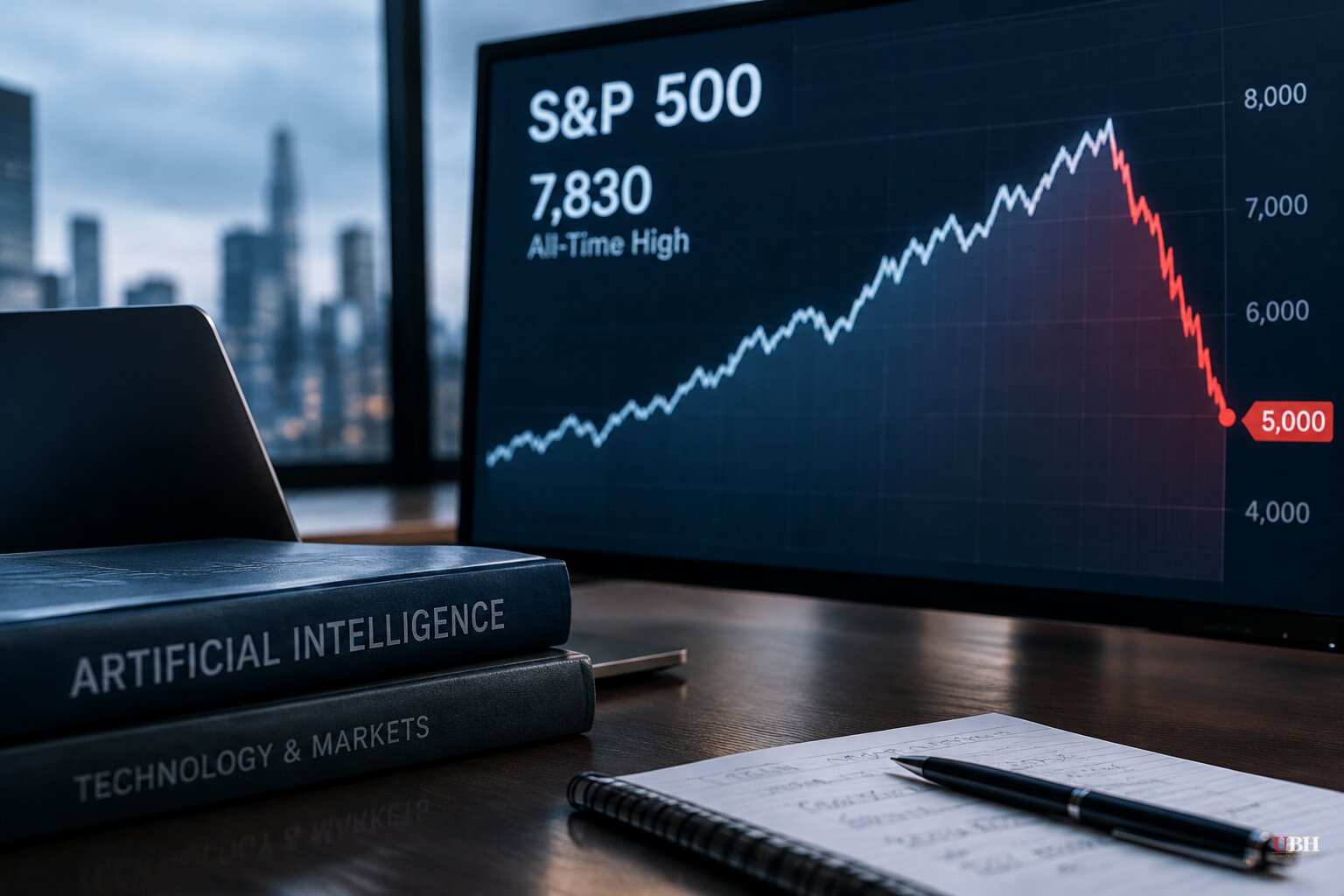
The S&P 500 closed at a record 7,830 on Oct. 6, up 0.7% on the day. The same week, a London strategist put a number on how far it could fall.
Joachim Klement, head of market strategy at Panmure Liberum, says his base case is for the AI trade to disintegrate as soon as 2027. He and colleague Francisca Reis argue an AI-sector downturn could push the S&P 500 to 5,000 by the end of 2027. The index closed at 7,722.72 on Friday, so that would be a drop of more than 35% and, in Klement's framing, the worst crash since 2008.
The spending math
Klement says investors face a capital-spending dilemma. If hyperscaler outlays keep rising, they weigh on the tech stocks that dominate the index. If spending slows, chipmakers and data-center equipment makers take the hit.
He cites projections that hyperscaler capital expenditures could reach $1.2 trillion in 2027. He says the bubble could burst in 2027 or 2028, potentially alongside additional rate increases from the Federal Reserve and the Bank of England.
Others have put similar numbers on the build-out. JPMorgan CEO Jamie Dimon said in September that AI spending could reach $1 trillion in 2027, up from $700 billion this year. Dimon said that would boost GDP but could also add inflation.
Goldman Sachs strategist Ryan Hammond estimates AI users would have to spend at least $1 trillion a year for hyperscalers to earn enough to justify their outlays.
Debt is paying for part of it
The research firm Bull Theory says hyperscalers are expected to invest nearly $800 billion in 2026. It says AI spending is consuming 93% of their cash flow, and that bond issuance has reached about $250 billion. Those are the firm's estimates.
S&P Global Market Intelligence counts $917.8 billion in corporate bonds raised cumulatively between 2019 and 2025. Over the same stretch, the 30-year Treasury yield rose to 5.2% from 2.58% in 2019, according to Kiplinger's reporting. Borrowing is more expensive than it was when the cycle started.
Investor Whitney Tilson names five companies as carrying much of the infrastructure spending: Alphabet, Amazon, Meta, Microsoft and Oracle. He sees eight parallels with the dot-com bubble, including unproven business models, heavy losses, circular financing, rising debt and a "new paradigm" narrative.
The concentration is real. The Magnificent 7 now make up about one-third of the S&P 500's total market value. The S&P is up more than 88% over three years and the Nasdaq Composite up 111%.
The bears have positions
Michael Burry, the investor who bet against housing before 2008, wrote on X that the market is "quite obviously in its first stage of grief, denial." He says that stage lasted 6 to 9 months in 2000 and 2008. Counted from now, that points to the first or second quarter of 2027.
Burry said in a newsletter he is "moving timelines up" and wants more leverage in his short positions. He has taken positions against Micron and the iShares Semiconductor ETF. He is betting his own money on this view.
Arthur Hayes, BitMEX co-founder, told CNBC in Singapore that every major technological rollout has been overbuilt, followed by a crash and a bailout. He expects pressure in late 2027 or 2028, when new capacity comes online and infrastructure providers seek payment from AI companies. Hayes runs a crypto investment firm and argues Bitcoin would benefit from a bailout. Bitcoin is down 4.35% this year and trades around $83,430.
The case against panic
Nobody in this group is saying the technology is fake. Richard Yashenek, chief investment strategist at Intech, put it this way: "AI can be transformational, but it still creates investment risks."
Hayes himself draws a line inside the trade. He notes Nvidia and memory-chip makers are already profitable, while OpenAI, Anthropic and SpaceX are heavy users of computing power without making money. The Goldman figure comes with a caveat in its own coverage: it does not necessarily mean a crash is coming or that this is a bubble.
The market is also still rising. Nvidia is up 81% over two years including dividends, and Alphabet returned 109%. The Nasdaq 100 gained about 49% over the same period. Anyone who sold on the 2025 warnings missed a lot.
Buffett's old test still applies. In a 1999 Fortune essay he wrote that the key is "determining the competitive advantage of any given company and, above all, the durability of that advantage." He noted 129 airlines had gone bankrupt in 20 years despite flight transforming society.
What Klement says to watch
Klement favors defensive holdings in a downturn: food producers and retailers, pharmaceuticals and tobacco. He also sees utilities as a "good bet," excluding those lifted by expected AI power demand.
Bull Theory adds a political trigger. It warns a Republican loss in the November midterms could set off an AI bubble burst because the industry depends on capital spending and outside financing. That is one firm's claim, and no source has shown how a midterm result would cut AI funding.
Klement says "the upcoming Q3 earnings season and then the full-year earnings and guidance for 2027 in January will provide a critical reality check." The first test is whether hyperscalers raise or trim their 2027 spending plans in the coming weeks, and whether revenue grows as fast as the bills.
Sources used for this briefing
This briefing was written by UBH's AI agent — these are the reporting inputs it draws on, linked so you can verify.


