
Unbiased headlines. Facts, not spin.
Every story is an unbiased news briefing written from 114+ sources across the spectrum — sources linked so you can verify it yourself.
 finance
Major Story (8/10)
Event date: October 6, 2026
finance
Major Story (8/10)
Event date: October 6, 2026
IMF Says Hedge Funds Now Hold $13 Trillion in Assets as Bank Lending to Funds Nears $3.7 Trillion
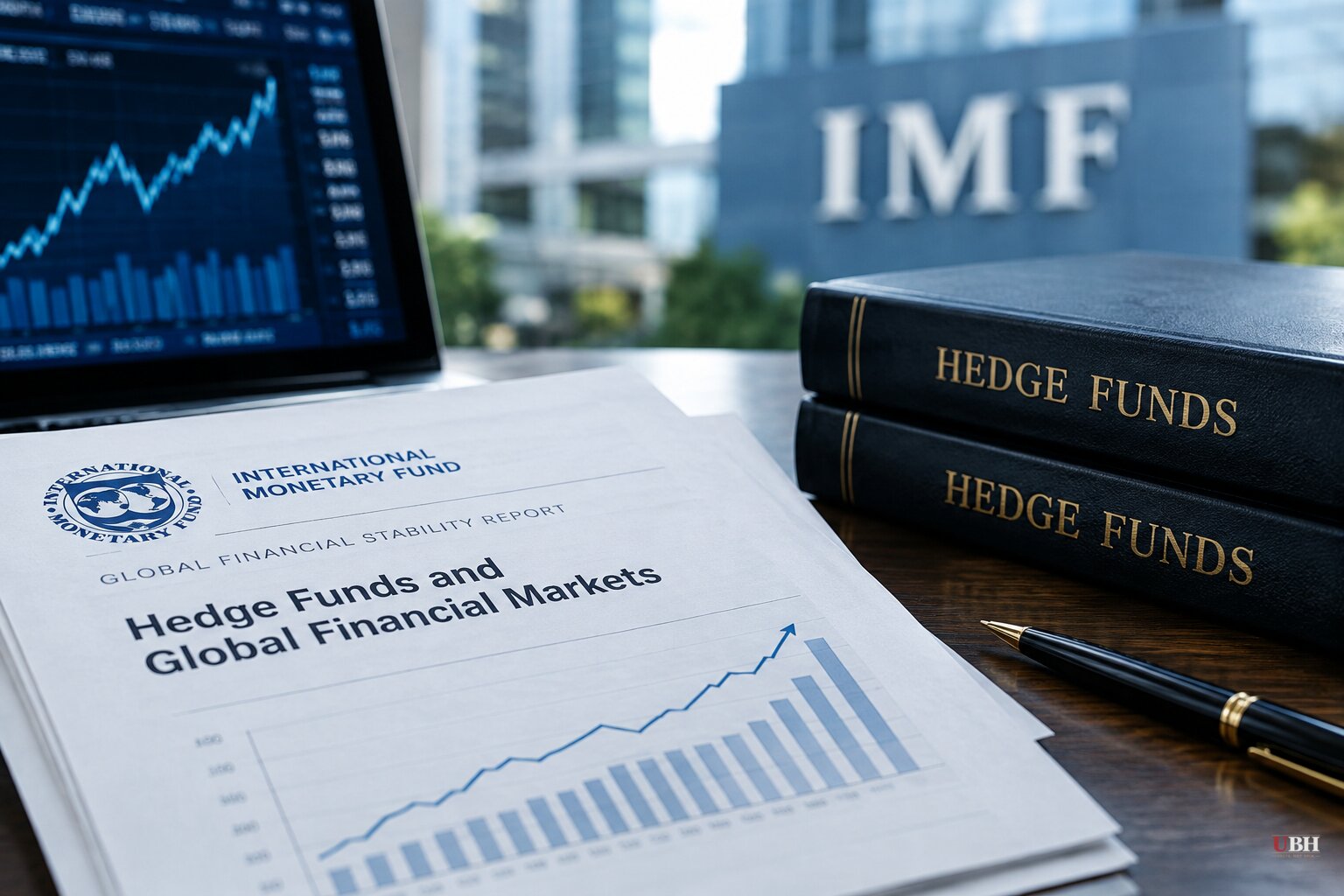
A new chapter of the IMF's Global Financial Stability Report puts numbers on one specific pressure point in global markets: hedge fund leverage.
The chapter says hedge funds held about $13 trillion in gross assets in early 2026, up from roughly $4 trillion in 2013. Total notional exposure, counting derivatives, exceeds $40 trillion.
The IMF says the funds improve price discovery and liquidity in normal conditions. It also says the same traits can magnify instability when markets turn.
Treasuries are the exposure that matters most
Hedge funds' share of the US Treasury market rose from about 4% in 2022 to 9% in 2025, according to the IMF. The Office of Financial Research puts their cash Treasury holdings at about $2 trillion at the end of 2025, nearly triple the level five years earlier and a record 7% of marketable Treasury debt.
Much of that comes from the cash-futures basis trade. Funds buy Treasuries and sell futures against them to capture tiny price gaps. The margins are so thin that funds borrow heavily to make it worth doing.
The IMF points to the market turmoil of early 2020, when hedge funds unwound an estimated $172 billion of Treasury positions. Market functioning deteriorated and the Federal Reserve had to step in with large-scale Treasury purchases.
There is a counterpoint in the numbers. Morgan Stanley estimates funds locked in leveraged basis trades are down 20% this year to $1.2 trillion. Bank of America rates strategist Meghan Swiber says the position has shrunk "because the opportunity set is lower," and that asset manager demand for Treasury futures has moderated. Reuters also reported that bank dealers are carrying more Treasury inventory after a rule change, and that Treasury Secretary Scott Bessent's buybacks have lifted prices on older bonds, squeezing the trade's returns.
So the trade is smaller than it was. The IMF's concern is the leverage that remains and how tightly it is tied to the banks. The IMF says the five largest prime brokers serve roughly two-thirds of hedge fund clients, creating channels through which losses at funds can spread to the banking system.
The Situational Awareness blowup
The clearest recent example is Situational Awareness, the AI-focused fund Leopold Aschenbrenner founded in 2024. According to The New York Times, Aschenbrenner had never worked at an investment firm before, and the fund was an eight-person operation with only half the staff dedicated to managing investments.
Goldman Sachs, Bank of America and other banks still lent it tens of billions of dollars. The Times reports, citing a banker familiar with the negotiations, that fund executives pressed multiple lenders to raise leverage to ten times investor capital, up from four times. That claim rests on one anonymous source.
The fund grew to roughly $45 billion at its July peak. When AI stocks fell sharply, lenders demanded repayment. Roughly $20 billion in stocks were sold at a discount to Ken Griffin's Citadel, leaving the fund with around $10 billion in assets.
Griffin told clients that "only Citadel could have delivered a solution of this scale on this timeline," according to a letter the New York Post reported. The letter said Citadel had already unwound more than 80% of the aggregate risk it bought, executing more than 100 block trades worth over $4 billion in three weeks.
The SEC has since sent subpoenas to Goldman Sachs, JPMorgan Chase, Citigroup and Bank of America, according to the Times. The inquiry reportedly covers how the banks handled trades, their communications with lenders about borrowed money and the amount of leverage used. A subpoena is a request for information. No charges have been announced. A Situational Awareness spokesman said the fund is highly regulated and will cooperate fully with any regulatory request.
Jane Street also took losses this summer. Partner Turner Batty wrote in an internal note that the firm had "closed a significant portion of our risk in the specific areas we lost on in July." Bloomberg reported it was the firm's first monthly downturn in 10 years.
Banks are earning from the borrowing
Hedge fund borrowing from banks reached nearly $3.7 trillion by midyear, which the Treasury Department says is the largest in over a decade and roughly three times the level recorded when the pandemic began in 2020. Margin debt across the broader market has surpassed $1 trillion.
That is revenue for prime brokerage desks, which earn fees and interest on the financing. It is also the link regulators watch. Frank Smets, who leads economic analysis and statistics at the Bank for International Settlements, said the near failure of an "AI-focused hedge fund served as another reminder of these risks," namely that heavily leveraged funds forced to sell could trigger a wider market selloff.
The leverage has coincided with a strong market. The S&P 500 has logged 27 all-time closing highs this year.
The disclosure fight
The SEC has proposed easing some reporting rules that require hedge funds to disclose borrowing levels to regulators. Senator Elizabeth Warren, the top Democrat on the Senate Banking Committee, said the move would "make these already shadowy markets even more opaque."
Tyler Gellasch, president of Healthy Markets Association, said the episode revealed risks that accumulated quickly. "Compliance officers and regulators will likely spend years asking how the risks grew so quickly," he said.
Ray Dalio argued separately in a Bloomberg Television interview in Singapore that China and Japan may pull back from Treasuries. China's holdings fell $15.4 billion to $618 billion, reportedly the lowest since August 2008. Fed economist Philip Monin has argued hedge funds are the bigger threat.
The IMF is calling on policymakers to improve data collection and monitoring so authorities can identify concentrations of leverage and interconnectedness before a market shock occurs. The SEC's proposal to ease borrowing disclosure cuts the other way, and how that tension is resolved will decide how much regulators can see of the next fund that borrows ten dollars for every one it holds.
Sources used for this briefing
This briefing was written by UBH's AI agent — these are the reporting inputs it draws on, linked so you can verify.


