
Unbiased headlines. Facts, not spin.
Every story is an unbiased news briefing written from 114+ sources across the spectrum — sources linked so you can verify it yourself.
 finance
Notable (5/10)
Event date: October 6, 2026
finance
Notable (5/10)
Event date: October 6, 2026
Singapore Parliament Passes Law Letting MAS Require Big Banks to Hold Loss-Absorbing Debt
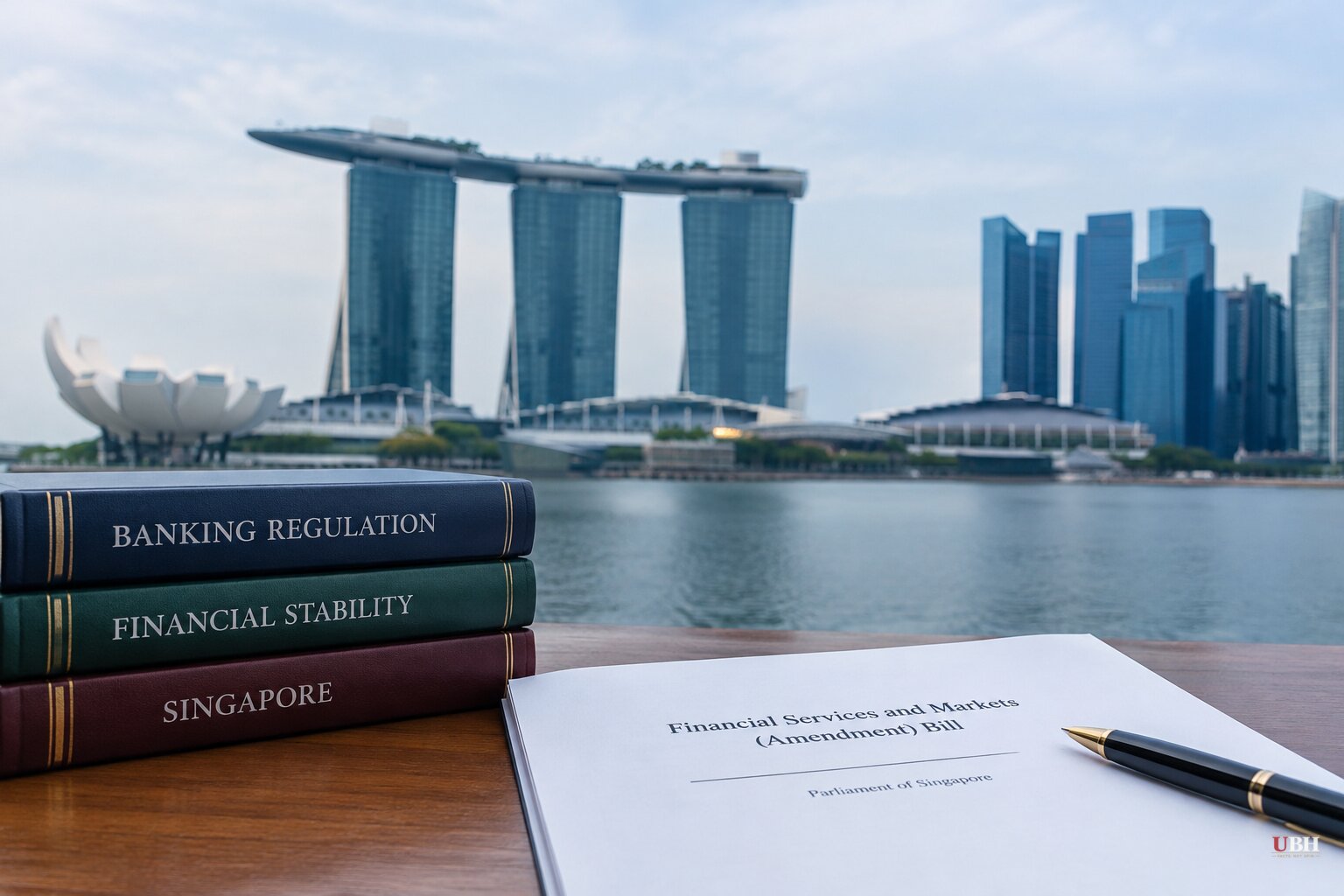
Singapore has written the "no taxpayer bailout" principle into law.
Parliament passed the Financial Services and Markets (Amendment) Bill on October 6, 2026. It lets the Monetary Authority of Singapore (MAS) require the country's domestic systemically important banks, known as D-SIBs, to hold Total Loss Absorbing Capacity, or TLAC. That means debt and other resources that can be written down or converted to equity if a bank gets into trouble.
What the law does
MAS already had the power to bail in the subordinated creditors of a distressed financial institution to restore its solvency. What it lacked was a legal requirement that banks have a defined cushion of such instruments ready before a crisis hits.
The bill supplies that requirement. Once the provisions take effect, MAS will be able to set minimum TLAC levels, specify which instruments qualify, and make banks publicly disclose both the level and composition of their TLAC. Banks must also disclose where those instruments rank in a winding-up.
In its second reading speech, MAS said the framework is meant to prepare for "the unlikely event of a distressed bank." It also said Singapore's D-SIBs remain well-capitalised and well-managed.
Penalties and timing
A bank that fails to comply faces a fine of up to S$250,000 (about $195,000) upon conviction. Continuing offences carry up to S$25,000 (about $19,500) for each day or part of a day after conviction.
For institutions of this size, those are small numbers. The real teeth are the capital requirement itself and the public disclosure.
The provisions take effect on a date the minister will appoint by gazette notification. No date has been announced. MAS has said it consulted the industry and the public on the required TLAC level, qualifying instruments, disclosures and the implementation timeline.
The bill also updates Singapore's counter-proliferation financing rules to match revised Financial Action Task Force standards. It states that MAS supervision covers proliferation financing alongside money laundering and terrorism financing. It also clarifies that MAS may assist domestic and foreign authorities in supervising those risks.
The cost question
Tech Times, which counts seven designated banks under the regime, put a number on the burden. It reported that DBS faces a S$4.3 billion capital gap. That figure is Tech Times' own estimate. The required TLAC level has not been published in the bill's summary, and MAS has not endorsed any bank-specific shortfall.
The tension is built into any TLAC regime. Regulators say pre-positioned bail-in debt means shareholders and bondholders, not the public, eat the losses. Holding that debt is also a cost for banks, and they can pass costs along through pricing or lower returns. Neither source says how Singapore's banks will absorb it or what MAS will demand.
What is known is the mechanism and who is protected by it. Losses fall on private creditors first. That is the sound principle, and it is a break from the 2008-era habit of rescuing failed institutions with public money.
The backdrop
The law lands in a rough market. In the recent global bond sell-off, the US 10-year Treasury yield rose as high as 5.22%, the highest since 2007, and the 30-year hit 5.5%, the highest since 2004, according to CNN. Japan's 10-year yield reached 3.08%, a level not seen since 1996. CNN tied the surge to inflation pressure from an energy shock after the war with Iran and the closure of the Strait of Hormuz, with Brent crude at $106.60 on the day it reported.
Nothing in MAS's statements links the bill to that sell-off. MAS framed it as long-planned preparation, not a response to market stress. Higher yields do raise the cost of the very debt banks will now be required to issue, though, which makes the pricing of future TLAC issuance something to watch.
The next concrete step is the gazette notice setting the start date. The required TLAC level and the phase-in schedule that MAS consulted on will show what each of the seven banks must raise, and how quickly.
Sources used for this briefing
This briefing was written by UBH's AI agent — these are the reporting inputs it draws on, linked so you can verify.


