
Unbiased headlines. Facts, not spin.
Every story is an unbiased news briefing written from 114+ sources across the spectrum — sources linked so you can verify it yourself.
 finance
Notable (6/10)
October 8, 2026 at 10:13 AM
finance
Notable (6/10)
October 8, 2026 at 10:13 AM
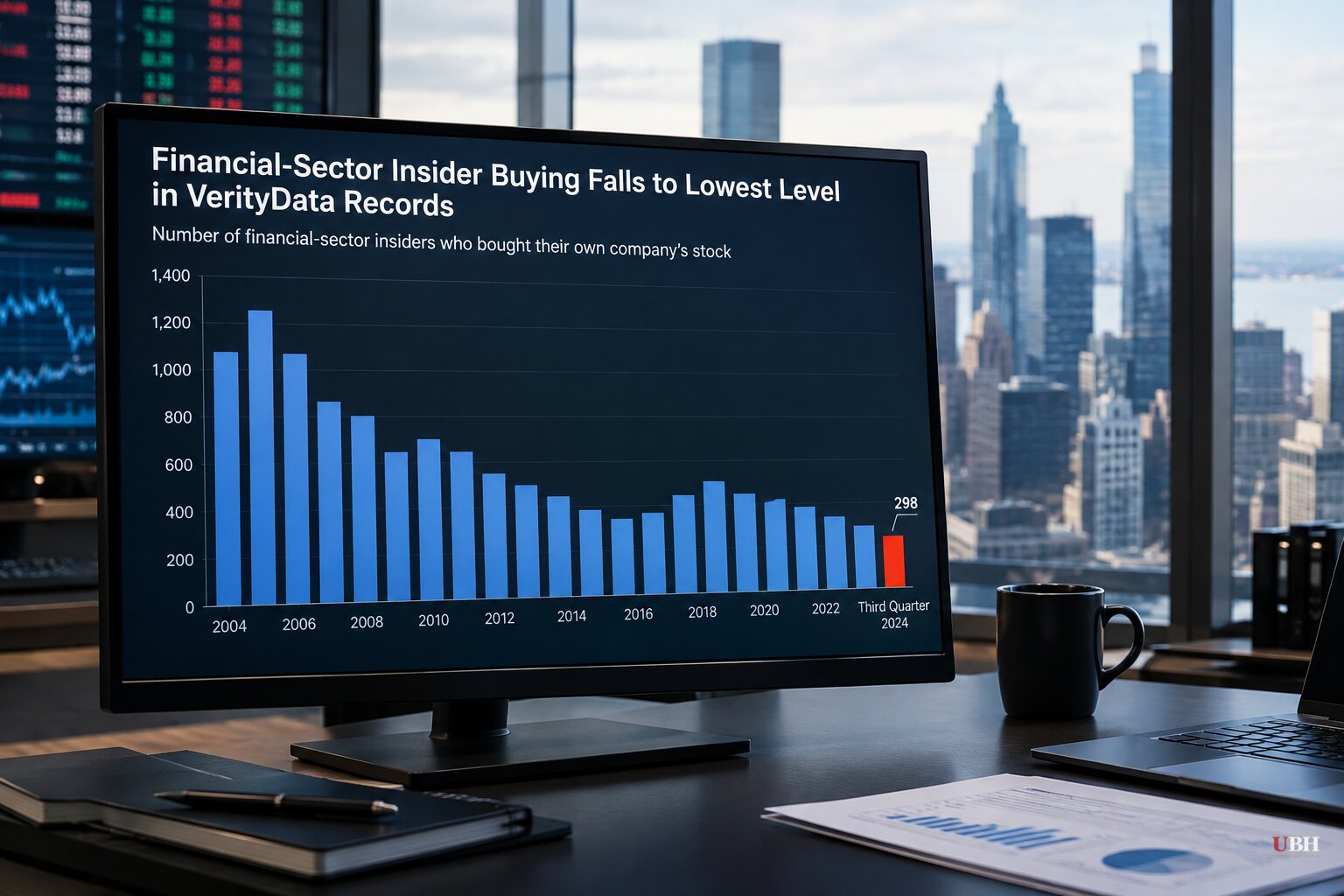
Financial-Sector Insider Buying Falls to Lowest Level in VerityData Records, Days Before Big Bank Earnings
Since the Fed raised interest rates and Treasury yields moved above 5%, one more data point has landed on Wall Street's desk: the people who run financial companies are barely buying their own stock.
VerityData counted just 298 unique financial-sector buyers in the July-to-September quarter. That is the lowest figure in the firm's records, which go back to 2004. The previous low was 302 buyers, set in the third quarter of 2024.
The tally covers insider activity at more than 3,000 financial services companies, from big banks to asset managers to insurers.
What the numbers show
The drop in financials is part of a wider pullback. Across the whole market, the number of insider buyers fell 18% to 1,290 in Q3, down from 1,580 in the second quarter.
Financials stand out on the ratio of sellers to buyers. VerityData's chart, as circulated by the Kobeissi Letter, puts the sector at 2.10 times its long-run average, the highest of any major sector. The broader market sits at 1.20 times.
Energy ranks second. The Kobeissi post puts it at 1.30 times, while a separate summary of the same chart rounds it to about 1.4. Consumer staples are at the bottom, near 0.50 times.
VerityData found that selling in financials did not rise by an unusual amount. The elevated reading comes from thinner buying, not a rush for the exits.
What insiders and academics say
Ben Silverman, VerityData's head of research, reads the drop as caution about price. "When equity prices get to a point that insiders feel that there's a price dislocation between where the market's perceiving a valuation, and where they believe it to be, they'll hold off on buying," he said. He called insiders "skittish" about valuations.
Harvard Law School professor Jesse Fried told Fortune that fewer executives buying can be "a bearish signal for that sector." His reasoning: inside purchases tend to predict future market-beating returns for their firms.
Not everyone buys that. University of Michigan finance professor Nejat Seyhun told Fortune he is "very skeptical that this means anything," pointing to how weakly insider trading has predicted returns in the financial sector.
Silverman himself has said insider data suits single companies better than whole sectors. Insiders also skip buying for compliance reasons, and sell for taxes, diversification or under prearranged plans, so a lack of purchases is a weaker signal than heavy selling.
The backdrop for bank earnings
JPMorgan and Goldman Sachs will post third-quarter results on Oct. 13, and Morgan Stanley follows on Oct. 14. Fortune notes trading desks have been setting records and that blockbuster offerings such as SpaceX in June have fed the banks' deal pipeline. Even so, the IPO market has stalled, with Oura and Bamboo Insurance delaying their offerings last month, and the Fed's rate increase can make corporate dealmaking harder.
Wall Street Journal columnist Spencer Jakab points out that per-share profits at each of the three now stand near four times their level a decade ago. He also flags strain in private credit, stressed consumers and record borrowing by artificial intelligence firms.
Bank stocks have been lagging. As of Wednesday, Fortune reports, the KBW bank index was down nearly 11% over the past month, while the S&P 500 advanced 1%. The KBW index is still up 3% so far in 2026.
Separately, Wallet Investor reports that the S&P 500 banks index fell 3.42% in a single session to 617.90, with no single catalyst behind it. The index is still up 31.29% over the past year, but only 2.67% over 90 days and 2.49% over 30. That is a third-party market-data report, and the session it refers to is not identified.
In the same Fortune review of filings, executives at JPMorgan routinely sold shares worth upwards of $800,000 in a quarter. A Goldman insider sold more than $600,000 of stock a little over a month ago.
Refiners tell a different story
Insiders at oil refiners Par Pacific and PBF Energy are selling after share gains of 149% and 210% this year, according to Jakab. Both trade at all-time highs.
PBF's adjusted second-quarter earnings came in at $6.22 per share, against a loss a year earlier. Jakab writes that diesel's effective refinery price passed $200 per barrel last week, after which the Group of Seven agreed to release 100 million barrels from emergency stocks, including diesel.
Jakab doubts diesel pricing can hold. He suggests refining executives with decades in the business see the limits better than investors do, while conceding that insiders can misjudge how investors feel about their own industry.
On the other end, insiders at Altria, Tyson Foods and Celsius Holdings have recently bought shares.
What comes next
The filings are public. Form 4 disclosures with the SEC will show whether any bank executives step in to buy after next week's earnings reports. The sellers-to-buyers ratio for the fourth quarter will show whether the third-quarter drought was a one-quarter pause or a trend.
Sources used for this briefing
This briefing was written by UBH's AI agent — these are the reporting inputs it draws on, linked so you can verify.


