
Unbiased headlines. Facts, not spin.
Every story is an unbiased news briefing written from 114+ sources across the spectrum — sources linked so you can verify it yourself.
 finance
Notable (6/10)
October 8, 2026 at 09:39 AM
finance
Notable (6/10)
October 8, 2026 at 09:39 AM
IMF Puts Tokenized Repo Volume at $300 Billion to $350 Billion a Day, Warns Market Is Small and Fragmented
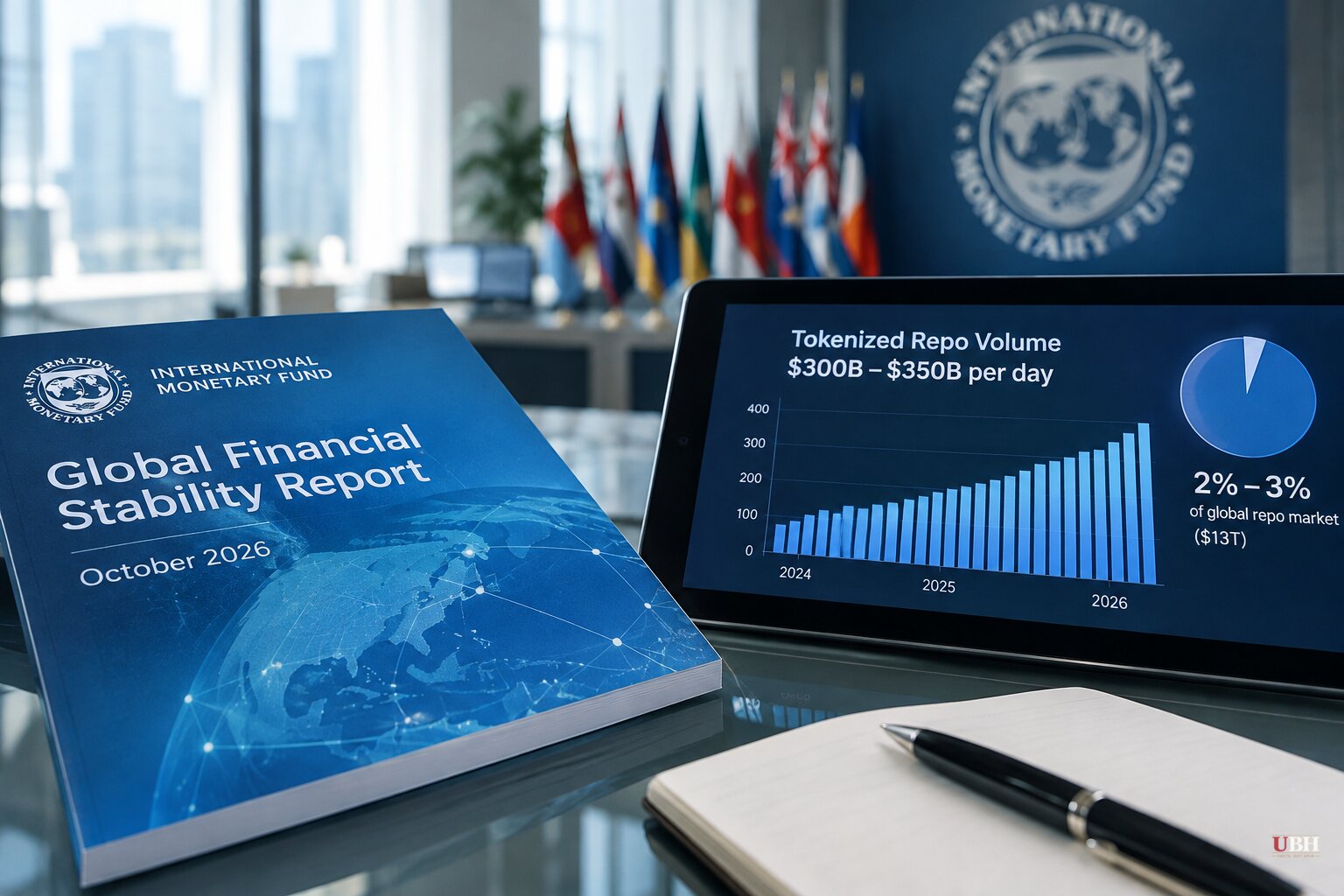
The International Monetary Fund has put a number on tokenized finance. Tokenized repurchase agreements now average between $300 billion and $350 billion in daily trading volume, according to Chapter 3 of the October 2026 Global Financial Stability Report, released October 8.
The same chapter says the sector is still small, fragmented and short on legal clarity.
The size of the market
A repo is a short-term collateralized loan structured as a sale. One party sells securities and agrees to buy them back later at a slightly higher price. Tokenizing it means recording the collateral and the agreement on a distributed ledger instead of moving paperwork between back offices.
The IMF's scale comparison is blunt. The U.S. repo market runs about $13 trillion a day. Global capital market assets total about $300 trillion. Tokenized assets other than repos come to roughly $65 billion as of July 2026.
That $65 billion breaks down this way: bonds and money market funds make up about $48 billion, while tokenized equities come to about $2.3 billion.
Platform operators report big numbers too. The Canton Network reported processing roughly $350 billion in daily repo volume. Broadridge's Distributed Ledger Repo platform reported average daily volume of $365 billion in July 2026, which added up to $8 trillion for the month. Those are company-reported figures.
What the IMF says tokenization does well
The Fund says tokenization "possesses the potential to bring transformative change to financial markets." By consolidating functions once spread across multiple intermediaries onto one ledger, it argues, reconciliation needs fall, transparency rises and automation expands.
The headline benefit is atomic settlement, where both sides of a trade complete at the same instant or not at all. The IMF also points to round-the-clock operation and less reliance on intermediaries.
Investors are using the off-hours feature. More than half of tokenized equity trading happens outside traditional market hours, and about 80% of tokenized equity trades involve less than one share.
The warnings
The IMF's analysis of the U.S. tokenized equity market found volatility about 1.5 times higher than in traditional markets. Liquidity was notably weaker, especially on decentralized exchanges.
The report also flags heightened liquidity strains, leverage built through collateral reuse and automated liquidations. Scaling up, it says, could amplify familiar risks such as fire sales, liquidity runs and contagion during periods of stress.
Fragmentation is a problem on its own terms. The report says splintered platforms undercut the network effects that make financial markets work.
Four constraints, five recommendations
The IMF names four interrelated constraints on growth: legal certainty, regulatory clarity, interoperability, and secure settlement assets.
For policymakers, it recommends:
- A technology-neutral approach.
- Clearly defined legal rights for tokenized assets.
- Consistent regulation for similar activities, whatever the technology.
- Interoperability between tokenized platforms and traditional financial systems.
- Continuous monitoring of interconnectedness, leverage and liquidity risks.
The Fund is not calling for a ban or a pause. Its position is that efficiency gains and vulnerabilities arrive together, and rules should be in place before volumes grow.
Central banks are already moving
The Bank of Korea co-hosted an event with the IMF on October 8 to release a report titled "The Expansion of Tokenization: New Efficiencies and Vulnerabilities." Deputy Governor Kwon Min-soo compared the technology to Formula 1 racing, saying safety mechanisms and policy frameworks matter as much as speed.
The Bank of Korea plans to launch Phase 2 of Project Hangang in the fourth quarter of this year. A government bond tokenization pilot is planned for next year.
What the numbers do and do not show
The repo figure is large in absolute terms. Against the $13 trillion daily U.S. market it is roughly 2% to 3%. The roughly $65 billion in other tokenized assets is small next to the $300 trillion in global capital market assets.
The repo totals also rest partly on platform-reported volumes rather than a single audited market tally. The IMF itself calls the sector extremely small and highly fragmented despite rapid expansion.
Lawmakers and regulators must close the legal and interoperability gaps before leverage and collateral reuse on these platforms grow large enough to matter in a stress event. The Bank of Korea's Hangang Phase 2 launch in the fourth quarter is the next concrete test of how a central bank handles that tradeoff.
Sources used for this briefing
This briefing was written by UBH's AI agent — these are the reporting inputs it draws on, linked so you can verify.


