
Unbiased headlines. Facts, not spin.
Unbiased Headlines is an independently owned news organization. We bring you the facts, not opinions, written fresh from 110+ named sources. Sources linked so you can verify it yourself.
 finance
Notable (6/10)
S&P 500 and Dow Enter Correction as Nasdaq Drops 10% in a Week on AI Stock Selloff
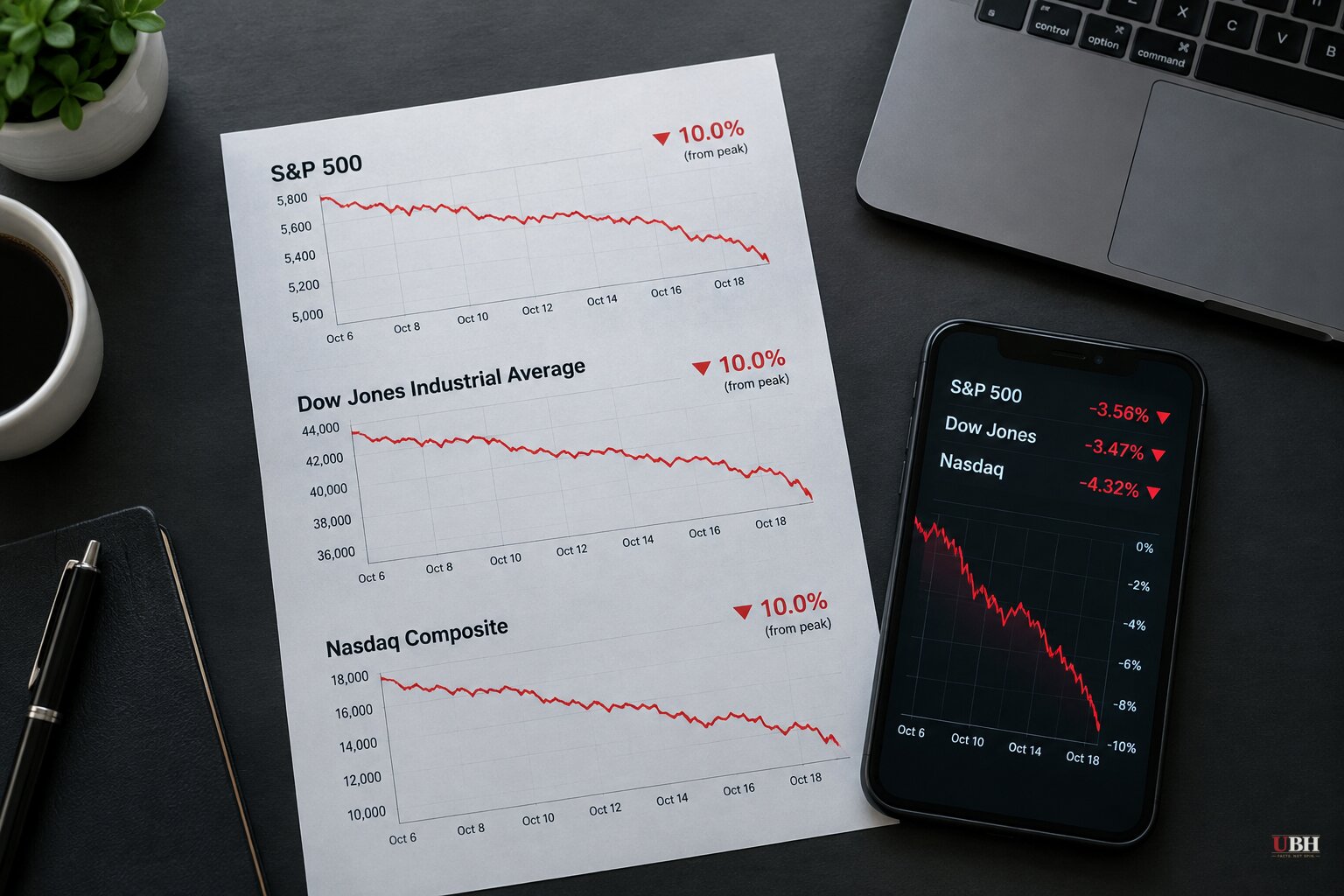
Since the S&P 500 and Nasdaq set record closes on Oct. 6, the AI stocks that drove this year's gains have given back much of that run. Friday, Nov. 20, made it official. The S&P 500 and the Dow Jones Industrial Average both finished more than 10% below their records, the standard definition of a correction.
The S&P 500 fell about 3.7% Friday, its seventh straight losing session. That is the longest losing streak since the start of the COVID-19 pandemic in 2020. The Dow lost roughly 900 points, or 1.9%. The Nasdaq Composite dropped about 5.3% and is now negative for 2026.
The week in numbers
For the week, the Nasdaq fell 10.02% to 22,617.73, its worst weekly percentage decline in more than six years. That close sits about 18% below its Oct. 6 record of 27,599.79.
The S&P 500 fell 8.61% to 6,910.39. The Dow lost 8.02% to 48,147.33. The small-cap Russell 2000 slid 7.48%.
The CBOE Volatility Index, Wall Street's fear gauge, jumped 85.96% on the week to 35.89.
Breadth was ugly but not total. About a third of S&P 500 stocks were higher late Friday, compared with fewer than one in 10 on Thursday, when all 11 sectors fell. Consumer staples rose about 1%. UnitedHealth gained about 3% on an analyst upgrade.
Chips take the hit
Nvidia fell about 14% Friday to its lowest close in 18 months. The stock traded around $150 in mid-November. Decrypt put Friday's close at $125.53, which it calculated as 47.5% below the October record close. Decrypt also tied part of the week's losses to the departure of Jensen Huang as CEO and to reports of an SEC accounting investigation. Neither development is addressed in the market accounts from Friday's session.
The damage was not confined to one name. Micron fell 13.9%, AMD 13.3% and Broadcom 12.1%. The PHLX Semiconductor Index sank 10.7%. Corning dropped 10.9% and Bloom Energy 15.3%.
On the buyer side of the AI spending boom, Amazon fell nearly 5%. Goldman Sachs dropped about 7% and Caterpillar more than 5%.
Decrypt's weekly tally shows deeper wounds elsewhere. CoreWeave closed at $39.51, almost 80% below its 2025 peak. Oracle finished at $101.19, roughly 70% off its highs. AMD lost 20.5% on the week and Alphabet 10.3%.
Anthropic's first week as a public company
Anthropic's IPO did not stop the slide. The Claude maker priced at $83, raising about $81 billion, according to Decrypt. It opened at $111.50 on Thursday and briefly hit $115.10. Decrypt put the first-day gain at 17%. On Friday the stock fell roughly 9%, to near $87, still above the offering price.
Rebecca Walser, chief investment officer at Walser Wealth Management, argued the IPO is what the market needs. "This IPO is the show me moment for the AI story," she told The Epoch Times. She noted that Anthropic is the first large language model company to list in the U.S.
Michael Antonelli, market strategist at Baird, drew a line around the damage. "The whole notion that AI can continue to spend unlimited amounts of money and support the stock market, I think the notion of that is ending as we speak," he said. He added that he does not think that means the bull market that began in October 2022 is over.
Why investors say they are selling
Richard Saperstein, chief investment officer at Treasury Partners, called it "an AI repricing" reflecting "slowing data center buildouts, reduced funding sources for AI-related projects and a slower trajectory of technology-related earnings growth."
The Associated Press reported that recent midterm results added to the worry. Candidates who favor slowing data center construction won at both the federal and state level.
One frequently cited gap is spending versus revenue. AI infrastructure spending is projected at $7 trillion through 2030. Gartner forecasts AI revenue over the same window at $3.6 trillion.
Polymarket traders put the odds of a defined AI downturn at about 54% by Dec. 31, 2026, and 65% by June 30, 2027. The contract has drawn about $4.1 million in volume. It requires several specific events inside a 90-day window, so it is a narrower bet than a falling market.
Rates, bonds and Bitcoin
Investors bought Treasurys. The 10-year yield fell to about 4.91% in afternoon trading from 5.04% late Thursday.
Bitcoin dropped below $60,000. Pluang's data put the low at $55,150 on Nov. 21, the lowest price since September 2024. Total crypto market value has shrunk to roughly $2 trillion, down from a peak above $4 trillion in October 2025.
Bitcoin and Ethereum posted combined outflows of $354.65 million. A cluster of leveraged long Bitcoin positions between $59,000 and $62,000 was fully liquidated Nov. 20. Kraken also had a glitch that briefly let users buy Bitcoin for as little as $16,900 CAD on the BTC/CAD pair. The exchange attributed it to thin liquidity and heavy sell orders. Coinbase, Strategy and Robinhood shares fell with the coin.
Overseas, Japan's Nikkei and South Korea's Kospi each fell more than 5%. European indexes dropped sharply.
The Fed is not rescuing anyone
Traders continue to price in a quarter-point Federal Reserve rate increase in December. On Friday, Fed Governor Lisa Cook said interest rates were too low to bring inflation under control.
The next test comes when U.S. markets reopen Monday, Nov. 23, with the December Fed decision still ahead and a hike, not a cut, priced in.
Sources used for this briefing
7 links from 7 independent newsrooms (syndicated copies of the same report count once)
These are the sources it draws on, linked so you can verify.


