
Unbiased headlines. Facts, not spin.
Unbiased Headlines is an independently owned news organization. We bring you the facts, not opinions, written fresh from 110+ named sources. Sources linked so you can verify it yourself.
 finance
Notable (6/10)
Goldman Sachs Lists Three Triggers for a Stock Market Bottom as S&P 500 Sits 12% Below Record
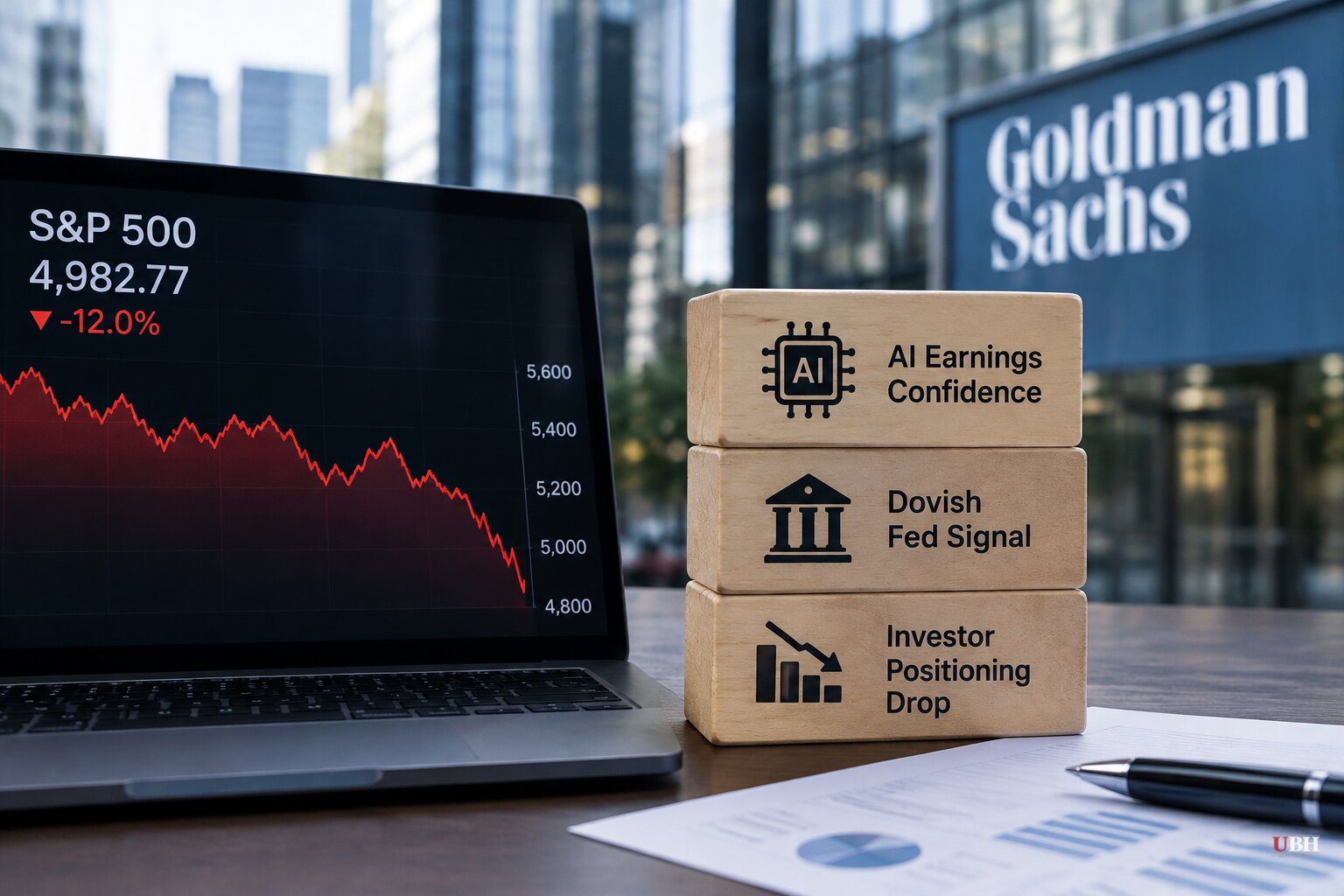
Since the AI-led selloff pushed the S&P 500 and Dow into correction on Friday, Nov. 20, the question on Wall Street has moved from how far stocks fall to what would stop the slide. Goldman Sachs has now answered that in writing.
The S&P 500 closed Friday at 6,918.45, down 3.59% for its seventh straight loss, the longest streak since February 2020. The Nasdaq Composite fell about 5.3% and is down more than 2% for the year. Goldman says the S&P is 12% below its Oct. 6 record.
Goldman says the selloff has broadened
In a note from strategist Snider, Goldman said the selloff "expanded this week from an AI unwind to a broader growth downgrade." The S&P 500 excluding AI stocks had held up until this week and now sits 6% below its high.
Goldman's AI stock basket is down 32% since Oct. 6. Cyclical stocks have lagged defensives by 5 percentage points over the past 10 days.
The note's figures are priced as of Nov. 19, so they do not capture Friday's drop. Goldman Sachs shares themselves fell about 7% Friday, among the worst performers in the Dow.
Three things that would signal a bottom
Goldman said any one of three developments would support a bottom and a recovery: news that raises confidence in AI earnings, a dovish signal from the Federal Reserve, or a big drop in investor positioning.
AI earnings. Investor Dan Niles told CNBC that a price war between Anthropic and OpenAI is hurting both companies. He said their combined sequential revenue growth fell from 75% in the second quarter to 48% in the third, while combined losses rose from $7.9 billion to about $8.4 billion.
Goldman's own outlook calls the AI picture for 2028 and beyond "highly uncertain."
The Fed. Futures put the odds of a December rate hike at about 95%. Goldman's economists expect hikes in December and March, taking the federal funds rate to a peak of 4.25% to 4.5%.
Philadelphia Fed President Anna Paulson said Thursday that the Fed will need to raise rates again because inflation is too high. Fed Governor Lisa Cook said Friday that rates are too low to bring inflation under control.
Treasuries rallied Friday, pulling the 10-year yield to about 4.91% in afternoon trading from 5.04% late Thursday. That was a flight to safety, not a policy shift.
Positioning. A sharp drop in investor positioning has often marked the end of past drawdowns, according to Goldman.
Anthropic's IPO became the test case
Anthropic's initial public offering raised $93.5 billion after underwriters exercised their option, surpassing SpaceX's $85.7 billion as the largest IPO on record. The shares were priced at $83.
The stock opened at $111.50 on Thursday and briefly hit $115.10. It jumped 17% on the day, then gave most of that back Friday to close at $88.91.
Robert Pavlik of Dakota Wealth said, "Anthropic faded relatively quickly." A US Bank Asset Management executive said the company's valuation, about 40 times trailing sales according to a Reuters-cited figure, "assumes years of rapid growth."
That is the skeptics' case in their own words. The bulls' case is that the earnings condition could be met by a single strong report, which would not require the Fed to do anything.
Nvidia and the chip complex
Nvidia fell about 14% Friday to its lowest close in 18 months. AMD, Broadcom and Micron each dropped by double digits, and CoreWeave and Nebius also fell sharply.
Amazon and Meta Platforms, big buyers of AI hardware, were hit too. The Dow lost about 900 points, or 1.9%.
All three major indexes had their worst week since the April 2025 tariff announcement. The Nasdaq lost about 10% for the week, and the S&P 500 and Dow each lost about 8%.
Outside tech, about a third of S&P 500 stocks were still higher late Friday. Consumer staples gained about 1%, and UnitedHealth rose about 3% on an analyst upgrade. Japan's Nikkei and South Korea's Kospi each fell more than 5%.
Hedge funds are already bracing
A separate Goldman analysis by Brian Garrett identifies seven early signs of market healing. Garrett cautions they are not confirmation of a durable bottom.
Hedge fund net leverage has fallen toward levels historically associated with drawdowns of more than 20%, while the S&P 500 is only modestly below its highs. Implied stock correlation is near historical lows. On a down day for the index, 80% of S&P 500 constituents can still advance.
Bonds are increasingly working as a hedge against AI weakness, Garrett found. Defensive equities, however, have become expensive, and systematic selling remains a near-term obstacle.
What comes next
The Fed meets Dec. 9, and futures show almost no doubt about the outcome.
With the Fed trigger unlikely and the AI-earnings trigger unresolved, Goldman's own framework points to positioning as the nearest possible signal. Hedge fund leverage has already fallen sharply, and Goldman has not said whether Friday's rout supplied the "big drop" it is waiting for.
Sources used for this briefing
6 links from 4 independent newsrooms (syndicated copies of the same report count once)
These are the sources it draws on, linked so you can verify.


