
Unbiased headlines. Facts, not spin.
Unbiased Headlines is an independently owned news organization. We bring you the facts, not opinions, written fresh from 110+ named sources. Sources linked so you can verify it yourself.
 finance
Major Story (7/10)
Binance Hack Three Weeks On: $2.82 Billion Frozen, $32 Million Recovered, Investigator Says
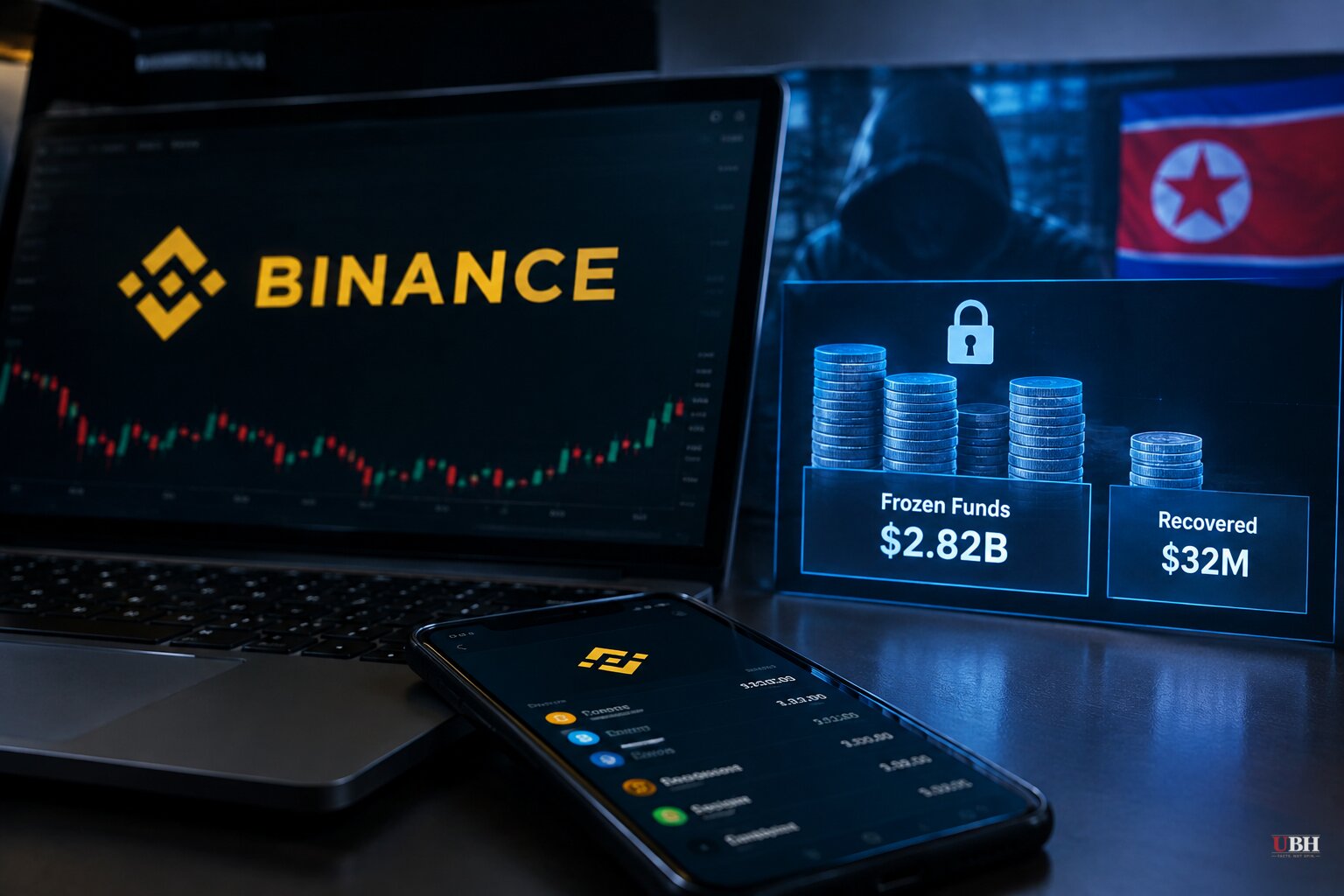
Since the Oct. 29 breach of Binance, the largest crypto heist on record, the story has moved from who did it to whether any of the money comes back. As of Nov. 20, the answer so far is: very little.
Blockchain investigator SomaXBT, in analysis circulated by Wu Blockchain on Nov. 20, put the numbers this way: about $2.82 billion frozen across various platforms, $2.67 billion still under the attacker's control, and just $32 million actually recovered. That is roughly 0.5% of the $6.4 billion taken.
Frozen is not recovered
Freezing stops thieves from spending. Recovery returns money to its owner. Those are different steps.
Binance said at the time of the hack that about $6.34 billion in digital assets was affected and that about $2.85 billion had been frozen or intercepted. The company attached a caveat: the figure is subject to reconciliation and market-price swings, because most of the frozen assets sit in tokens whose dollar value moves constantly.
Roughly $2.3 billion of the frozen funds is in the stablecoins USDT and USDC, whose issuers can lock balances on-chain. The U.S. Department of Justice has secured court authorization to seize or restrain more than $1.2 billion, according to Crypto Briefing's reporting.
In mid-November, Binance won a worldwide freezing injunction from the Abu Dhabi Global Market courts. Cointelegraph reported the order carries a $6.5 billion ceiling. That figure is a legal limit on what can be frozen, not a tally of money recovered. Freezing orders hold assets in place while legal proceedings run. They do not return them.
There is also a caution on the $32 million number. Shattered.io noted that Binance's own statements do not back that exact pairing of $2.82 billion frozen and $32 million recovered, and called the recovery figure unconfirmed as of Nov. 21. Binance did not disclose how much had been returned under the court orders.
Where the rest of the money sits
SomaXBT's tracing shows the attackers still hold 18,270 bitcoin from the original theft. Those coins have not moved since the exploit.
Other funds are being pushed through obfuscation tools. More than 5,100 bitcoin went through THORChain, a cross-chain liquidity protocol. Another 1,482 bitcoin entered CoinJoin mixing, mostly through the kruw coordinator. Both complicate tracing.
How the attack worked
Binance's own post-incident report, as relayed by Breitbart, lays out a monthslong operation. In June 2026, an employee identified as Engineer A downloaded tampered software disguised as a popular AI coding tool. Binance's security team caught the malware, replaced his device and reset all employee credentials. The attackers had already collected information on Engineer A and his colleagues' roles.
In September, Engineer B was approached on a legitimate job-search platform by someone posing as a project director. A fake HR representative used photos and video taken from a real social media account. In a second round, someone posing as the CEO of a fake company had him download a work assignment containing malicious code.
On Oct. 20, the attackers used that compromised computer and an internal Binance AI tool to take over Engineer A and a third employee. They found a deployment permission token still on Engineer A's machine. On Oct. 29, they used it, draining the hot wallets in about 20 minutes.
The FBI attributed the theft on Oct. 31 to TraderTraitor, a North Korean actor it also blamed for last year's $1.5 billion Bybit hack. The bureau said it was seeing the stolen assets converted, mostly into ethereum, and expected further laundering. It urged service providers to block transactions tied to a list of TraderTraitor addresses.
North Korea has denied involvement. Its state-backed media called the accusation a grave political provocation.
Who is absorbing the loss
Binance co-CEO Richard Teng promised on Oct. 31 that all customers would be fully reimbursed. The company drew on half of its $1 billion Secure Asset Fund for Users, its futures insurance fund and its corporate treasury, setting aside more than $6 billion. It has said it intends to rebuild the SAFU fund to about $1 billion.
Binance said it had replenished 98% of affected tokens and was buying the rest, which it described as less liquid and slower to source at scale. Crypto Briefing reports that coverage of customer balances was completed by Nov. 12.
Binance's balance sheet shows $157 billion in current total assets, according to the company's figures. Customers still left. After withdrawals resumed, Binance saw net outflows of about $4.7 billion, a figure that also reflects broader market swings.
That means the company, not its customers, is currently carrying the gap between the $6.34 billion it fronted and the $32 million investigators say has come back. The frozen $2.82 billion is potential upside only if courts release it to Binance.
The history behind the headline
Binance was co-founded in 2017 by Changpeng Zhao and Yi He. Zhao pleaded guilty in 2023 to failing to maintain an effective anti-money-laundering program, served a four-month prison sentence, and received a pardon from President Trump last year. Nothing in the reporting ties that history to the hack.
The stablecoin freezes show issuers can act quickly when told. The bulk of what was taken, though, did not land in a form that could be frozen.
What comes next
The U.S. seizure actions and the Abu Dhabi injunction will move on court calendars, not blockchain time. Investigators are watching the 18,270 bitcoin that has sat still for three weeks. Binance says it is working with law enforcement and blockchain analytics firms to track it. Among the things to watch are whether the Justice Department's authorization over more than $1.2 billion converts into actual returned funds, how the Abu Dhabi injunction is enforced across borders, and whether the frozen stablecoin balances get released to Binance.
Sources used for this briefing
7 links from 7 independent newsrooms (syndicated copies of the same report count once)
These are the sources it draws on, linked so you can verify.


