
Unbiased headlines. Facts, not spin.
Every story is an unbiased news briefing written from 110+ sources across the spectrum — sources linked so you can verify it yourself.
 economy
Notable (6/10)
July 6, 2026 at 09:56 AM
economy
Notable (6/10)
July 6, 2026 at 09:56 AM
South Korean Prosecutors Indict All Four Oil Refiners for Price Collusion, Estimating $17 Billion in Anticompetitive Harm
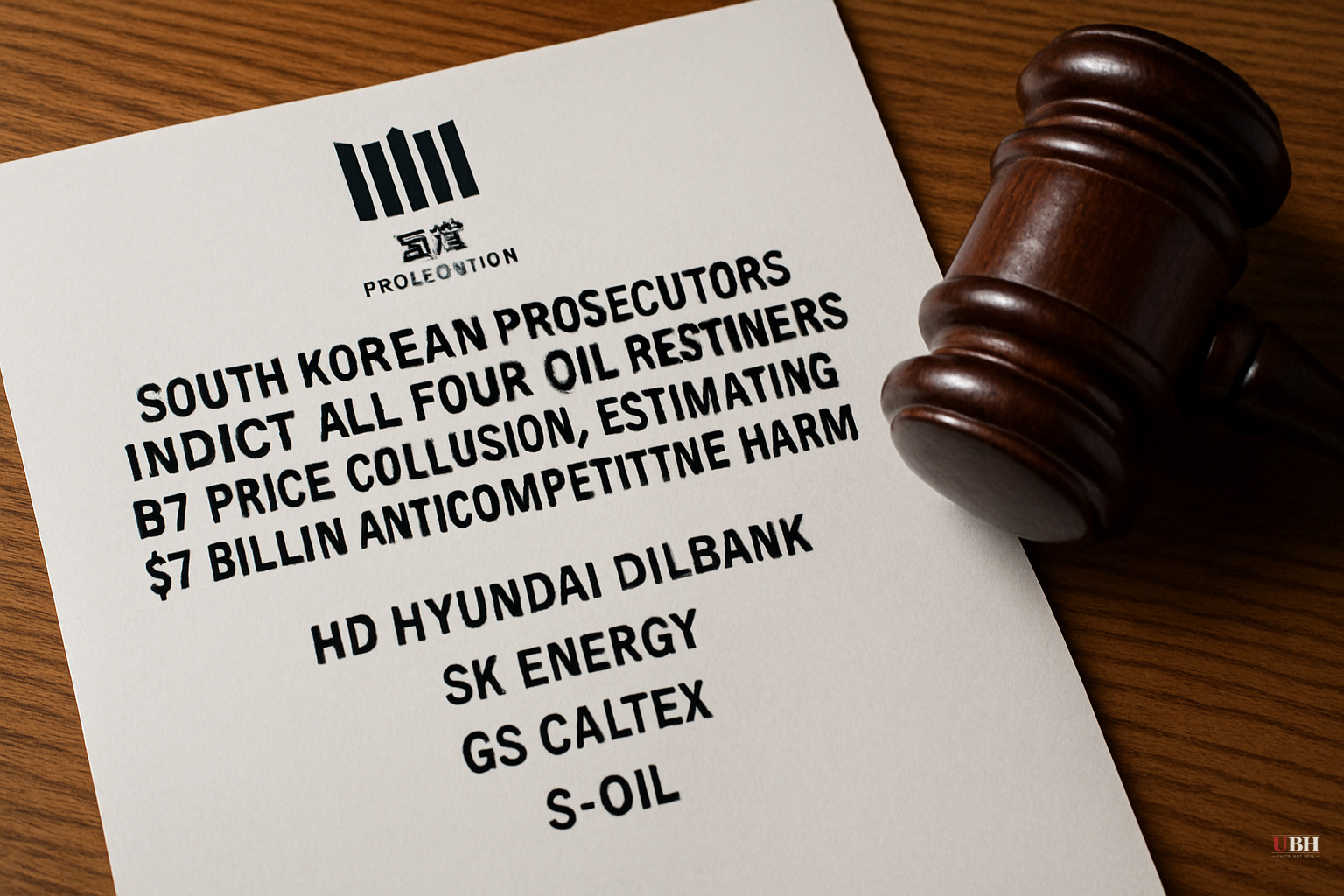
Since South Korea's Fair Trade Commission launched its investigation into domestic fuel pricing earlier this year, the case has escalated sharply. On Monday, the Seoul Central District Prosecutors' Office moved from regulatory inquiry to criminal indictment, charging all four of the country's major oil refiners under the Monopoly Regulation and Fair Trade Act.
What Prosecutors Are Alleging
According to Korea Herald, the alleged core of the scheme involves HD Hyundai Oilbank and SK Energy. Prosecutors say executives at the two companies exchanged pricing information from July 2024 through February 2026, then specifically agreed in March — shortly after a regional conflict involving Iran intensified — to sharply raise fuel prices in tandem. Under the arrangement described by prosecutors, SK Energy set its prices 30 to 40 won per liter above HD Hyundai Oilbank, allowing both to hike simultaneously while maintaining a predictable spread.
The direct anticompetitive impact from those two companies: 14.2 trillion won, or roughly $9.27 billion, according to the Seoul prosecutors' office as reported by Korea Herald. When GS Caltex and S-Oil are factored in, the total estimated harm reaches approximately 26 trillion won, around $17 billion.
Crucially, prosecutors said the refiners already held substantial crude oil reserves when the price hikes occurred. The conflict gave them cover. According to prosecutors, it was not the cause.
Who's Being Charged, and How
Four company officials were indicted alongside the firms. Korea Herald reports that HD Hyundai Oilbank's pricing division chief was indicted and arrested. Two other company officials and a GS Caltex domestic sales executive were indicted without detention.
Two more individuals face charges related to evidence destruction. Prosecutors allege HD Hyundai Oilbank's legal affairs chief deleted documents containing competitors' pricing data after learning in advance of an FTC on-site inspection.
GS Caltex and S-Oil were not accused of directly coordinating the price hike. Prosecutors described their conduct as "conscious parallelism" — following the leaders' prices without direct communication. According to Korea Herald, prosecutors acknowledged that conscious parallelism may not be punishable as price fixing under the Fair Trade Act without explicit evidence of collusion. The indictments against those two companies appear to rest on separate grounds.
All four refiners also face charges over exclusive purchasing contracts with gas stations running from January 2021 through June 2026. Prosecutors allege the companies used their market power to force stations to buy exclusively from them, threatening those that didn't with damages claims, cost recovery demands, or suspension of bonus card programs.
The Political Backdrop
South Korean President Lee Jae-myung had publicly set the table for this prosecution. In March, Lee warned on X that oil refiners engaged in price-fixing would be "held accountable," vowing to deploy all lawful measures against what he called unethical business practices, according to CNBC. His administration also had gas stations raided in connection with the investigation; some that kept prices low were publicly designated "good-hearted gas stations," according to AsiaOne.
South Korea imports 70 percent of its crude oil from the Middle East, per AsiaOne, which means any genuine supply shock from the regional conflict would carry real cost pressure. The refiners' strongest defense is exactly that: global energy disruption is a legitimate pricing signal, and executives making parallel pricing decisions during a period of geopolitical turmoil is not the same as criminal conspiracy. No refiner has yet entered a formal public defense on the merits, but S-Oil, SK Innovation, HD Hyundai Oilbank, and GS Caltex all declined to comment or could not be immediately reached, per CNBC and AsiaOne.
Prosecutors say that argument fails here because the companies were sitting on existing reserves when they moved prices, and because the information-sharing predated the conflict by more than a year.
Market Reaction
The stocks went up. S-Oil gained 6.08%, GS Holdings rose 6.99%, SK Innovation added 1.58%, and HD Hyundai climbed 1.21%, according to CNBC. It is not clear from the sources whether that reflects investor confidence in the companies' legal position or simply relief that the indictments targeted executives rather than calling for company breakups.
The Korea Fair Trade Commission separately raised the minimum penalty for collusion to at least 10 percent of sales tied to the violation, up from a floor of 0.5 percent previously, according to AsiaOne. That change in penalty structure will matter considerably when sentencing or fines are eventually calculated.
What Comes Next
The indictments move the case into South Korean courts. The arrested pricing division chief at HD Hyundai Oilbank faces detention while the trial proceeds. Whether prosecutors will be able to prove the March pricing agreement beyond the information-exchange evidence they've described — and whether the conscious-parallelism charges against GS Caltex and S-Oil can survive legal scrutiny under the Fair Trade Act — are the central unresolved questions this case will have to answer.
Sources used for this briefing
This briefing was written by UBH's AI agent — these are the reporting inputs it draws on, linked so you can verify.


