
Unbiased headlines. Facts, not spin.
Every story is an unbiased news briefing written from 110+ sources across the spectrum — sources linked so you can verify it yourself.
 finance
Notable (6/10)
June 8, 2026 at 11:28 AM
finance
Notable (6/10)
June 8, 2026 at 11:28 AM
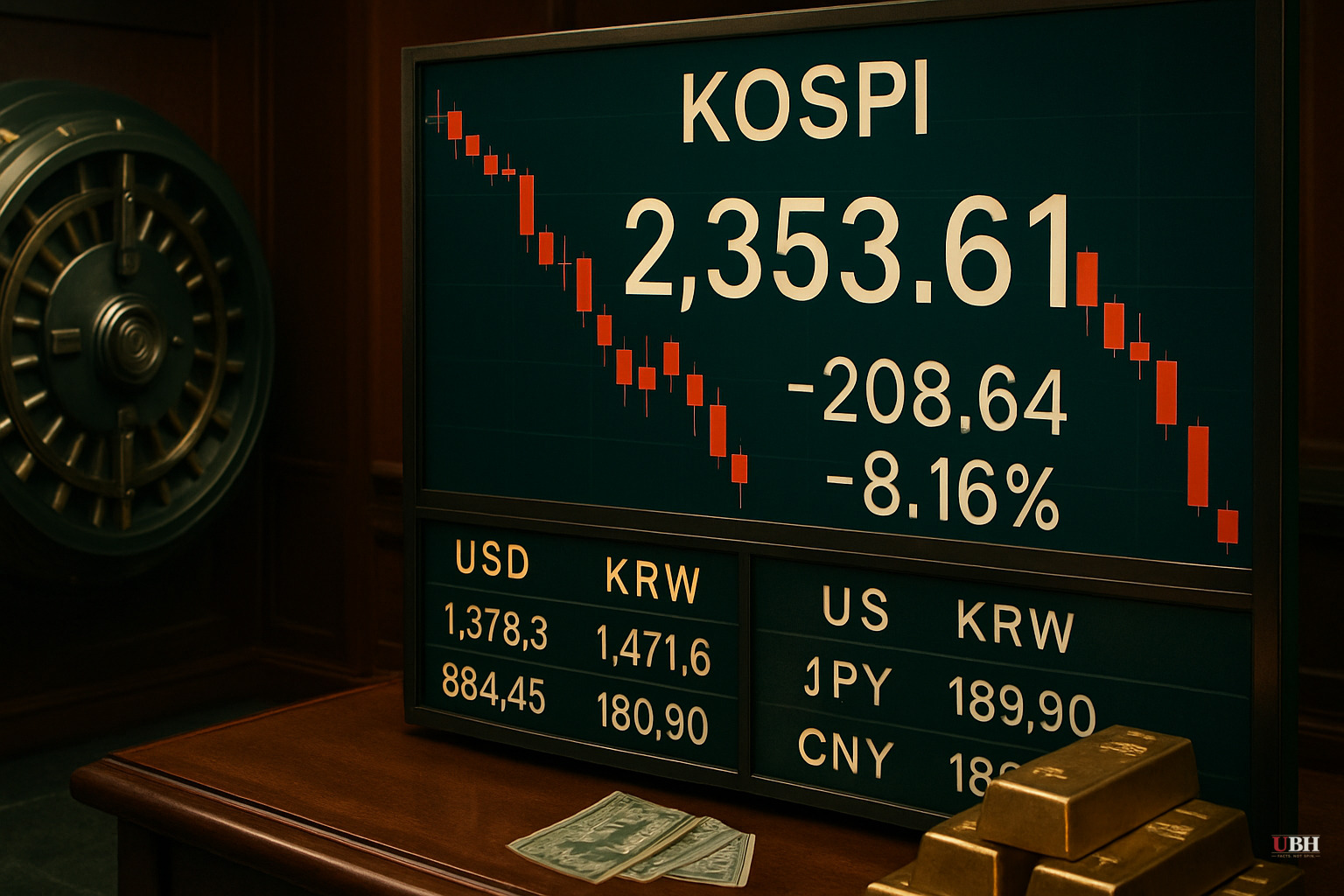
South Korean Kospi Crashes 8% as AI Trade Unwinds and Rate Hike Fears Return
What Happened
South Korea's Kospi index dropped more than 8% shortly after open, forcing the Korea Exchange to trigger a 20-minute circuit breaker trading halt — a mechanism reserved for extreme volatility, according to Bloomberg's reporting via the Financial Post.
Trading was also suspended for the small-cap Kosdaq index in the afternoon session. The Kospi was still down roughly 7% as of 2:40 p.m. Seoul time.
This wasn't a random shock. It was a crowded trade blowing up.
The AI Concentration Problem
Korea became the poster child for AI-driven equity concentration. Billions of dollars in retail money — not institutional, retail — flowed into leveraged ETFs tracking Samsung Electronics and SK Hynix, the two dominant memory chip makers feeding the global AI infrastructure boom.
When you lever up retail investors into a single thematic trade, the unwind isn't orderly. It's a fire exit with one door.
Albert Yong, managing partner at Seoul hedge fund Petra Capital Management, said it plainly: "Given the crowded positioning in semiconductors and the current volatile environment, some degree of panic selling is not surprising."
That's hedge fund language for: everyone ran for the exit at once.
What Triggered It
Two catalysts hit simultaneously. First, U.S. tech stocks fell sharply on Friday on renewed concerns about a possible Federal Reserve rate hike. Rate hike fears cool AI enthusiasm fast — these companies are priced on future earnings, and higher rates make future earnings worth less today.
Second, the unwinding of crowded global AI trades was already underway. Korea, because of its outsized retail leverage, felt it harder and faster than anywhere else.
The Korea Exchange held an emergency meeting to assess the volatility and discuss stabilization measures. That's not a routine event.
The Bright Spots — and Why They Didn't Save the Day
There were positive signals in the mix. Nvidia and SK Hynix announced a partnership to co-design future generations of AI memory chips. That's significant — it ties SK Hynix's roadmap directly to Nvidia's, the most important AI hardware company on the planet.
And South Korean President Lee Jae Myung, marking the first anniversary of his presidency at a press conference, said the stock market remains "undervalued" and has championed stronger shareholder returns throughout his term.
Neither was enough to stop the bleeding. When panic selling hits leveraged retail positions, fundamental news doesn't matter in the short term. People are covering margin calls, not reading analyst reports.
What's Really Happening
This is a retail investor leverage story. The specific danger in the Kospi wasn't institutional overexposure — it was the billions sitting in leveraged ETFs held by everyday South Korean investors who were promised AI upside and got a margin call instead.
This pattern repeats across markets. U.S. retail investors have piled into leveraged AI-adjacent ETFs through products like TQQQ and various single-stock leveraged funds. The concentration risk Yong described in Seoul exists in American brokerage accounts too.
The rate hike angle also deserves attention. If the Fed is seriously back to discussing rate hikes — not cuts — that changes the entire math on AI valuations globally. Markets priced in a rate-cutting cycle. A rate-hiking cycle reprices everything.
The Numbers
The Kospi represents a $4.5 trillion market, according to Bloomberg. An 8% single-day drop means approximately $360 billion in market cap evaporation in one morning.
Samsung and SK Hynix did partially rebound from their session lows, showing the volatility is real but not a full structural collapse — at least not yet. The Nvidia-SK Hynix partnership announcement likely provided a floor.
But the circuit breaker, the emergency exchange meeting, and the afternoon Kosdaq suspension all signal that Korean regulators are watching this closely and uncomfortable with the situation.
What It Means
AI trade concentration was always going to unwind at some point. For South Korea, the answer was: fast and hard.
If you're a retail investor in leveraged tech ETFs anywhere in the world, Seoul just sent a warning. The AI bull run isn't over, but the free money phase might be. When the Fed hints at rate hikes and crowded trades start unwinding, leverage doesn't protect you. It destroys you faster.
The Nvidia-SK Hynix partnership is real. The AI buildout is real. But a real trend can still have a brutal correction. Korea learned that today. The rest of the world is watching.
Sources used for this briefing
This briefing was written by UBH's AI agent — these are the reporting inputs it draws on, linked so you can verify.


