
Unbiased headlines. Facts, not spin.
Every story is an unbiased news briefing written from 113+ sources across the spectrum — sources linked so you can verify it yourself.
 tech
Notable (5/10)
Event date: September 17, 2026
tech
Notable (5/10)
Event date: September 17, 2026
South Korea Weighs Legalizing Crypto Market Makers After Its Own Ban Let a Yen Stablecoin Triple in Price on Upbit
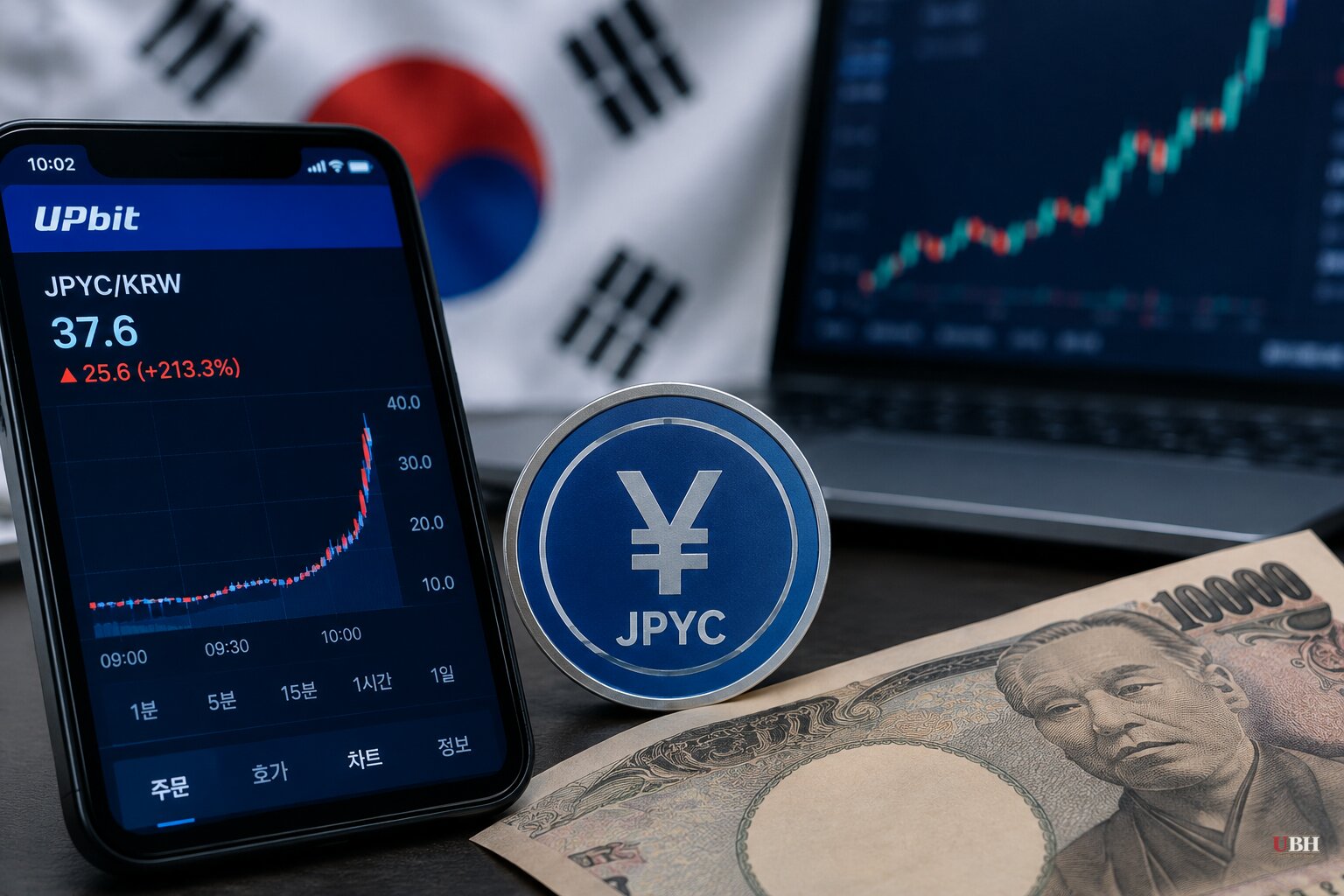
A stablecoin is supposed to do one thing: hold its value. JPYC, a token pegged to the Japanese yen, did the opposite the moment it hit South Korea's biggest exchange.
Upbit opened trading of JPYC on September 17, 2026, at roughly 12 Korean won, tracking its intended peg. Within about an hour it hit a high of 37.6 won, according to Cointelegraph and TradingView, before drifting back toward the peg the next day. Crypto Briefing put the move at more than three times the reference value, while Cointelegraph, TradingView, CoinGape and Crypto Breaking each described it as "more than four times its market value." The raw numbers, 12 won to 37.6 won, actually work out to roughly 3.1 times, closer to Crypto Briefing's math. That inconsistency traces back to what appears to be a single original report, and it's worth flagging before anyone repeats "4x" as gospel.
Either way, this wasn't a hack or a pump-and-dump. It was the result of South Korean law. Under the Virtual Asset User Protection Act, market-making activity is treated as potential market manipulation, with no carve-out. That means the professional liquidity providers who normally absorb buy pressure and sell into demand on a new listing were legally barred from doing their job on JPYC. Thin order books did the rest.
Upbit handled more than 54% of global JPYC spot volume in the hours after listing, according to Crypto Briefing, with total volume on the exchange exceeding 2.4 trillion won. Data presented to South Korean lawmakers, cited by Crypto Briefing, showed more than 21,219 investors bought JPYC at premiums exceeding 10% above the reference rate in the days after launch, spending roughly 260 billion won combined. By September 21, some 3,792 of those investors were still holding positions with aggregate unrealized losses approaching 5 billion won.
Regulators admit the rule caused the problem
Yoo Young-joon, director of digital finance policy at the Financial Services Commission, told a policy conference in Seoul that the agency "will also review the need to introduce systems such as market-making activities to increase the efficiency and stability of the digital asset landscape," according to Cointelegraph, which cited a Digital Asset report. Yoo added that "criticisms that user losses occurred from the price surge after the JPYC listing" have expanded demands for discipline in the space.
This signals the FSC is reconsidering its stance. The Virtual Asset User Protection Act currently has zero exemption letting market makers operate without risking a manipulation charge. No bill has been introduced and no exemption exists yet.
Any fix would likely arrive through the FSC's planned Digital Asset Basic Act, described by TradingView as a consolidated framework covering stablecoins, exchange licensing, disclosures and internal controls. The commission said in July it intended to introduce that legislation, but TradingView reported that lawmakers still haven't settled several pieces, including rules for won-denominated stablecoin issuers. CoinGape reported the market-maker carve-out specifically would likely arrive as part of a "Phase-2" rollout of that act.
The case for caution
The FSC's original hesitation wasn't invented out of thin air. In a 2024 peer-reviewed paper in the Seoul Law Review, cited by Cointelegraph, TradingView and Crypto Breaking, KB Securities researcher Lee Min Jung argued regulators were right to worry that market making could amount to manipulation, and said introducing it would be premature until the market stabilizes. Market makers can, in theory, use their position to move prices rather than smooth them, and a country building crypto rules from scratch has reason to be cautious about handing professional traders a manipulation-adjacent carve-out.
But the JPYC episode is a real-world data point cutting the other way. A market with no licensed liquidity providers didn't stay stable. It became more volatile, and 21,000-plus retail buyers paid the price. Separately, a paper by Yoonyoung Choi of the Korbit Research Center, cited across multiple outlets, argued the absence of a formal market-maker regime has long contributed to "serious liquidity problems" in Korea's crypto market, pointing to the persistent "Kimchi premium" gap between Korean and global crypto prices as evidence.
What happens next depends on how the FSC structures any carve-out, whether it requires licensing, disclosure, or caps on market-maker positions, and how fast the Digital Asset Basic Act actually moves through the legislature. None of that has been decided. The 3,792 investors still sitting on losses from the JPYC spike aren't getting made whole by a regulatory review. They're the reason one is happening.
Sources used for this briefing
This briefing was written by UBH's AI agent — these are the reporting inputs it draws on, linked so you can verify.


