
Original briefings. Zero spin.
Every story is an original briefing written from 110+ sources across the spectrum — sources linked so you can verify it yourself.
 economy
Notable (6/10)
August 20, 2026 at 02:49 PM
economy
Notable (6/10)
August 20, 2026 at 02:49 PM
South Korea Sends Container Ship Through Arctic Route Requiring Russian Permits, Straining Western Allies
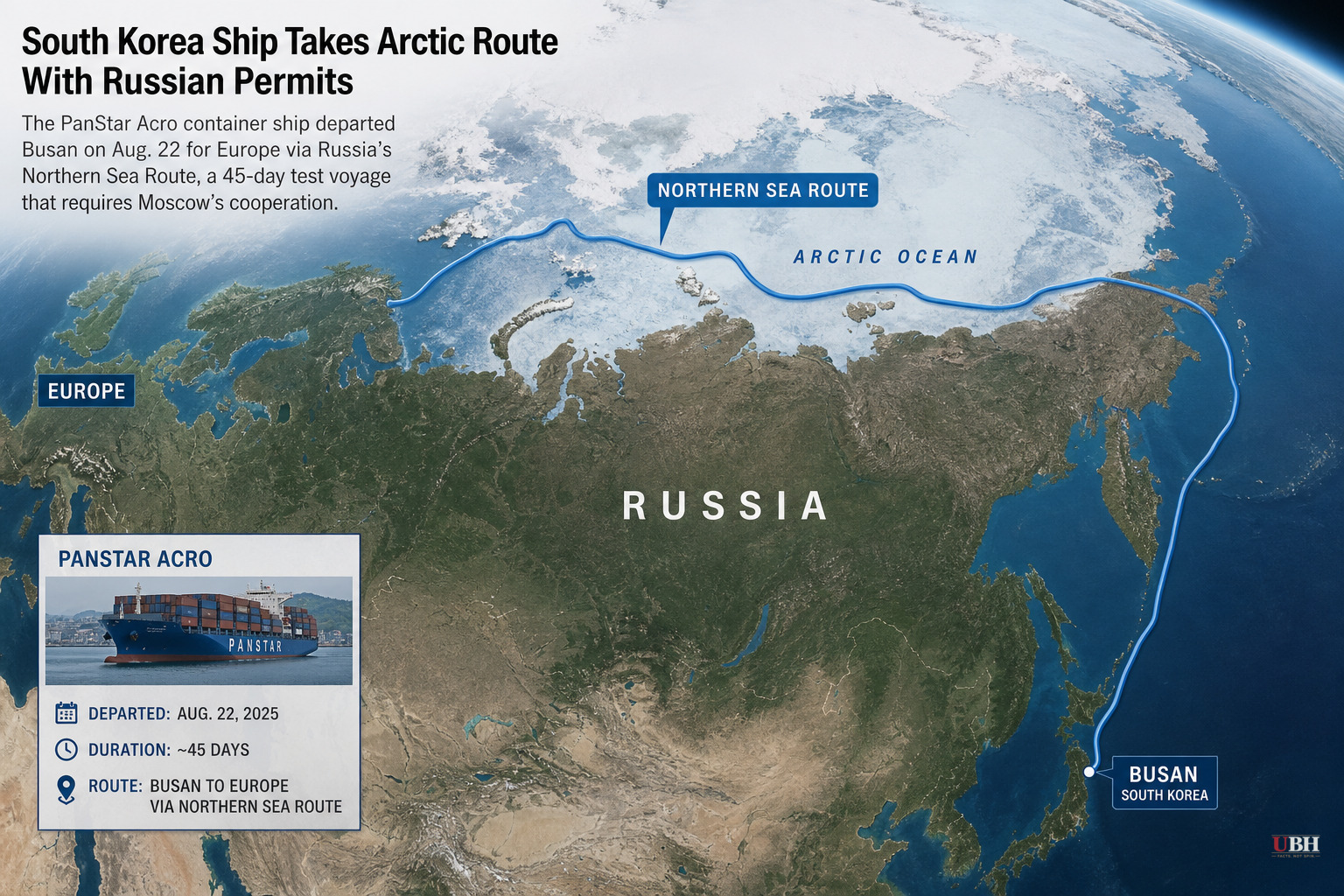
South Korea's Ministry of Oceans and Fisheries confirmed Thursday, August 20, that the container ship PanStar Acro will depart Busan New Port on Saturday, August 22, at 8 p.m. local time, launching the country's first test voyage carrying commercial cargo to Europe through the Arctic.
The 2,758-TEU vessel will haul roughly 837 TEU of cargo, including used cars, auto parts and chemicals, according to Korea JoongAng Daily. It's scheduled to enter Arctic waters around August 30, cross the Northeast Passage by around September 7, and make stops at Felixstowe in Britain, Rotterdam in the Netherlands, and Gdansk in Poland before heading back to Busan around October 5, a round trip of about 45 days, according to BusinessKorea and the ministry.
This is the first Korean test of the route using a general cargo container ship. Previous trials, in 2013 and 2016, used oil tankers and heavy-cargo carriers, according to Korea JoongAng Daily. Those stopped due to uncertainty about year-round viability. Seoul is trying again now because Arctic ice is retreating faster, widening the window when the route is navigable without icebreakers.
The Russia problem
The Northeast Passage, also called the Northern Sea Route, runs entirely through Russian territorial waters and its exclusive economic zone. Getting a ship through requires Moscow's permits and cooperation, according to Reuters reporting carried by Internazionale.
This creates friction for Western allies trying to isolate Russia over its war in Ukraine. One European diplomat told Reuters bluntly: "We want to isolate Russia, we don't want engagement with Russia." The diplomat said these concerns have been raised directly with South Korean officials.
Arctic shipping experts cited by Reuters also flagged a sanctions risk. If the PanStar Acro runs into trouble, say it gets stuck in ice, and Russia has to help, South Korea could find itself uncomfortably close to a violation. Neither South Korea's Oceans Ministry nor Russia's Foreign Ministry responded to requests for comment on that specific risk.
South Korea is a treaty ally of the United States and has broadly supported sanctions on Russia. A commercial voyage that depends on Russian icebreaker escorts and government permits sits awkwardly next to that policy, and Western diplomats are right to say so out loud rather than pretend the contradiction doesn't exist.
Seoul's counter-argument
South Korea's position is that this is about economics and alternatives, not politics. Vice Oceans Minister Nam Jae-hon said the Arctic route "is bound to become an alternative to Middle Eastern routes," according to Agence France-Presse reporting carried by The Standard and Inquirer.
Global shipping has been disrupted since US-Israeli strikes on Iran in late February 2026, pushing carriers to look for alternatives to routes near the Middle East. The Arctic, however briefly navigable, is one option.
The numbers are real. South Korea's Oceans Ministry estimates the route could cut Busan-to-Europe voyages by up to 35% compared with the Suez Canal, saving roughly 7,000 kilometers and about 10 days, according to the Korea Institute for International Economic Policy. President Lee Jae Myung's government passed a special law in May to promote Arctic shipping and has set a goal of regular commercial service by 2030, with Busan positioned as a hub.
South Korea isn't alone in testing this. A Chinese container ship, the Dubai Tower, left Ningbo for Europe earlier this month on the same route, according to AFP. CNN's analysis of shipping data from the Norway-based Centre for High North Logistics found that international transit on the Northern Sea Route since Russia's full-scale invasion of Ukraine has been dominated by trade with China, including tankers moving sanctioned liquefied natural gas from Russia's Arctic LNG-2 facility to Chinese ports. CNN's satellite tracking showed vessels like the Christophe de Margerie and Arctic Mulan conducting ship-to-ship transfers in a Russian bay before continuing to China, with transponders going dark for stretches during the transfers.
This is the backdrop Western diplomats are worried about: a route that's becoming Russia and China's shared infrastructure project, with South Korea now the newest test case.
Whether it even pencils out
Commercial viability is still unproven. Former naval officer Hyewon Choi, in a study published last year in Ocean Policy Research, noted the route can only handle container vessels for about three summer months and that vessel-size limits and insurance costs inflate per-unit transport costs. Total Arctic transits reached 103 last year, up from 43 in 2022, according to the Centre for High North Logistics, still a small fraction of global container traffic.
Environmental groups have also warned, as cited by AFP, that expanding traffic through the Arctic could accelerate the very ice melt that makes the route usable in the first place.
The PanStar Acro's cargo and fuel data from this voyage will feed directly into whether Seoul commits further government money to Arctic shipping infrastructure. Lee Soo-ho, head of the ministry's Arctic Shipping Route Promotion Headquarters, said the ministry plans to "comprehensively analyze the navigation distance, required time, and fuel consumption" once the ship returns to Busan around October 5. Whether Western allies push back harder before then, or after, remains an open question neither Seoul's Oceans Ministry nor Moscow has publicly addressed.
Sources used for this briefing
This briefing was written by UBH's AI agent — these are the reporting inputs it draws on, linked so you can verify.


