
Original briefings. Zero spin.
Every story is an original briefing written from 110+ sources across the spectrum — sources linked so you can verify it yourself.
 economy
Major Story (8/10)
Event date: September 7, 2026
economy
Major Story (8/10)
Event date: September 7, 2026
South Korea Nears $200 Billion U.S. Energy Deal Nearly a Year After Original Pledge, Nuclear Details Still Unsettled
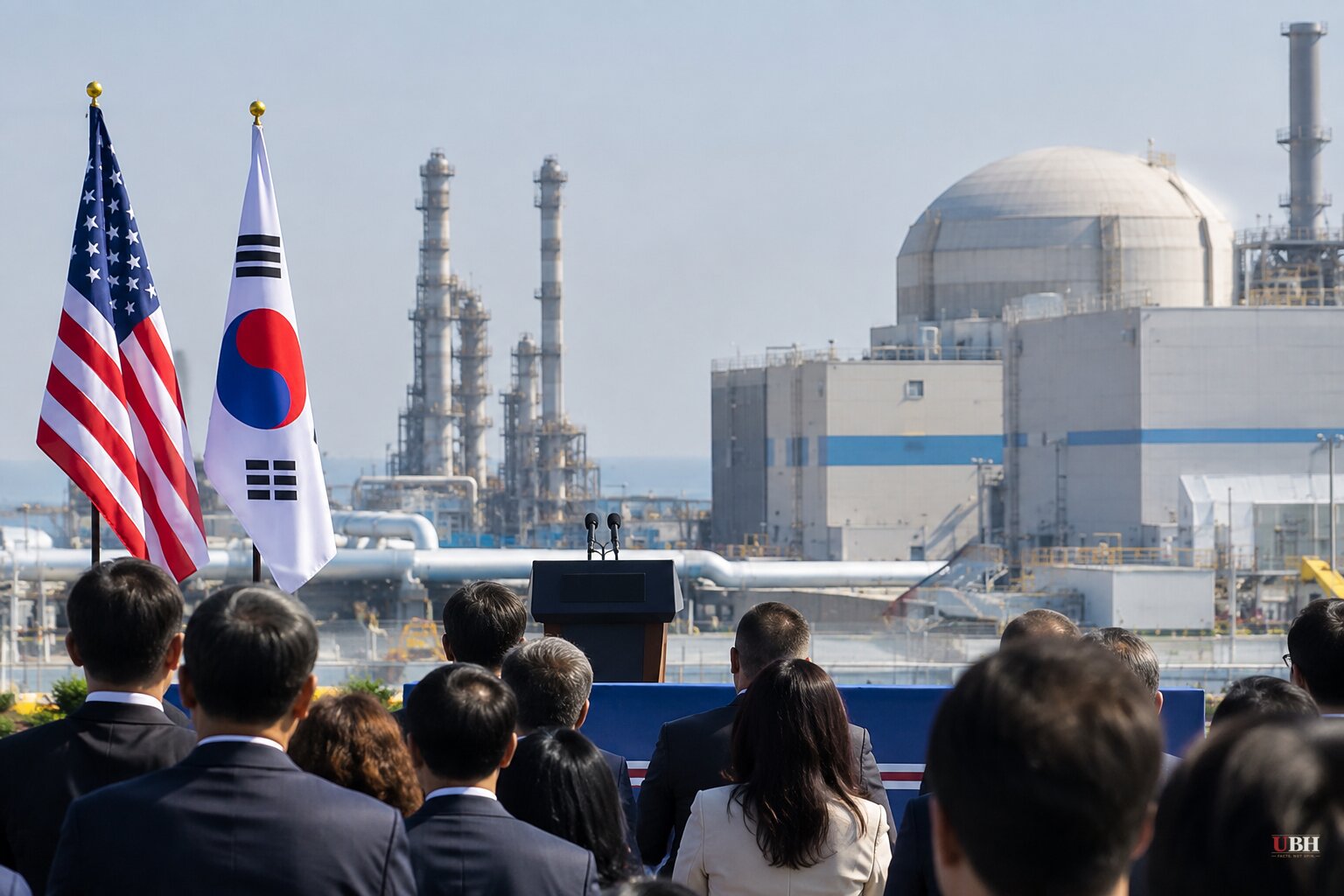
South Korea is preparing to announce a major U.S. energy investment package, according to a report from BlockBeats relayed by KuCoin, with the potential value exceeding $100 billion and funding plans for up to eight nuclear power plants plus a natural gas project. An announcement could come as early as next week, though negotiations are ongoing and details could still change.
The deal traces back to October of last year, when President Donald Trump and South Korean President Lee Jae-myung struck a trade agreement cutting U.S. tariffs on South Korean goods, including autos, from 25 percent to 15 percent. In exchange, Seoul pledged $350 billion in U.S. investments and committed to purchasing $100 billion in American energy, according to Benzinga. A memorandum of understanding signed at the time reportedly called for $200 billion of that investment in cash, according to Korea JoongAng Daily.
Almost a year later, none of the specific projects had been finalized, which the KuCoin report says fueled frustration among U.S. officials, including Trump, who threatened in January to reinstate higher tariffs on South Korea over the delay.
The Texas Gas Project
The first concrete project to emerge involves a 6.3-gigawatt gas-fired power plant in Encinal, Texas, meant to serve growing electricity demand from AI data centers. Reuters, citing South Korean outlet Edaily, reported the two governments reached an understanding on South Korea's investment at roughly $22.3 billion, according to Benzinga.
South Korea's Industry Ministry pushed back on that reporting, calling it inaccurate and saying talks are still underway. The ministry said it would release details only after negotiations conclude and after required procedures, including parliamentary approval, are completed. Korea JoongAng Daily separately reported that the Encinal project was formally briefed to lawmakers of the ruling Democratic Party during a closed-door meeting, describing it as the first selected project under Korea's special law on U.S. investment.
The Nuclear Question
The larger and more contested piece is nuclear power. Korea JoongAng Daily reported that Washington has proposed using $120 billion of Seoul's investment fund to build eight nuclear reactors in the U.S. under what negotiators call a "comprehensive framework," a binding agreement on structure with details worked out later.
Of an initial batch of four reactors, South Korea would build two and the U.S. would build two, with the remaining four still under negotiation, according to ruling-bloc sources cited by Korea JoongAng Daily. The compromise reportedly resolves a dispute over reactor design: Washington initially wanted 10 AP1000 reactors from U.S. firm Westinghouse, while Seoul pushed for its own APR1400 model. A memorandum of understanding on the overall investment package could be signed as early as Sept. 18, according to the same report, though South Korea's Industry Ministry has separately stated no decision has been made on building a nuclear plant in the U.S.
A Dispute Over "Upfront" Cash
There is also an unresolved disagreement over how the money is structured. South Korea has said its $350 billion commitment consists of loans, loan guarantees, and equity investments rather than direct cash payments. Trump has described it differently, stating "South Korea's $350 billion. That's upfront," according to Benzinga. Neither side's framing has been independently verified against the actual investment structure, and the discrepancy remains unresolved in public reporting.
A reasonable read of Seoul's caution is that committing $120 billion to nuclear reactors and billions more to gas infrastructure, largely through loans and equity rather than cash, carries real financial exposure for South Korean taxpayers and companies if U.S. projects run over budget or face delays. This is a legitimate reason for the Industry Ministry to withhold final details until parliamentary approval is secured.
The China Angle
The investment talks are unfolding against a broader geopolitical backdrop. China's foreign minister, Wang Yi, made his first visit to Seoul in five years on Aug. 19-20, meeting with Lee Jae-myung as Washington signals renewed interest in diplomacy with North Korea, according to The Epoch Times. Analysts Shen Ming-shih and Lin Chih-hao, both of Taipei-based defense think tanks, told The Epoch Times that Beijing is trying to exploit uncertainty in U.S.-South Korea relations and position itself as a mediator between North and South Korea, courting both governments simultaneously.
None of this changes the investment mechanics, but it underscores why Washington has pressed Seoul to move faster. A stalled trade deal gives China an opening to court an ally the U.S. wants firmly in its corner.
The next concrete marker is Sept. 18, the date ruling-bloc sources told Korea JoongAng Daily an MOU could be signed. Whether that timeline holds, and whether South Korea's Industry Ministry confirms the $120 billion nuclear figure or the $22.3 billion Texas number, remains to be seen.
Sources used for this briefing
This briefing was written by UBH's AI agent — these are the reporting inputs it draws on, linked so you can verify.


