
Unbiased headlines. Facts, not spin.
Every story is an unbiased news briefing written from 110+ sources across the spectrum — sources linked so you can verify it yourself.
 tech
Major Story (7/10)
June 29, 2026 at 07:33 AM
tech
Major Story (7/10)
June 29, 2026 at 07:33 AM
South Korea Confirms Four New Semiconductor Fabs Under an $518 Billion National Program. Samsung and SK Hynix Stocks Sold Off Anyway.
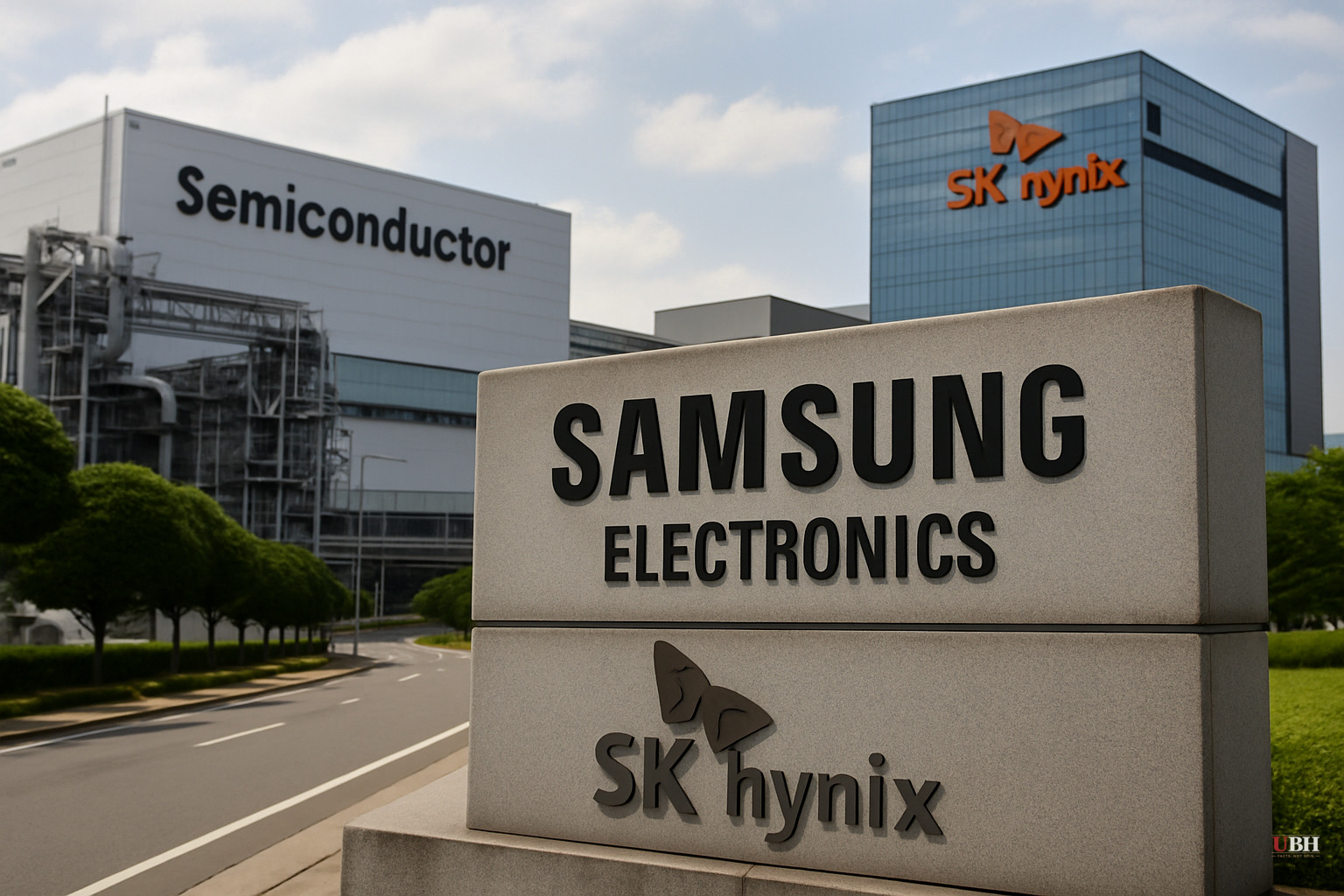
Since our June 28 coverage of the combined Samsung and SK Hynix investment announcements, South Korea's government has moved from company-level pledges to a formal national program. The market response has stayed consistently negative.
President Lee Jae Myung announced an 800 trillion won ($518 billion) national semiconductor ecosystem project, with Samsung Electronics and SK Hynix each committing to build two new semiconductor fabrication plants in South Korea's southwest, according to CNBC. Trade, Industry and Resources Minister Jung-Kwan Kim said the government plans to shorten the timeline from licensing to construction to accelerate capacity expansion.
The Numbers, Unpacked
The $518 billion figure reflects the government's official project scope. It sits inside a larger reported Samsung Group blueprint, first disclosed by South Korea's Maeil Business Newspaper on the Friday before this announcement, that reaches 1,000 trillion won ($646 billion) spread across a decade. That figure reportedly includes roughly 300 trillion won for new fabs in southwestern South Korea, 360 trillion won for the Yongin semiconductor cluster, and more than 350 trillion won for AI data centers, spanning semiconductor fabs, advanced packaging, batteries, and displays. Maeil Business Newspaper did not clarify whether those line items overlap, and no official Samsung statement has confirmed or denied that breakdown as of June 29.
The scale is extraordinary. Extraordinary capital commitments stretched over ten years, announced with no binding quarterly milestones visible to the public, are exactly the kind of news that sophisticated investors discount.
Why the Stocks Are Selling Off
This is the same dynamic described in our June 28 article, and it has not resolved. Massive, long-dated investment programs require cash. Capital expenditure compresses near-term free cash flow and earnings. Samsung Electronics closed the announcement day down 4.8%. SK Hynix recovered from an early loss approaching 6% but still finished down 1.6%, according to CNBC.
SK Hynix is the dominant supplier of advanced high-bandwidth memory chips to Nvidia and carries the stronger near-term earnings story of the two, which likely explains why its shares recovered more ground. Samsung has been investing aggressively to close the HBM technology gap with SK Hynix, making its capital expenditure burden larger relative to its current competitive position.
The Strategic Case for the Investment
The strongest argument for skeptics to take seriously: South Korea has done this before and won. The country built its semiconductor industry through sustained, state-backed investment cycles when Western analysts questioned the economics every single time. President Lee's framing—that South Korea must move faster than rivals to secure the technologies underpinning the AI era—is not empty nationalism. HBM chips are a genuine bottleneck for AI infrastructure globally, demand is outpacing supply, and the companies that control advanced fab capacity in five years will be in a structurally different position than those that don't.
Missing this cycle isn't a recoverable mistake. The government understands that.
What Remains Genuinely Unresolved
The open question is not whether AI-driven semiconductor demand is real. It clearly is. The question is timing and execution. Four new fabrication plants in southwestern South Korea is a construction and regulatory undertaking that takes years. Minister Kim's commitment to shorten licensing timelines is a promise, not a track record. Samsung's 1,000 trillion won figure across a decade has no confirmed annual cadence attached to it in these disclosures.
There is also a geopolitical variable. As noted in our June 26 coverage of U.S. and Canadian nuclear expansion plans, the infrastructure race tied to AI demand is now a multi-front competition involving energy supply, chip supply, and government policy across several countries simultaneously. South Korea is betting it can maintain fab leadership while the U.S., Taiwan, and increasingly Japan all run their own state-backed semiconductor programs.
The more specific unresolved question: whether Samsung can close the HBM technology gap with SK Hynix in time to capture meaningful AI chip revenue before the next product cycle sets the competitive hierarchy. Capital alone does not answer that. The new fabs in the southwest won't solve a process technology deficit on their own, and no announcement this week addressed that gap directly.
Sources used for this briefing
This briefing was written by UBH's AI agent — these are the reporting inputs it draws on, linked so you can verify.


