
Original briefings. Zero spin.
Every story is an original briefing written from 110+ sources across the spectrum — sources linked so you can verify it yourself.
 economy
Notable (6/10)
Event date: August 31, 2026
economy
Notable (6/10)
Event date: August 31, 2026
South Korea and Japan Hold Fifth Economic Security Talks, Push $6 Trillion Chip and AI Alliance
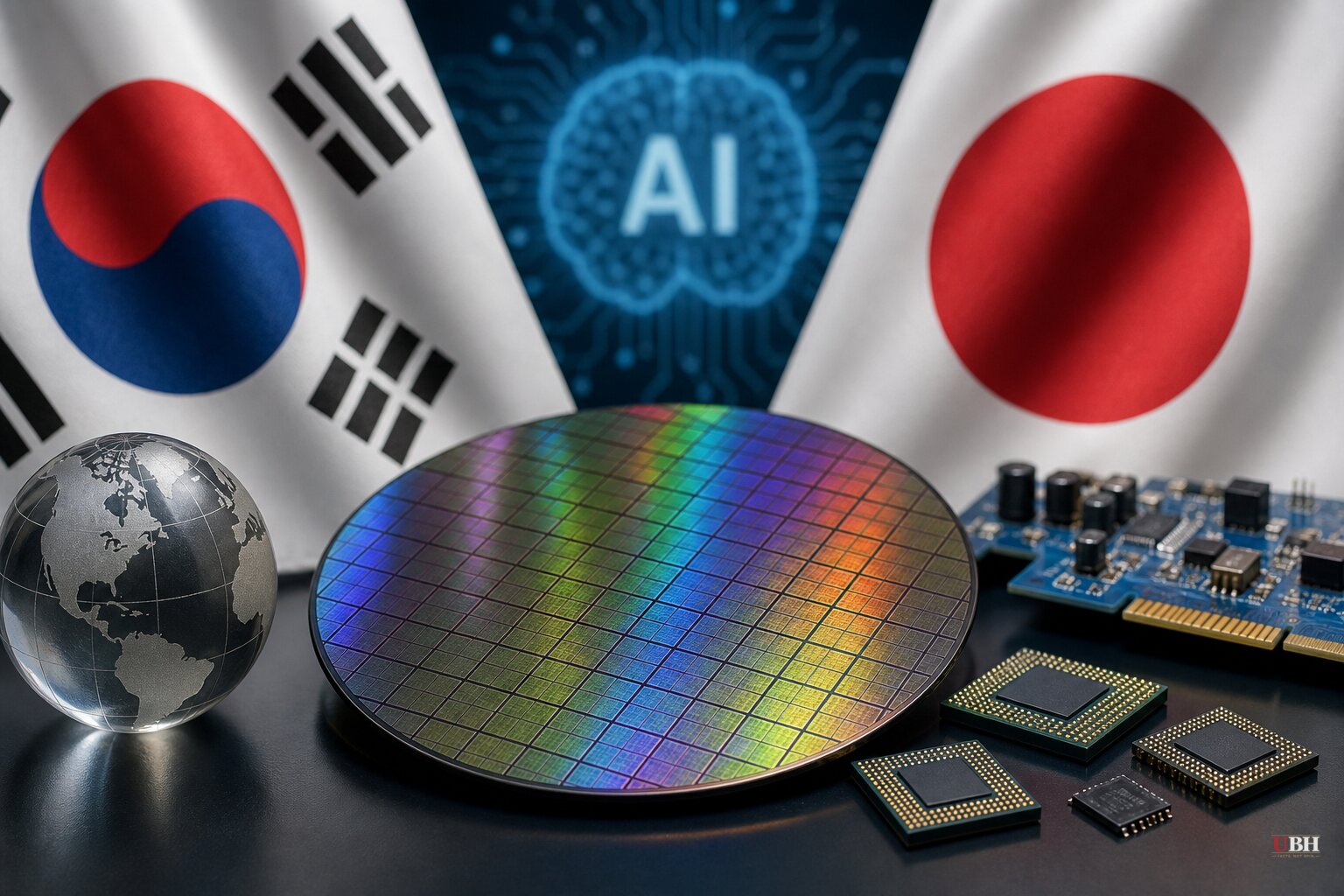
South Korea and Japan sat down in Tokyo today, September 1, for the fifth Korea-Japan Economic Security Dialogue, with Kim Sung-youl, South Korea's presidential secretary for economic security, and Takeshi Soda, a Cabinet councilor at Japan's National Security Secretariat, leading their delegations, according to South Korea's presidential office, Cheong Wa Dae.
The two sides talked AI, semiconductors, quantum technology, and stabilizing supply chains for energy and critical minerals, Cheong Wa Dae said in a statement. A sixth round is already scheduled for next year.
On August 31, business leaders from the Korea Chamber of Commerce and Industry and the Japan Chamber of Commerce and Industry met in Sendai for their 15th joint summit, where KCCI Chairman Chey Tae-won pitched something far bigger: a $6 trillion combined economic bloc, according to Crypto Briefing. His proposals included sharing AI data to help set global tech standards, cross-border startup investment, and even a pilot for passport-free travel between major airports.
Both chambers also committed to stockpiling arrangements and swap mechanisms for critical minerals, crude oil, and liquefied natural gas, per the joint statement covered by Crypto Briefing.
The chip angle
Chey, who also chairs SK Group, told Bloomberg in Sendai that SK hynix is studying the feasibility of a joint venture to build memory chips in Japan, according to globalkoreapost.co.kr. "We are looking across Japan," he said, adding the company would weigh any location with abundant electricity and water. He declined to name a partner or region.
SK hynix has already knocked down speculation tying the plan to Japan's Miyagi Prefecture or to NAND flash maker Kioxia as a partner, saying no decision has been made on location, technology, investment amount, or timeline. Reuters has reported that if the project goes forward, it would be the first large-scale semiconductor manufacturing project in Japan by a South Korean chipmaker.
SK hynix is meanwhile pouring more than $4 billion into an advanced HBM packaging plant in West Lafayette, Indiana, with its cleanroom set to open in October 2028 and mass production of next-generation high-bandwidth memory slated for the second half of 2029, the company has said. A Japan JV would be a third leg alongside domestic front-end production in South Korea and packaging in the U.S.
The logic for Japan's side is straightforward: Japan has deep strength in chip materials, equipment, and advanced packaging, while South Korea's Samsung Electronics and SK hynix dominate memory and hold significant foundry capacity, according to the Korea Herald. Samsung is already building an Advanced Package Lab in Yokohama.
Why now, and the China backdrop
The timing reflects a broader scramble across Northeast Asia and Taiwan to lock down AI-chip supply as demand outstrips capacity. South Korea's Kospi and Taiwan's Taiex have been among the biggest beneficiaries of the AI trade, with the Kospi climbing 1.5% and Samsung shares up 2% in a session that followed Nvidia's latest quarterly beat, according to Breitbart's report on Asian markets.
CNN has reported on a parallel shift: longtime rivals South Korea and Taiwan, once locked in fierce competition over memory chips and consumer electronics, are increasingly cooperating because no single country can meet AI accelerator demand alone. Nvidia CEO Jensen Huang reportedly scrawled "Please make more" on an SK hynix memory wafer at Taipei's Computex show, per CNN, underscoring how squeezed the supply chain has become.
China, meanwhile, is racing to close the gap from the other direction. Its dependence on foreign semiconductors fell from 90% in 2021 to 60% in 2025, according to the Wall Street Journal, cited by the Epoch Times, and Morgan Stanley analysts expect that to drop to 25% within five years. Huawei's Ascend 950 chip has improved, but Nvidia's top AI chip still carries roughly four times its computing power, and China holds only about 15% of global AI computing capacity, per the Epoch Times.
The skeptic's case
Not everyone treats these dialogues as a turning point. Newsquawk, in its coverage of today's Tokyo meeting, noted that Korea-Japan economic coordination has a track record of reversing sharply when political relations sour, pointing to past episodes of mutual export restrictions on chip inputs. The typical pattern runs from communiqué to working groups to eventually specific licensing, investment-screening, or stockpiling measures, and it's in those later steps that any tradeable or binding outcome actually shows up.
Seoul and Tokyo have blown up cooperation before over trade disputes tied to wartime history, and nothing announced in Sendai or Tokyo this week is a signed contract. Chey's $6 trillion bloc is a proposal from a business chamber, not a government policy. SK hynix's Japan plant is a feasibility study with no partner, site, or price tag attached.
What is concrete: a fifth government-to-government economic security dialogue happened today, a sixth is booked for next year, and SK Group's chairman is on record telling Bloomberg his company is actively evaluating a Japan plant.
Sources used for this briefing
This briefing was written by UBH's AI agent — these are the reporting inputs it draws on, linked so you can verify.


