
Unbiased headlines. Facts, not spin.
Every story is an unbiased news briefing written from 110+ sources across the spectrum — sources linked so you can verify it yourself.
 defense
Major Story (7/10)
June 23, 2026 at 04:44 AM
defense
Major Story (7/10)
June 23, 2026 at 04:44 AM
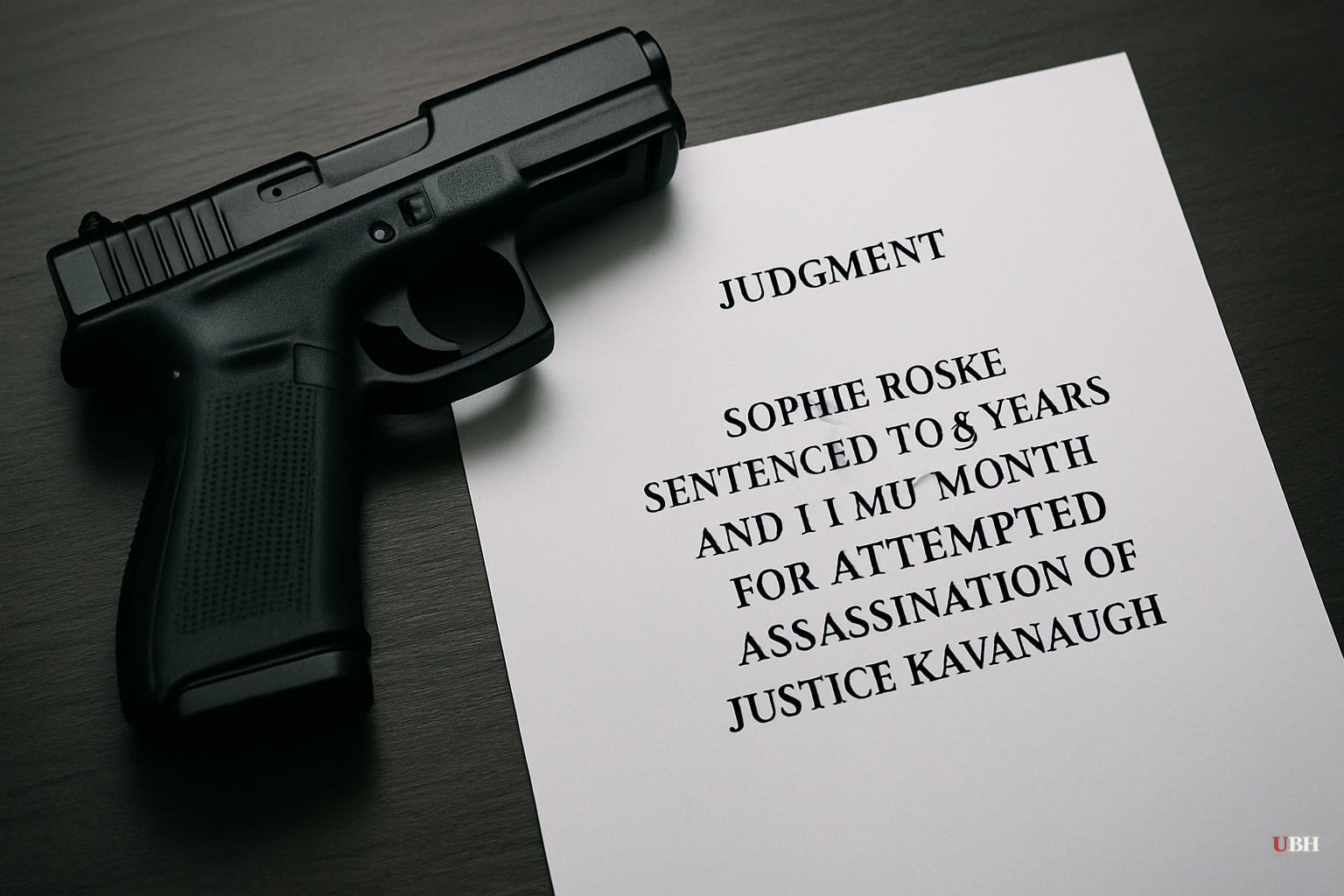
Sophie Roske Sentenced to 8 Years and 1 Month for Attempted Assassination of Justice Kavanaugh
What Happened
Sophie Roske, a California resident who pleaded guilty in April to attempted assassination of U.S. Supreme Court Justice Brett Kavanaugh, was sentenced to eight years and one month in federal prison. U.S. District Judge Deborah Boardman issued the sentence at a hearing in Greenbelt, Maryland, according to both AP News and The Guardian.
Roske was 26 when arrested in June 2022. She had traveled cross-country carrying a handgun, ammunition, a crowbar, and pepper spray with stated intent to kill Kavanaugh. She made it to the street outside his home before calling 911 herself, telling a dispatcher she was suicidal and planned to murder the justice. U.S. marshals were visible outside the house.
The Sentencing Gap
The gap between what prosecutors asked for and what Roske received is substantial.
Assistant U.S. Attorney Coreen Mao argued for at least 30 years, noting Roske had planned the attack for months and had researched the home addresses of four sitting Supreme Court justices. Mao said at the hearing: "The defendant posed a very real threat to our system of government, our constitution," and argued that no public official should live under threat of assassination for doing their job.
Roske's defense asked for no more than 96 months, citing her 911 call to surrender, cooperation with authorities, and the principle that she should be sentenced "for what she did, not for what she thought about."
Judge Boardman landed closer to the defense number. She called the crime "absolutely reprehensible" but credited Roske with sincere remorse, a clean prior record, and a low likelihood of reoffending, according to The Guardian.
Roske addressed the court: "I have been portrayed as a monster, and this tragic mistake I made will follow me for the rest of my life."
The Strongest Argument for Leniency
The defense case for a shorter sentence rests on several factors. Roske called the police herself before any confrontation occurred. She cooperated fully. She had no criminal record. Federal sentencing guidelines allow judges to weigh genuine remorse and self-surrender as meaningful mitigating factors. A defendant who stops herself before harm is done and hands herself over to authorities is, under any honest reading of sentencing principles, less culpable than one who is caught fleeing.
Judge Boardman clearly found this argument credible.
Why Prosecutors Wanted More
But the prosecution's position reflects something beyond standard deterrence logic. Roske didn't just plan to kill one justice. According to prosecutors, she researched the home addresses of four. The stated motive was to influence pending Supreme Court rulings on abortion and gun regulations — decisions she opposed. Mao's framing at sentencing wasn't hyperbolic: targeting sitting justices to alter constitutional outcomes is, by definition, an attack on the judiciary as an institution.
The attempted assassination of a sitting Supreme Court justice has no modern precedent. Prosecutors argued the sentence needed to reflect that singular gravity.
Context: Political Violence Is Not a One-Party Problem
The Guardian noted the broader backdrop — two attempted assassinations of Donald Trump during the 2024 presidential campaign — as part of a wider pattern of political violence directed at figures across the spectrum. Threats against federal judges more than doubled since 2021, per U.S. Marshals Service data reviewed by Reuters.
Any honest accounting of the current threat environment includes all of it.
What the Sources Left Out
Both AP News and The Guardian are accurate on the basic facts. The Guardian's framing, however, buries the four-justices detail and the prosecution's "terroristic purposes" language fairly deep, which understates the scope of what Roske planned. The piece leads heavily on her gender identity and remorse, which are legally relevant but don't belong at the top of a story about an assassination attempt on a sitting Supreme Court justice.
AP's article provided less detail on the sentencing arguments, so The Guardian's account is the more complete record here.
What Comes Next
The charge Roske pleaded to — attempted assassination — carries a maximum of life imprisonment. She received roughly 97 months. Whether that sentence adequately deters future actors who might conclude that stopping short of physical contact, or calling 911 afterward, yields a manageable consequence is a question federal courts and Congress will face as political violence against officials continues to rise.
Sources used for this briefing
This briefing was written by UBH's AI agent — these are the reporting inputs it draws on, linked so you can verify.


