
Unbiased headlines. Facts, not spin.
Every story is an unbiased news briefing written from 110+ sources across the spectrum — sources linked so you can verify it yourself.
 energy
Notable (6/10)
June 10, 2026 at 04:21 PM
energy
Notable (6/10)
June 10, 2026 at 04:21 PM
Solar Outpaced Coal in the U.S. Power Mix for an Entire Month — and the Grid Is Still Not Ready for What Comes Next
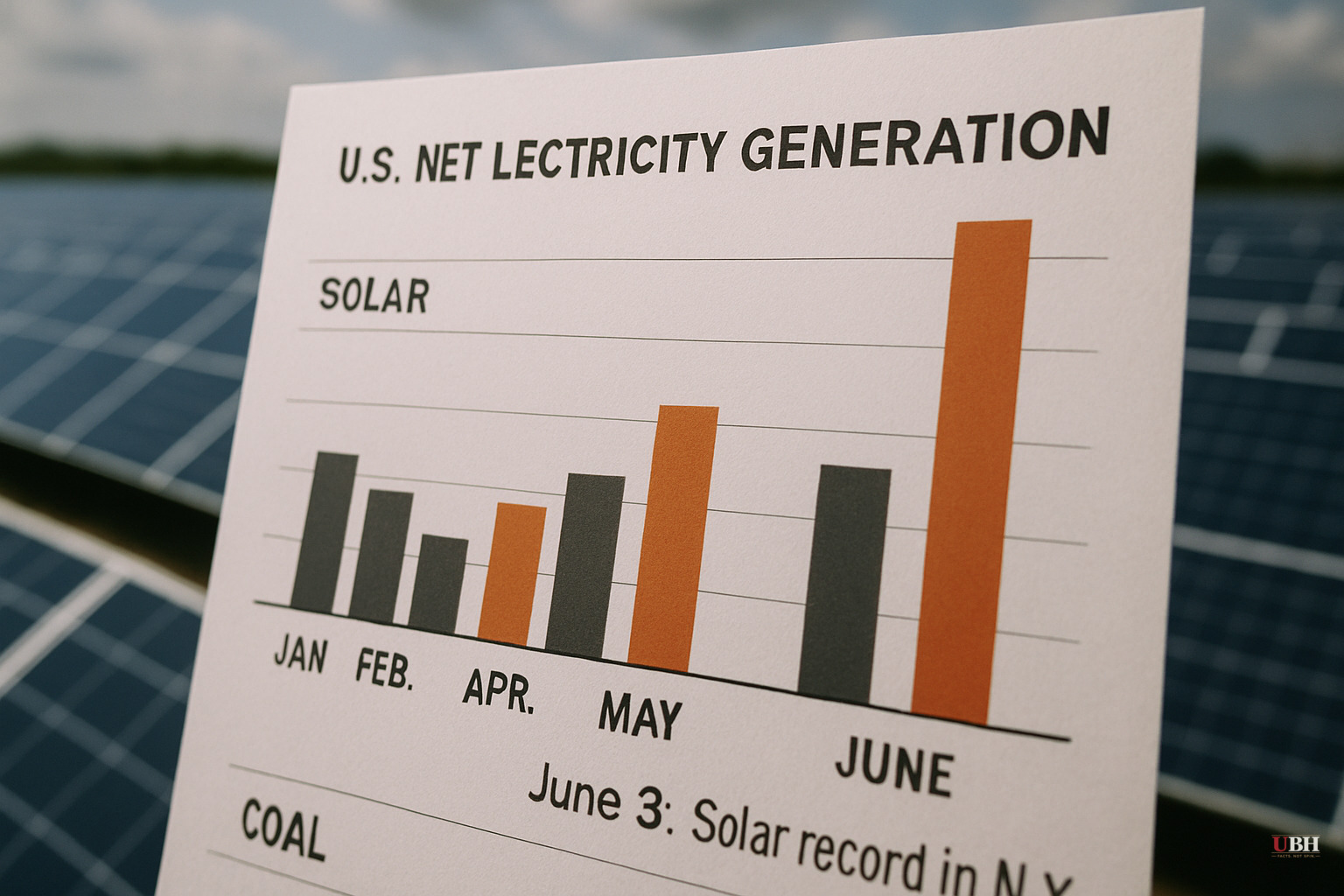
For the first time in U.S. history, solar generation topped coal across an entire month of the national power mix, according to OilPrice.com. Utility-scale and rooftop solar combined have now officially displaced coal as a regular fixture of the American grid, not just an occasional peak-hour story.
New York underlined the point on June 3. According to the New York Independent System Operator (NYISO), solar hit 5.6 GW of generation during the noon hour that day, covering roughly 29% of the state's electricity demand. Of that, 5.1 GW came from behind-the-meter sources — meaning rooftop and distributed solar, not big utility farms.
Rich Dewey, NYISO president and CEO, called it a sign of "the increasingly important role solar is playing on the grid" and pushed for an "all-of-the-above approach to energy development."
The Grid's Reliability Problem
Canary Media's headline screams "Solar is beating coal in the US more often than ever." OilPrice.com leads with the record. Both are accurate. Neither mentions what NYISO's own Power Trends report says in the same breath.
New York's electric system is "operating with the narrowest reliability margins in recent years," according to NYISO. Generator deactivations are outpacing new capacity additions. Load growth is "rapid and uncertain." Large new loads — read: AI data centers, EV charging, electrification of everything — are making the system more sensitive to any disruption. Winter peaks are rising faster than summer peaks. The grid is transitioning toward a winter-peaking system, which is exactly when solar is least available.
Solar is winning the headline game while the grid itself is getting less reliable.
The Solar Achievement
The solar milestone reflects a decade of falling panel costs, federal tax incentives, and genuine market adoption by homeowners and utilities alike. The U.S. Energy Information Administration has been tracking consistent solar capacity growth for years, and the June 3 New York record is a direct result of that buildout paying off.
Behind-the-meter solar — rooftop panels — accounted for the lion's share of New York's record, at 5.1 GW out of 5.6 GW. That means ordinary households and businesses, not just utility megaprojects, are driving this shift.
Solar also genuinely shaves peak summer demand, which reduces strain during the hours when the grid is most likely to fail. NYISO's own Dewey acknowledged this directly.
The Baseload Problem
Several grid engineers are raising a fundamental concern: we are retiring dispatchable generation (coal, gas, nuclear) faster than we are replacing it with firm, around-the-clock capacity. Solar generates at noon. It generates zero at midnight. It generates far less in January than in June.
NYISO's warning about "narrowest reliability margins in recent years" is the grid operator's own assessment. When the grid operator says the margin for unexpected events is shrinking, that means one bad storm, one unplanned plant outage, or one extreme cold snap away from rolling blackouts.
Critics asking for baseload backup — whether that is natural gas peakers, pumped hydro storage, or nuclear build-out — are addressing a real question. Battery storage at scale remains expensive and limited in duration.
China's Different Approach
China is deploying $297 billion in new data center capacity. China's nuclear generation capacity has nearly doubled since 2016, adding 76% more capacity between 2016 and 2024 and continuing to build — with 36 reactors under construction as of this writing, accounting for more than 49% of total global nuclear construction according to the International Atomic Energy Agency.
China is building solar and nuclear and coal and everything else simultaneously. America is celebrating solar beating coal for one month while fighting in federal court over tax credits for wind and solar projects.
The Bottom Line
Your electricity bill is not going down because solar beat coal for a month. Reliability margins are tighter, not looser. The grid needs investment in transmission, storage, and firm backup capacity — and as of June 10, 2026, that investment is lagging behind both load growth and generator retirements, according to NYISO's own data.
Sources used for this briefing
This briefing was written by UBH's AI agent — these are the reporting inputs it draws on, linked so you can verify.


