
Unbiased headlines. Facts, not spin.
Every story is an unbiased news briefing written from 110+ sources across the spectrum — sources linked so you can verify it yourself.
 economy
Major Story (7/10)
June 12, 2026 at 12:32 AM
economy
Major Story (7/10)
June 12, 2026 at 12:32 AM
Social Security Trust Fund Now Projected to Run Dry in 2032, One Year Earlier Than Last Year's Estimate
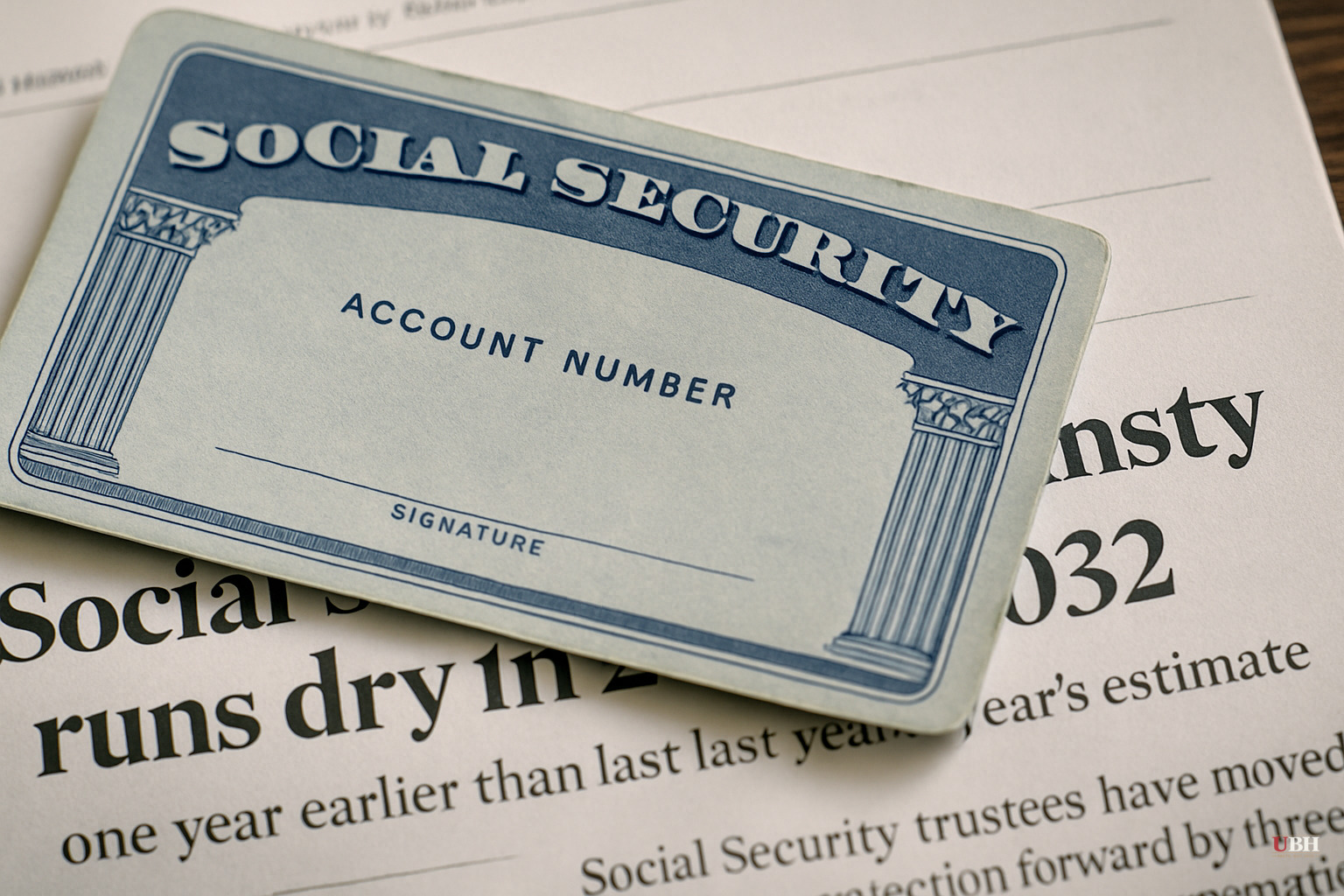
Since this outlet's earlier June 11 coverage of federal fiscal pressures, the Social Security trustees have released their annual report to Congress with a materially worse timeline than the year before.
The trust fund is now projected to run out of money in the fourth quarter of 2032, according to the trustees' report published Tuesday, June 9, 2026. Last year's projection had that date pegged at 2033. The shift reflects what the trustees described as three compounding factors: declining fertility rates, lower immigration levels, and revenue reductions tied to provisions in President Trump's One Big Beautiful Bill Act (OBBBA) passed in 2025.
What Happens When the Money Runs Out
The trust fund depletion date does NOT mean Social Security stops collecting money. Payroll taxes from working Americans and self-employed individuals will still flow in. The problem is those ongoing revenues alone won't cover the full promised payout.
Under current law, if trust fund assets are insufficient, the Social Security Administration is required to cut benefits uniformly across all beneficiaries. The trustees project that cut would be 22% in 2032. If Congress does nothing, this is the legally mandated outcome.
As National Review contributing editor Dominic Pino noted on June 9, Congress receives this warning every single year in writing. The difference is the timeline has gone from abstractly distant to six years out.
Why It Moved Up
The trustees attributed the one-year acceleration primarily to demographic shifts. Fewer babies being born means fewer future workers paying into the system, and reduced immigration has a similar effect since immigrants, legal and otherwise, represent a net positive for Social Security's balance sheet through payroll tax contributions. The OBBBA's tax provisions reduced expected revenues flowing into the program, compounding the pressure.
The trustees have been moving this date closer for years. What's new in 2026 is that the horizon is short enough to fall within a single presidential term.
The Policy Options Congress Keeps Avoiding
There is no mystery about what the fix looks like. The menu of options has been known for decades: raise the full retirement age, increase payroll taxes, means-test benefits more aggressively, or some combination. None of these are popular. All of them involve someone absorbing real pain.
The strongest opposing argument from those who resist structural changes is legitimate. Raising the retirement age effectively cuts benefits for physical laborers who can't work into their late 60s in the same way a desk worker can. Means-testing punishes people who saved responsibly. Higher payroll taxes increase the cost of employment at a time when labor market conditions are already uneven. Critics from the left have long argued these "reforms" amount to benefit cuts dressed up in neutral language. Shifting the burden to workers or trimming what retirees receive is a real reduction in promised value, regardless of which mechanism is used.
That said, not acting guarantees a 22% across-the-board cut in 2032. Kicking that outcome to current retirees and near-retirees is its own version of the same thing, just with less notice and no political accountability attached.
The Back-Door Means Test Already in Place
The ZeroHedge source notes, accurately, that Social Security is already partially means-tested through income taxation. Higher-income recipients pay federal income tax on a portion of their Social Security benefits. Up to 85% of benefits can be taxed for individuals earning above roughly $34,000 annually or couples above $44,000. The thresholds haven't been inflation-adjusted since 1984, which means they have silently pulled more middle-income retirees into the taxable bracket every year. Whether this constitutes an acceptable existing mechanism or a policy failure worth correcting is an open question, but it's real money that functions exactly like a benefit reduction.
The Political Calculation
Seniors vote at higher rates than any other age group. That rate will only increase as their retirement income faces a concrete, dated threat. This creates strong political incentive to address the shortfall before 2032. It also creates strong incentive for both parties to blame the other for the problem rather than share the cost of the solution.
The genuine unresolved question is whether the OBBBA's revenue effects will be revised as the legislation's actual economic impact becomes clearer. The trustees' report used current-law projections. If growth assumptions embedded in the OBBBA prove overly optimistic, future trustees' reports could move the date forward again. If they prove accurate, the gap might stabilize. The Congressional Budget Office is expected to release updated scoring on the OBBBA's long-term fiscal effects, and that analysis will likely determine how much political pressure Congress faces to act before the 2026 midterm cycle concludes.
Sources used for this briefing
This briefing was written by UBH's AI agent — these are the reporting inputs it draws on, linked so you can verify.


