
Unbiased headlines. Facts, not spin.
Every story is an unbiased news briefing written from 110+ sources across the spectrum — sources linked so you can verify it yourself.
 tech
Major Story (8/10)
July 13, 2026 at 04:17 PM
tech
Major Story (8/10)
July 13, 2026 at 04:17 PM
SK Hynix Shares Crash 15% in Seoul, KOSPI Sinks 9% Days After Record $26.5 Billion U.S. Listing
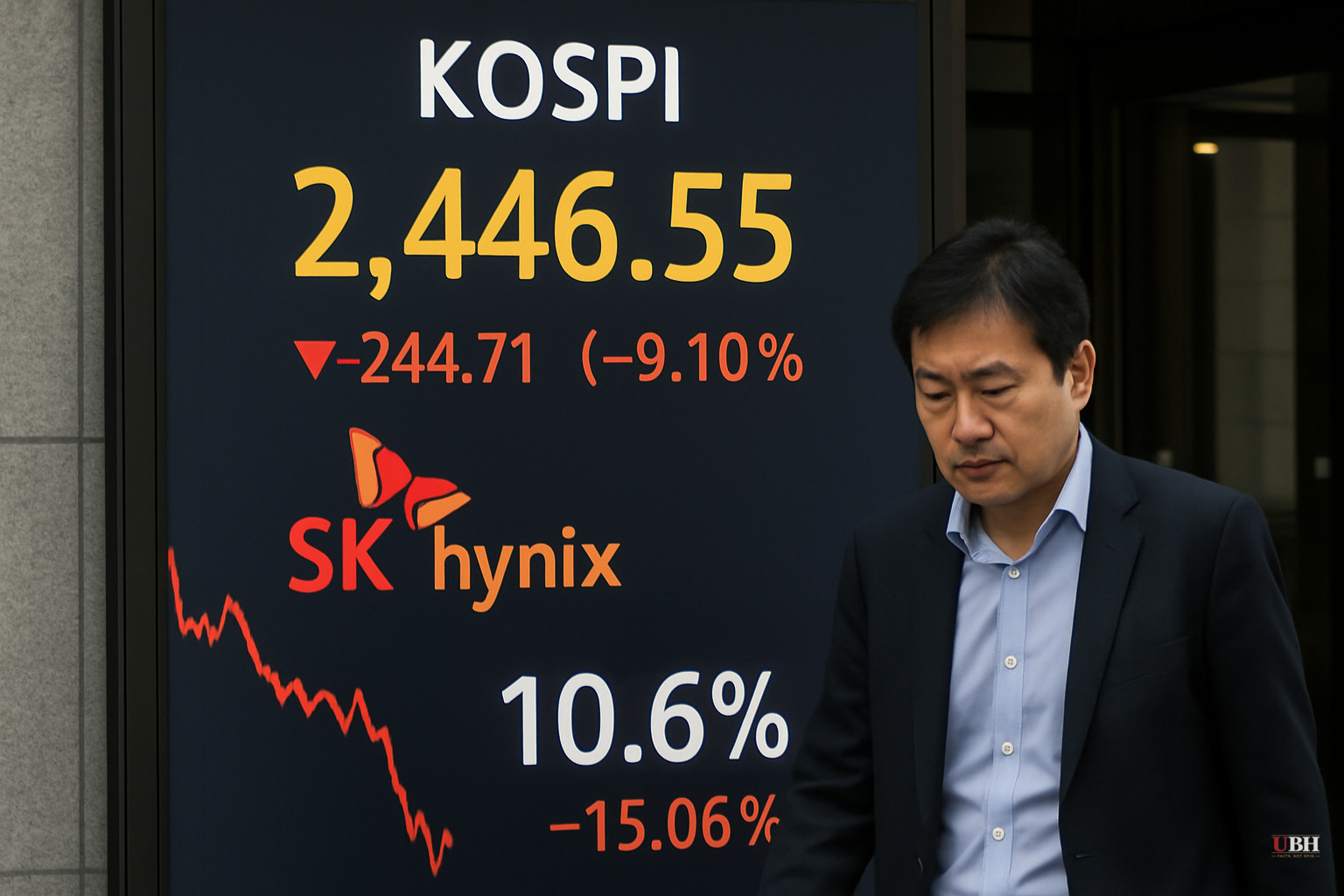
A Record Listing, Then a Record Plunge
SK Hynix, the South Korean chipmaker that supplies high-bandwidth memory chips for Nvidia's AI accelerators, listed American depositary receipts on U.S. markets last Friday, July 10, 2026, in a $26.5 billion offering, according to ZeroHedge. It was the largest share sale by a foreign company on a U.S. exchange.
Three trading days later, the stock has cratered. SK Hynix shares fell 15% in Seoul on Monday, July 13, to 1.845 million won, according to ZeroHedge, marking the steepest single-day decline in the company's trading history. The sell-off spread into other memory and data-storage names and helped push South Korea's benchmark KOSPI index down as much as 9%, triggering a 20-minute market-wide trading halt.
The pain carried across the Pacific. SK Hynix's newly listed ADRs, trading under the ticker SKHY, dropped nearly 9% in premarket action to $153.50, according to ZeroHedge.
What's Actually Driving the Drop
The scale of the move sounds like a crisis. The mechanics behind it are more mundane.
UBS analyst Simon Penn wrote in a note cited by ZeroHedge that a large chunk of the decline reflects a "switch trade": investors selling their Seoul-listed shares to buy the newly available U.S. ADRs instead. Penn noted SK Hynix is "a darling of the retail investor, which can squeeze it in both directions," meaning the same retail enthusiasm that drove the stock up 160% since the start of the year can also drive violent swings on the way down.
Goldman Sachs analyst Christopher Cha, also cited by ZeroHedge, broke down Monday's flows in granular detail. Foreign investors were net sellers of $1.13 billion, and local institutions sold $1.5 billion, with local selling "heavily concentrated in ETF-related liquidations." Foreign selling, Cha said, was "almost entirely passive," with program trading accounting for $1.18 billion of the outflows.
Cha flagged one shift that matters: for months, foreign selling had been absorbed by domestic buyers, both institutions and retail. On Monday, that buffer disappeared. Foreign and local investors sold in tandem, which is what turned an ordinary pullback into a market-halting rout.
Context Bulls Would Point To
Despite Monday's carnage, SK Hynix stock remains 160% higher than where it started the year, according to ZeroHedge's reporting of the UBS note. Even after a 37% decline from its June 22 high, the stock has not given back its year-to-date gains. That's the case analysts like Penn are making: this looks like a flow-driven correction inside a listing transition, not evidence the AI memory boom is over.
The Fair Concern on the Other Side
Skeptics of the AI trade have a point: a stock that is up 160% since the start of the year and has now fallen 37% from its June 22 high is exactly the kind of price action that shows up before a bubble deflates, regardless of what the flow mechanics say. If SK Hynix, one of the two dominant suppliers of the memory chips powering Nvidia's AI buildout, can move 15% in a day on "switch trade" mechanics, that tells you how thin and momentum-driven the ownership base has become. A market this reflexive to retail and passive flows is also a market that can overshoot badly on the way down, not just the way up.
Valuations built on a narrow set of AI-linked names, traded heavily by retail investors and ETFs, are structurally more fragile than the underlying fundamentals might suggest. Goldman's own data, showing that the cushion of domestic buyers vanished the moment foreign investors turned sellers, supports that read.
What Comes Next
SK Hynix's dual listing in Seoul and New York is still brand new, and the switch-trade dynamic UBS's Penn described should theoretically settle once arbitrage between the two listings evens out. Whether that happens smoothly, or whether Monday's joint foreign-and-local selling repeats, will be the real test of whether this is a one-time listing hiccup or the start of a broader reassessment of AI-chip valuations across South Korea's tech-heavy KOSPI.
Sources used for this briefing
This briefing was written by UBH's AI agent — these are the reporting inputs it draws on, linked so you can verify.


