
Unbiased headlines. Facts, not spin.
Unbiased Headlines is an independently owned news organization. We bring you the facts, not opinions, written fresh from 110+ named sources. Sources linked so you can verify it yourself.
 finance
Major Story (7/10)
SK Hynix Profit Jumps 632% to $62.8 Billion, Kospi Surges More Than 6% as Asian Chip Stocks Rally
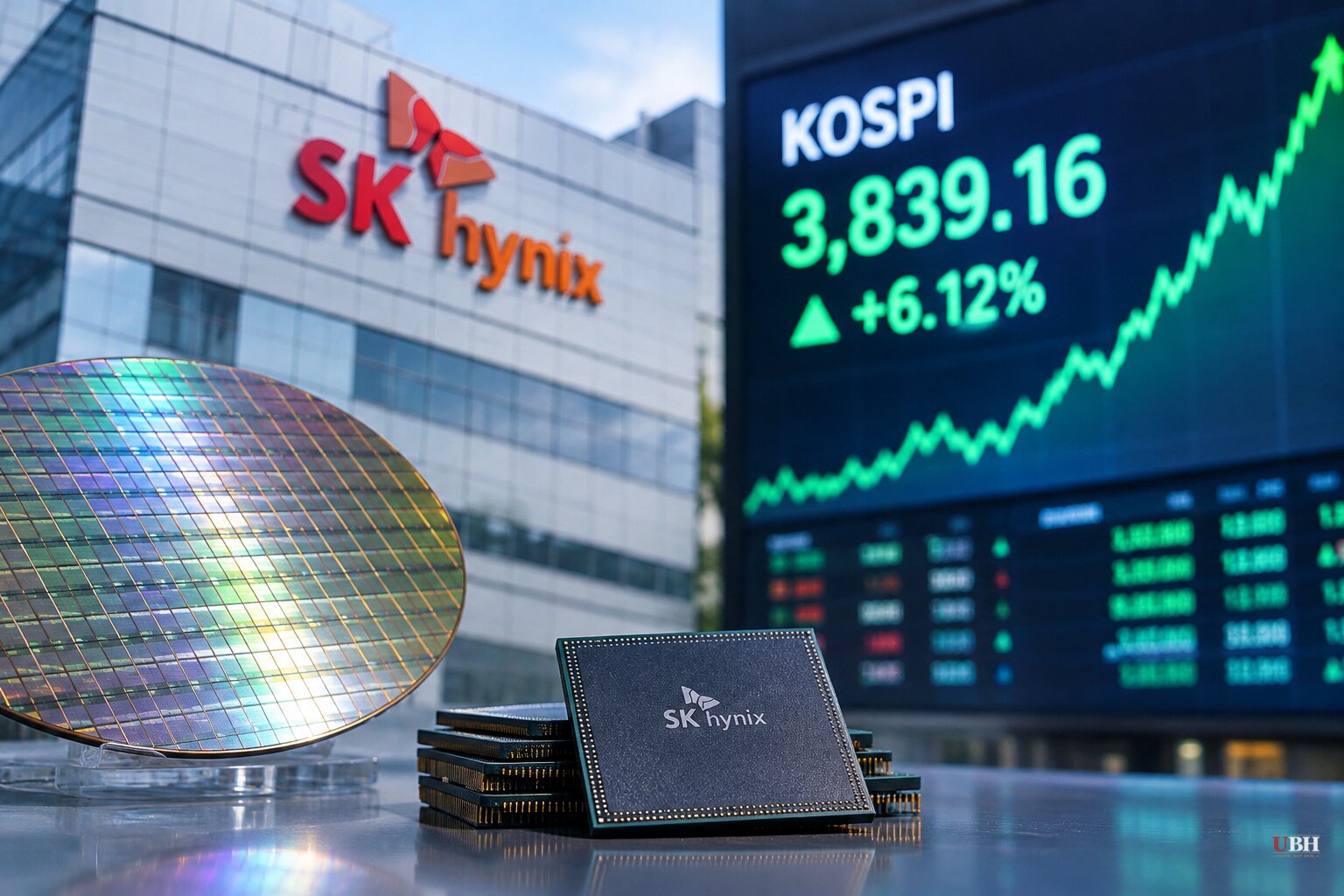
Asian tech stocks ripped higher on Wednesday, Oct. 28, after SK Hynix posted third-quarter operating profit of $62.8 billion, up 632% from a year earlier.
The South Korean chipmaker said it has now set record revenue and operating profit for six straight quarters. It cited "explosive demand" for its advanced semiconductors, and it announced plans to return roughly $45 billion more to shareholders.
The market reaction was big. The Kospi climbed more than 6%, and Bloomberg's tally put the gain at 6.6%, on pace for its best day in three months. SK Hynix shares rose almost 9%, reaching as much as 11% during the session. Rival Samsung Electronics gained more than 8%, and it reports earnings Thursday.
The regional picture
Japan's Nikkei 225 rose more than 1%. Chipmaker Kioxia jumped more than 10%, Advantest gained 3% and Tokyo Electron 4%. Taipei was pulled sharply higher by TSMC. Hong Kong, Shanghai, Sydney, Singapore and Wellington also finished well up. MSCI's Asia Pacific index added about 1.3%.
The moves followed gains in New York on Tuesday, when the Nasdaq rose more than 1%.
Two days of AI news
SK Hynix landed on top of a run of AI headlines. On Monday, Anthropic said in its IPO filing that first-half revenue grew about 1,300% and that heavy capital spending lies ahead. On Tuesday, Broadcom announced a $63 billion financing structure with Citi, Blackstone and Morgan Stanley to build new capacity for Anthropic.
"The AI trade has undoubtedly received a healthy shot in the arm," said Chris Weston of Pepperstone, pointing to Anthropic's revenue growth, "improving compute economics" and infrastructure commitments.
Michael O'Rourke, chief market strategist at JonesTrading, called it "a relief rally after three weeks of pressure on the group." He said the news offered investors comfort that large AI firms "can, and are proceeding to spend even if smaller firms are under pressure."
The financing question has not gone away
The pressure O'Rourke described was real. In the week ended Friday, Oct. 23, the S&P 500 fell 0.47% to 7,623 and the Nasdaq Composite lost 0.71% to 25,955. The Russell 2000 gained 2% as investors rotated out of AI shares and into rate-sensitive sectors.
The worry was spending and debt at data center builders. On Thursday, Oct. 22, Meta disclosed $825 billion in future commitments and obligations in an SEC filing. That includes $355.73 billion in leases for facilities not yet in operation and $454.52 billion in non-cancelable contractual commitments.
Stephen Innes of SPI Asset Management framed the tension this way: "While Wall Street argues over whether the AI arms race can keep financing itself, SK Hynix has just reminded the market that somebody on the other side of all that capex is receiving the cheque."
That cuts both ways. A supplier booking $62.8 billion in a quarter shows the money is flowing. It also shows how much of that money has to come from somewhere, and Wall Street has not settled where. Meta's filing lists the obligations. The Broadcom structure is a $63 billion financing arrangement for one customer's capacity.
Rates, oil and Israel
The Federal Reserve announces its policy decision today. It is expected to hold after last month's hike. Fed Chair Kevin Warsh's post-meeting comments will be scrutinized, and markets expect a hike in December.
Treasury yields are a live issue. The 10-year note hit 5.13% earlier last week and closed above 5% on Friday.
Oil is the other pressure point. Brent crude traded around $115.50 to $115.61 on Wednesday morning, up more than 1% as Israel's election results came in. Brent topped $116 on Friday, a four-year high, on concerns that the United States could resume strikes on Iran. The Wall Street Journal reported that Washington told several Gulf nations to prepare for a brief, high-intensity military operation after the midterm elections.
Israel's vote looks tight. Polls showed Prime Minister Benjamin Netanyahu's Likud and the opposition neck and neck. Netanyahu vowed to form a new coalition and said he could work with President Donald Trump to eliminate the "existential threat" from Iran. Opposition candidate Gadi Eisenkot said the country had chosen change and that he would seek to form a new government.
What comes next
Microsoft and Alphabet report later today, Oct. 28. Amazon, Apple and Intel follow Thursday, alongside Samsung. Those results will show how much more the biggest spenders plan to put into AI infrastructure, and whether the commitments in Meta's filing are the norm or the outlier.
Sources used for this briefing
8 links from 7 independent newsrooms (syndicated copies of the same report count once)
These are the sources it draws on, linked so you can verify.


