
Unbiased headlines. Facts, not spin.
Unbiased Headlines is an independently owned news organization. We bring you the facts, not opinions, written fresh from 110+ named sources. Sources linked so you can verify it yourself.
 finance
Major Story (7/10)
Midterm Prediction Markets Top $1.4 Billion in Trading Volume Six Days Before the Election
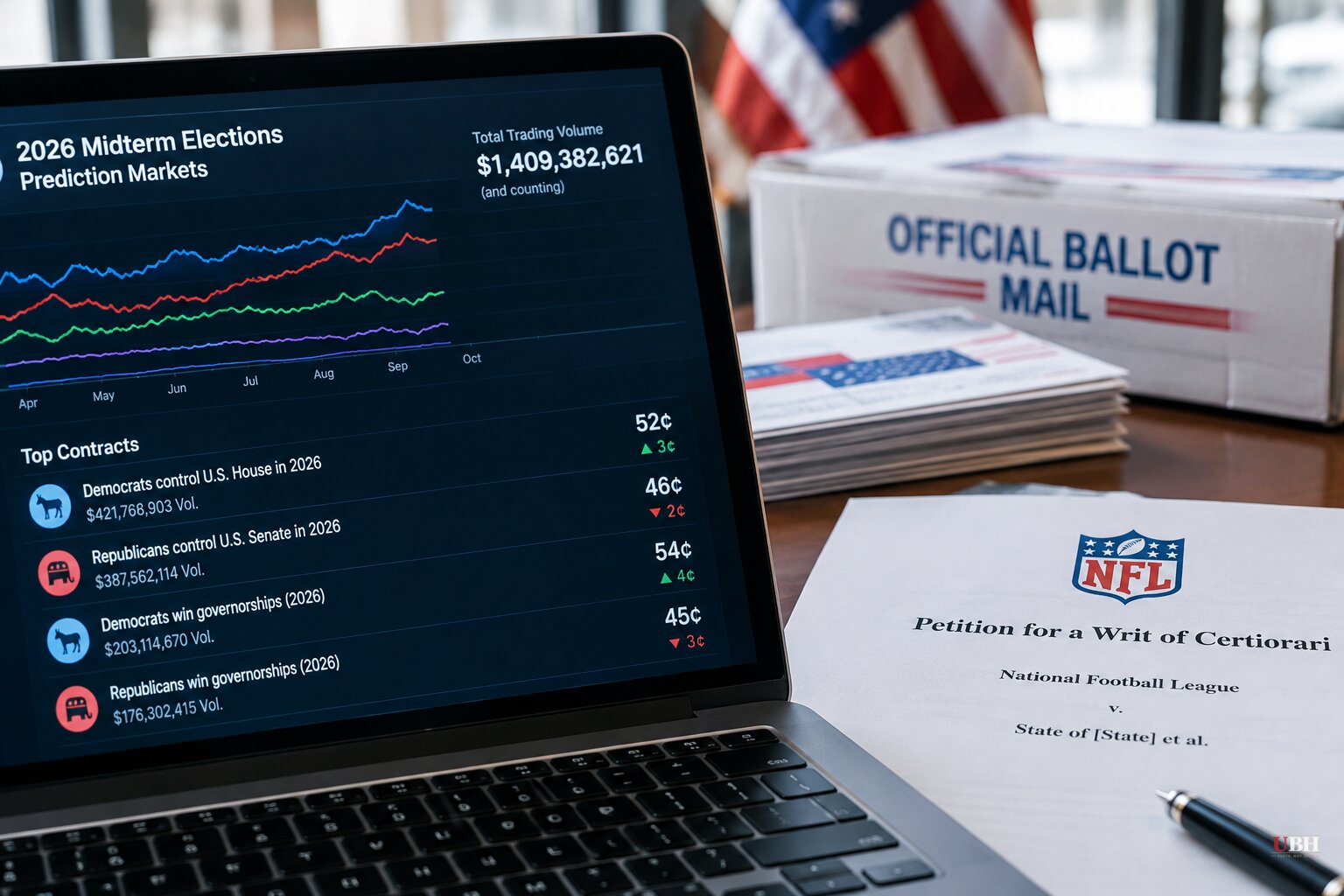
Since Kalshi and Polymarket became the NBA's preferred prediction-market partners on Monday, the industry's fight over who regulates it has widened. The money, the rules and the politics are now colliding six days before the Nov. 3 midterms.
The money
Midterm-related prediction markets have passed $1.4 billion in trading volume, according to a CNN analysis. Kalshi, the largest U.S. platform, told CNN it has seen nearly $1.1 billion on midterm contracts. Polymarket said it has seen more than $340 million, counting both its U.S. platform and its offshore site.
Volume is not the same as money wagered on a given outcome. It measures overall activity, meaning how much money changed hands before markets closed.
The Council on Foreign Relations, in an October report titled "Betting on Democracy," expects the total to exceed $2 billion by Election Day. Industry newsletter writer Dustin Gouker told CNN that trading is expected to ramp up sharply that day as professional traders chase volatility while polls close. He also noted that election volume is "still much less than sports and crypto markets."
Most people who trade on prediction markets lose money, CNN reported.
Insider trading
Federal regulators have pledged to crack down on insider trading tied to the midterms. Kalshi has already suspended six 2026 candidates for improperly betting on their own races, according to CNN.
The CFR report says existing rules "invite fraud and insider trading." It calls on Congress and the CFTC to define insider trading in election markets, require public disclosure of large positions, pressure offshore exchanges to adopt U.S. standards, and study the effect on retail traders. It also says Congress must adequately fund the CFTC.
Sean Patrick Maloney, president of the Coalition for Prediction Markets, made a related argument on Bloomberg this week. Federally regulated platforms, he said, should be treated as financial markets overseen by a well-funded CFTC, not as casinos. He expects the industry to expand further into politics and financial markets.
The NFL goes to court
The NFL filed an amicus brief arguing that prediction markets are sports gambling and should be regulated by states. "Billions of dollars will be bet on NFL games through prediction markets each season, and any delay from the Court will result in increasing consumer harm and risk to game integrity," the league wrote.
The league also said the CFTC never referenced contracts the NFL objected to months ago, including markets on coaching and officiating decisions and injuries. Kalshi, the NFL said, continues to list such contracts. The NFL has deals with official sportsbooks but none with prediction-market operators.
The CFTC disputes the league's account. "It's unfortunate the NFL declined to sign an MOU with the CFTC," public affairs director Brooke Nethercott told Fox News Digital. An MOU would have let the league share information with the agency, she said. A CFTC source added that senior NFL staff told CFTC staff weeks ago they were close to commercial partnerships with several operators. The NFL has not publicly addressed that claim.
The NBA, NHL and MLB have all signed MOUs with the CFTC.
Elections and public confidence
Polymarket and Kalshi allow trading on thousands of midterm outcomes, even though surveys show most Americans oppose betting on elections, according to AFP. Both firms also issue race "projections" on social media.
Davina Hurt, government ethics director at Santa Clara University's Markkula Center for Applied Ethics, told AFP the risk is that "financial market expectations carry more weight in the public's mind than the votes themselves." A high probability "is not a promise," she said.
The Los Angeles mayoral primary in June shows how that can play out. Republican Spencer Pratt lost after prediction markets had shown him favored to advance. Right-wing influencers cited the odds as evidence of fraud, according to AFP. Some of those X posts carried "paid partnership" tags, which drew backlash and prompted action from both platforms.
"The June primary reinforced how quickly expectations about election outcomes can become confused with actual election results," said Michael Sanchez, spokesman for the Los Angeles County registrar's office.
Kalshi's communications head, Elisabeth Diana, said the odds are a complement to polling. "On prediction markets, you trade what you think will happen. On polls, you say what you want to have happen," she told AFP. Kalshi says manipulation attempts are canceled out by other buyers. A Kalshi memo shared with AFP tells paid partners they "shall not call into question the integrity or accuracy of any official vote tally result."
Young bettors
The Daily Wire cited a study published earlier this year finding that 36% of boys aged 11 to 17 took part in gambling or gambling-related activities in the past year. Gen Z accounts for roughly half of online betting activity, it said, and the outlet projected that prediction markets could reach $1 trillion in volume by 2030. That projection is the outlet's own and is not a figure from a regulator or exchange.
Legal status
The CFR report says opposition to election markets comes from Democratic Party leaders, state governments and much of the electorate. The central legal question is whether election contracts qualify as "swaps" under federal commodities law, which would let them be offered nationwide.
That question is being litigated and may reach the Supreme Court. The Biden administration tried to shut down election markets in 2024, but PredictIt prevailed in court and other federal courts ruled such markets permissible, according to CNN. The Trump administration has since embraced the industry and is finalizing rules that protect election markets.
Until a court rules, the markets operate at scale with federal backing. The first real stress test comes Nov. 3, when volume is expected to peak as results come in.
Sources used for this briefing
7 links from 7 independent newsrooms (syndicated copies of the same report count once)
These are the sources it draws on, linked so you can verify.


