
Unbiased headlines. Facts, not spin.
Unbiased Headlines is an independently owned news organization. We bring you the facts, not opinions, written fresh from 110+ named sources. Sources linked so you can verify it yourself.
 finance
Major Story (7/10)
Event date: October 27, 2026 ·
CFTC Sues Utah to Stop State Gambling Enforcement Against Prediction Markets
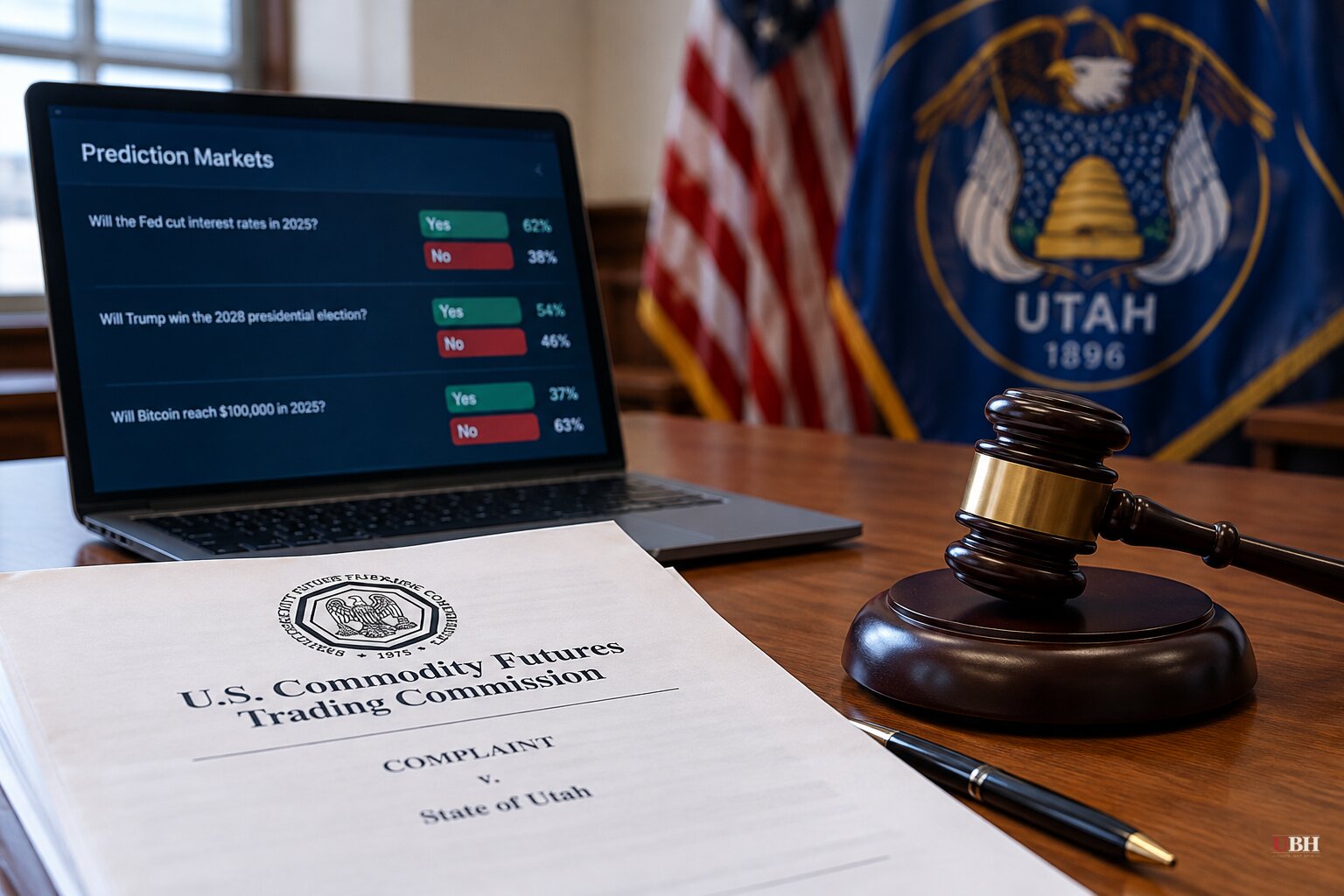
The Commodity Futures Trading Commission announced Tuesday, Oct. 27, that it has sued the state of Utah to stop it from using state law to shut down CFTC-registered prediction markets. The agency says it has also initiated legal proceedings against nine other states.
The complaint asks a federal court for declaratory and injunctive relief. The CFTC argues that Utah's actions obstruct "Congress's decision to federally preempt state law."
What triggered the suit
The lawsuit comes a week after Utah Attorney General Derek Brown filed a state-court action on Oct. 20 against five entities tied to Kalshi and the trading firm Susquehanna. Utah alleges the platform "lets Utahns bet on sports, elections, politics and other outcomes" in violation of state gambling law.
Utah wants an injunction and the return of losses and fees. The figure is estimated at between $30.6 million and $61.2 million.
"Kalshi runs an online casino in Utah and calls it a prediction market. That violates Utah law," Brown said in a statement.
Utah is one of the few states that bans all forms of gambling. Kalshi had already sued Gov. Spencer Cox, a Republican, and other state officials in February to head off enforcement. A federal judge in Utah ruled Aug. 4 that the Commodity Exchange Act does not stop the state from enforcing its gambling restrictions against prediction markets.
The federal argument
CFTC Chairman Michael Selig said in a press release that "Utah seeks to shut down prediction markets across a wide variety of markets." He added: "Event contracts do not just serve hedging and investment purposes. They also provide the public with information about the outcome of future events. Congress entrusted the CFTC to be the federal regulator with sole responsibility to oversee these markets."
The complaint says the contracts Utah is targeting are "swaps" under the Commodity Exchange Act. It says the exchanges offering them are CFTC-regulated Designated Contract Markets. In the agency's words, Utah is trying to "prevent a CFTC-regulated DCM from offering CFTC-approved financial products."
The agency has also said that "if a state challenges the lawful operation of a derivatives exchange, the Commission will protect federal sovereign interests." It has filed briefs in four federal appeals courts and one state supreme court.
The states push back
Cox has not been shy about his position. After Selig said the CFTC would challenge any state's attempt to regulate prediction markets, Cox said he would "use every resource within my disposal as governor of the sovereign state of Utah, and under the Constitution of the United States to beat you in court."
Utah is not alone in facing the CFTC. The agency's earlier targets include Arizona, Connecticut, Illinois, New York, Wisconsin, Minnesota, Rhode Island, New Mexico and Kentucky.
The NFL has weighed in on the states' side of the argument. In an amicus brief filed last Thursday, the league said prediction markets are sports gambling and should be regulated by states. "Billions of dollars will be bet on NFL games through prediction markets each season, and any delay from the Court will result in increasing consumer harm and risk to game integrity," the league wrote.
The league also objected to the CFTC's failure to address contracts it flagged months ago. These include markets on coaching and officiating decisions and injuries, which it says could be swayed by insider information.
The CFTC disputes the NFL's framing. Public affairs director Brooke Nethercott said the agency has engaged with the league "since day 1" and that "it's unfortunate the NFL declined to sign an MOU with the CFTC." A CFTC source said senior NFL staff told the agency weeks ago they were close to commercial partnerships with several prediction market operators. The NFL has not publicly confirmed that.
A split in the courts
The courts have not agreed. The Third Circuit supported Kalshi in New Jersey. The Ninth Circuit supported Nevada, and the Sixth Circuit sided with Ohio and Tennessee.
New Jersey officials petitioned the Supreme Court in September to take up their case against Kalshi. Similar disputes are pending in Michigan, Ohio, Kentucky, Nevada, Massachusetts, Wisconsin and New York. As of Tuesday, the Supreme Court had not announced whether it will hear arguments in the case.
On Oct. 9, the CFTC proposed classifying certain event contracts as swaps. That rule is not final.
The money involved
Artemis data show prediction markets did $419.1 billion in trading volume through Oct. 27. Sports contracts accounted for $173.6 billion, or 41.4%, followed by $149.3 billion in other event contracts and $60.3 billion in crypto.
Reuters has reported Kalshi's valuation at roughly $40 billion. CEO Tarek Mansour has said sports still make up nearly 65% of the company's revenue, down from about 95% nine months earlier.
A patchwork of state rules could make these contracts more expensive to offer or restrict access in certain markets. So far, there is no evidence that Susquehanna has withdrawn from Kalshi.
What comes next
Two tracks are now running at once. Utah's state-court case against Kalshi and Susquehanna affiliates continues, and the CFTC's federal complaint will test whether a federal court can stop it. The Supreme Court's decision on whether to take New Jersey's petition is the next clear marker. Mansour told Reuters the dispute could eventually reach the Supreme Court, which has not agreed to hear any such case.
Sources used for this briefing
7 links from 7 independent newsrooms (syndicated copies of the same report count once)
These are the sources it draws on, linked so you can verify.


