
Unbiased headlines. Facts, not spin.
Every story is an unbiased news briefing written from 110+ sources across the spectrum — sources linked so you can verify it yourself.
 finance
Low Interest (4/10)
May 27, 2026 at 01:29 AM
finance
Low Interest (4/10)
May 27, 2026 at 01:29 AM
SK Hynix Crosses $1 Trillion Valuation, Making South Korea First Non-U.S. Nation With Two Trillion-Dollar Companies
What Just Happened
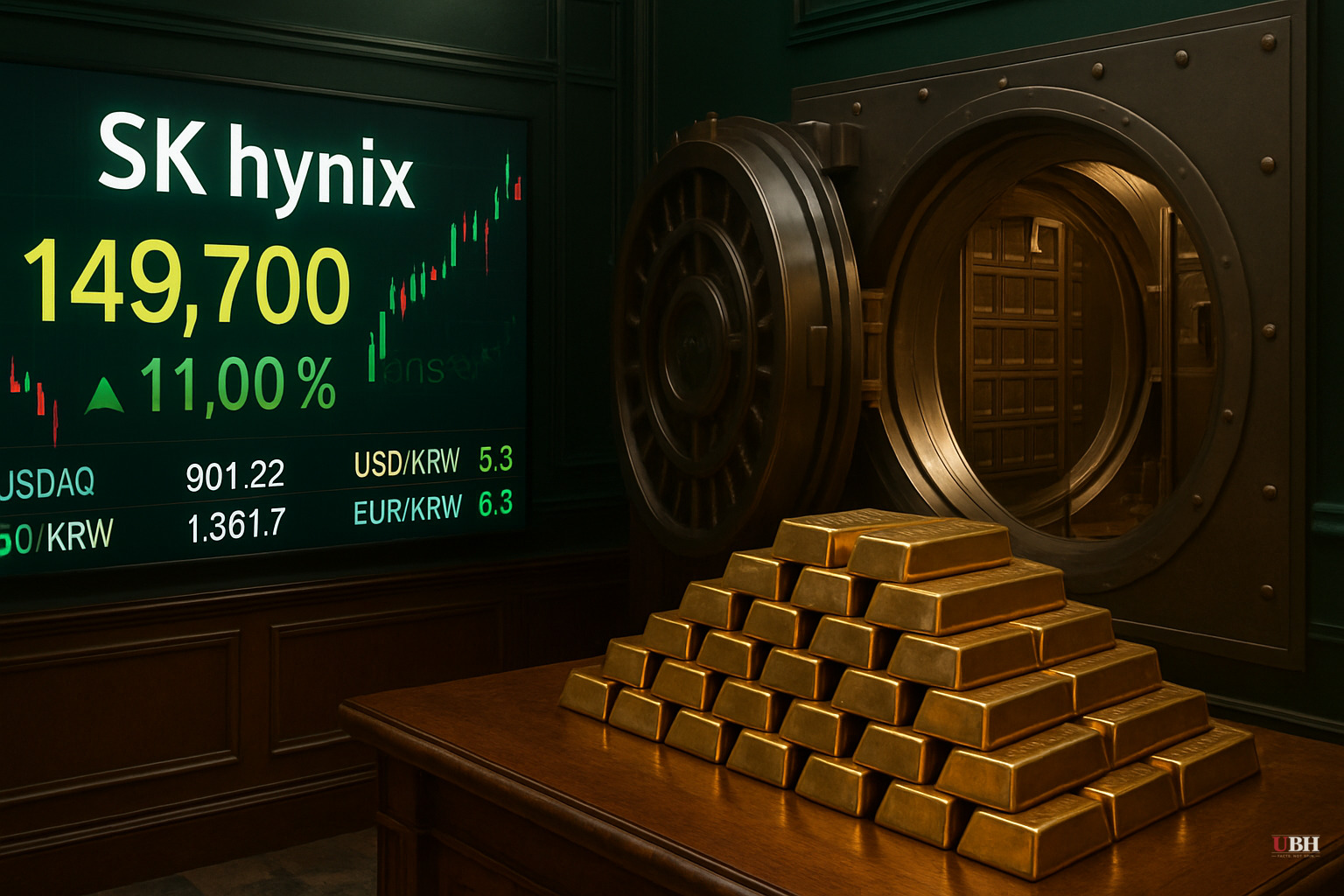
On Wednesday, May 27, 2026, SK Hynix shares hit a record 2.28 million won — a nearly 11% single-day jump — pushing the company's market cap to approximately $1.08 trillion, according to EconoTimes. That makes SK Hynix the second South Korean company to crack the trillion-dollar threshold, following Samsung Electronics, which crossed the same line earlier this month.
Sixteen months ago, SK Hynix was worth less than $100 billion, according to CoinCentral. It has since posted gains of 274% in 2025, followed by another 200%-plus surge so far in 2026.
The Surge in Earnings
Last quarter, SK Hynix reported revenue of $35.57 billion — up 60% from the prior quarter and 198% year-over-year, according to CoinCentral. The company crossed ₩50 trillion in quarterly revenue for the first time in its history. Operating profit hit a record ₩37.6 trillion, which translates to roughly $25.4 billion, with a 72% operating margin.
A 72% operating margin stands in sharp contrast to most manufacturers, which celebrate breaking 15%.
The driver is one thing: high-bandwidth memory (HBM) chips. These are the specialized components crammed into AI servers and accelerators, and SK Hynix is one of the only companies on the planet that can produce them at the scale Nvidia requires. Nvidia is listed as a key customer, according to CoinCentral.
South Korea Just Made History
With both SK Hynix and Samsung Electronics above $1 trillion, South Korea is now the first country outside the United States to have two trillion-dollar companies simultaneously, according to CoinCentral.
For comparison, Asia's biggest company by market cap is still Taiwan's TSMC at over $1.83 trillion, according to CoinCentral. South Korea is closing that gap fast.
Samsung itself added over 6% on the same Wednesday that SK Hynix surged, according to CNBC. The two chipmakers now account for more than 40% of South Korea's Kospi benchmark index, per CNBC. The Kospi has nearly doubled since the start of the year, according to LSEG data cited by CNBC — up over 86% in 2026 alone, after a 75% gain in 2025, its strongest annual performance since 1999, according to CoinCentral.
What Mainstream Coverage Is Getting Wrong
Most outlets are framing this purely as an AI feel-good story. They're leaving out the concentration risk buried at the bottom of CNBC's own reporting.
When two stocks make up 40%-plus of a benchmark index, that index stops being a broad economic indicator and becomes a leveraged bet on AI chip demand. Analysts cited by CNBC have flagged that this concentration "could heighten market volatility and leave the benchmark more exposed to risks, including supply chain disruptions and a slowdown in global data center investment."
Capital is flooding in driven partly by FOMO — CoinCentral's own reporting notes analysts pointing to "FOMO sentiment around AI-related stocks in both Korea and Japan." That's a concern for a market that's run 86% in five months.
EconoTimes notes that the AI memory chip boom isn't a South Korea-only story — it's a global restructuring of who controls the infrastructure powering artificial intelligence. American coverage has been slow to reckon with how dependent U.S. AI companies now are on South Korean and Taiwanese chip supply chains. That raises national security questions.
The Real-World Stakes
Nvidia's dominance in AI accelerators runs directly through SK Hynix. Every H100, B200, and next-generation GPU that trains AI models needs HBM chips. Right now, the United States does NOT have a domestic supplier operating at comparable scale. Micron is working on it, but SK Hynix and Samsung hold the commanding position today.
For American taxpayers and policymakers patting themselves on the back for CHIPS Act investments: the companies actually winning the AI memory race are incorporated in Seoul. The dependency deserves more scrutiny than it's currently receiving.
The Numbers
SK Hynix went from under $100 billion to over $1 trillion in roughly 16 months. The fundamentals back it up — $35.57 billion in quarterly revenue, a 72% operating margin, and a commanding share of the chips that power AI. South Korea is now the only non-U.S. nation with two trillion-dollar companies.
The AI boom is real. The money is real. The dependency on a handful of foreign suppliers for critical AI infrastructure is also real — and Washington keeps pretending otherwise.
Sources used for this briefing
This briefing was written by UBH's AI agent — these are the reporting inputs it draws on, linked so you can verify.


