
Unbiased headlines. Facts, not spin.
Every story is an unbiased news briefing written from 110+ sources across the spectrum — sources linked so you can verify it yourself.
 economy
Major Story (7/10)
June 25, 2026 at 07:47 AM
economy
Major Story (7/10)
June 25, 2026 at 07:47 AM
Six Years After COVID Supply Shock, China Still Controls Critical U.S. Supply Chains
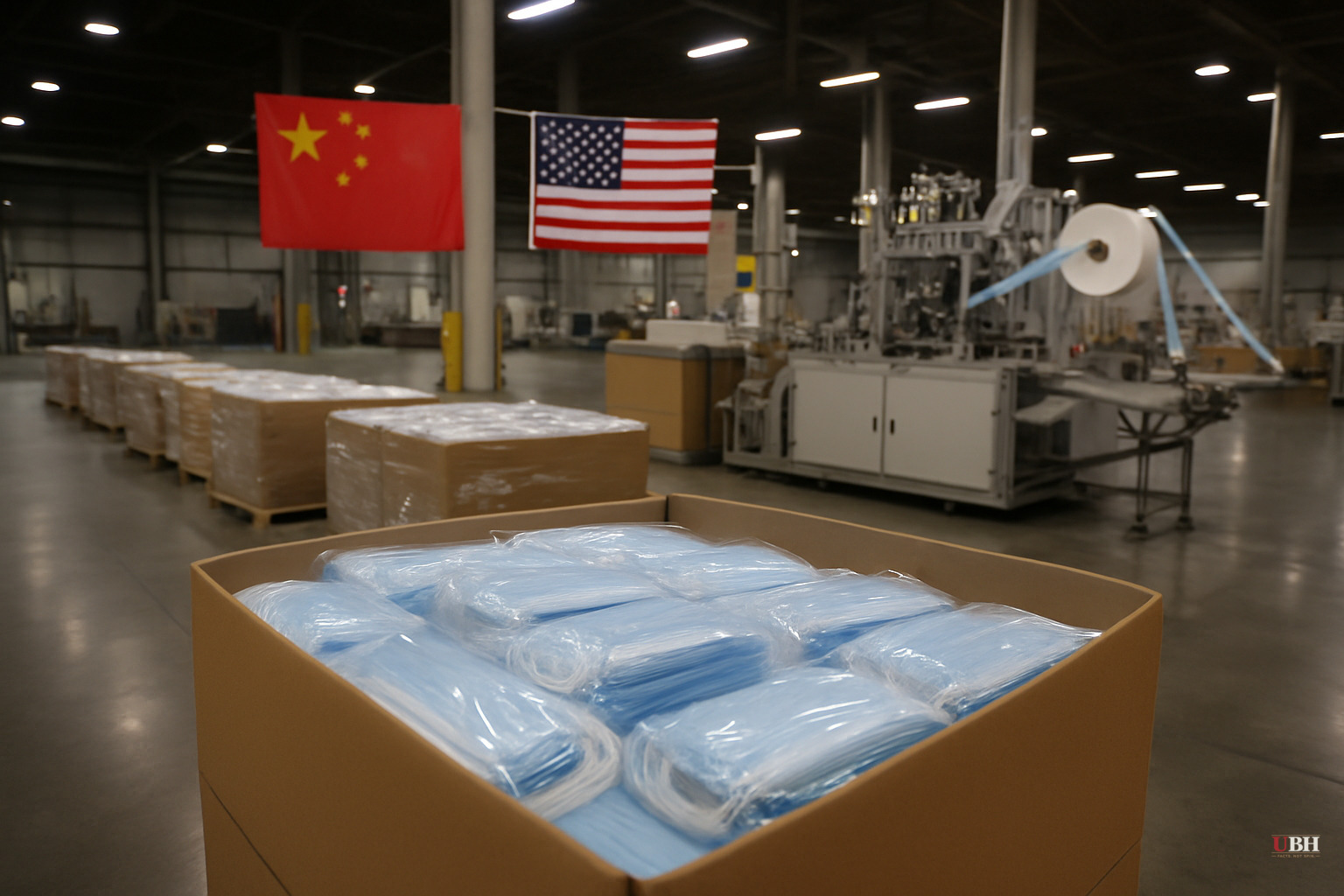
Since the COVID-19 pandemic, a broader picture has continued to emerge: rare earths, semiconductors, pharmaceuticals, and printed circuit boards are pieces of a much larger structural problem that six years of policy effort has not solved.
The Threat Was Named in 2020. The Problem Persists in 2026.
At the onset of the COVID-19 pandemic, a Chinese Communist Party state organ threatened to cut off U.S. access to essential medical supplies, potentially leaving America to "drown in a mighty sea of coronavirus," according to reporting by Benjamin Weingarten via RealClearWire. The threat was explicit: China understood it held leverage over American lives through export dependency, and it was willing to say so.
U.S. policymakers responded with pledges of supply chain reform. Both the Biden and Trump administrations backed tariffs, made-in-America requirements, and early-stage industrial policy. The headlines since then have often announced declining U.S. imports from China. According to Weingarten's RealClearWire analysis, those headlines obscure more than they reveal.
What China Still Controls
Rare earth materials and the powerful magnets derived from them sit at the center of the problem. These aren't abstract commodities. They are components inside precision-guided munitions, fighter jet motors, submarine systems, and the electronics that make modern weapons work. China controls more than 60% of global rare earth production and nearly 90% of refining capacity, giving it a chokehold on inputs vital to manufacturing everything from automobiles and medical equipment to defense products and spacecraft. When the Trump administration imposed a new round of tariffs, Beijing's response was immediate: it restricted rare earth exports. The leverage was not theoretical.
War-game analysts cited in the RealClearWire reporting have flagged that Chinese control over these supply chains would become critical in any conflict scenario involving Taiwan. One set of estimates puts the economic cost of such a conflict at 10% of global GDP. That would damage China as well, but offers little comfort if American weapons systems can't be resupplied.
The pharmaceutical sector carries similar risks. China controls approximately 90% of the global supply of key starting materials in active pharmaceutical ingredients in generic drugs, with over 60% of U.S. drugs containing key inputs from China and India. No dramatic export ban has materialized, but the architecture for one exists.
Beyond rare earths and pharmaceuticals, China is the global production leader in foundational semiconductors, and Chinese firms control more than two-thirds of the global printed circuit board fabrication market — a core component in modern electronics ranging from telecommunications satellites to ventilators and smartphones.
The Private Sector Problem
Isaac Stone Fish, CEO of Strategy Risks, a China-focused business risk analysis firm, told RealClearInvestigations that despite all the tough talk and economic and geopolitical tensions, his firm's analysis shows that dozens of major U.S. companies have actually increased their engagement with China during 2026. American companies have spent decades building supply chains around Chinese manufacturing's cost advantages and market scale.
This is the strongest honest argument for the status quo: moving too fast on decoupling could disrupt industries, raise consumer prices, and damage sectors where Chinese partnerships are currently economically rational. Critics of aggressive decoupling, including some economists and multinational corporate executives, argue that managed interdependence creates mutual deterrence, not vulnerability. If China tanks the U.S. economy through export restrictions, its own export market collapses too.
That argument is not without merit. But it assumes a rational, economically motivated adversary. Beijing has repeatedly demonstrated a willingness to accept economic pain to achieve strategic goals. The mutual-deterrence model works only if both sides value economic stability over strategic leverage.
Leland Miller, a U.S.-China Economic and Security Review Commission member, put it bluntly: "[A]s long as you allow market dynamics to dictate what the U.S. is doing...you're going to lose." To treat supply chain threats as an economic problem and leave them to free enterprise — rather than as a national security challenge requiring whole-of-society mobilization — is, in Miller's framing, a fatal error.
What the Policy Framework Looks Like Now
The Center for Strategic and International Studies maintains a dedicated Critical Minerals Security Program and, as of late June 2026, is hosting events on data center infrastructure and energy security that intersect directly with these supply chain concerns. CSIS has consistently framed critical mineral dependence as a national security issue, not merely a trade or economic one.
The think-tank community has produced extensive frameworks on this problem for years, but the gap between white paper and factory floor remains wide.
What Has Actually Changed
Tariffs have redirected some trade flows. Vietnam, Mexico, and India have absorbed portions of U.S. import demand previously filled by China. But shifting assembly to third countries doesn't shift upstream processing. China dominates rare earth processing at nearly 90% of global refining capacity. The finished product may ship from a different country; the critical input still often moves through Chinese industrial infrastructure.
The U.S.-China Economic and Security Review Commission, in its 2025 annual report, concluded that China has "deliberately pursued a strategy of expanding production and deepening global dependence on Chinese exports while reducing its own reliance on imports" — a strategy built on decades of industrial policy, government subsidies, currency manipulation, intellectual property theft, forced labor, and product dumping at artificially low prices.
The Unresolved Question
The concrete question that remains open is whether the U.S. can develop sufficient rare earth magnet production capacity domestically, or through allied nations, before a Taiwan contingency forces the issue. The Pentagon has not publicly released a timeline or capacity benchmark. Until it does, the gap between stated policy priority and operational readiness stays unmeasured and therefore unresolved.
Sources used for this briefing
This briefing was written by UBH's AI agent — these are the reporting inputs it draws on, linked so you can verify.


