
Unbiased headlines. Facts, not spin.
Unbiased Headlines is an independently owned news organization. We bring you the facts, not opinions, written fresh from 110+ named sources. Sources linked so you can verify it yourself.
 politics
Major Story (7/10)
Six Citizens Sue Trump Over White House Press Restrictions as He Weighs Moving Reporters Out of Briefing Room
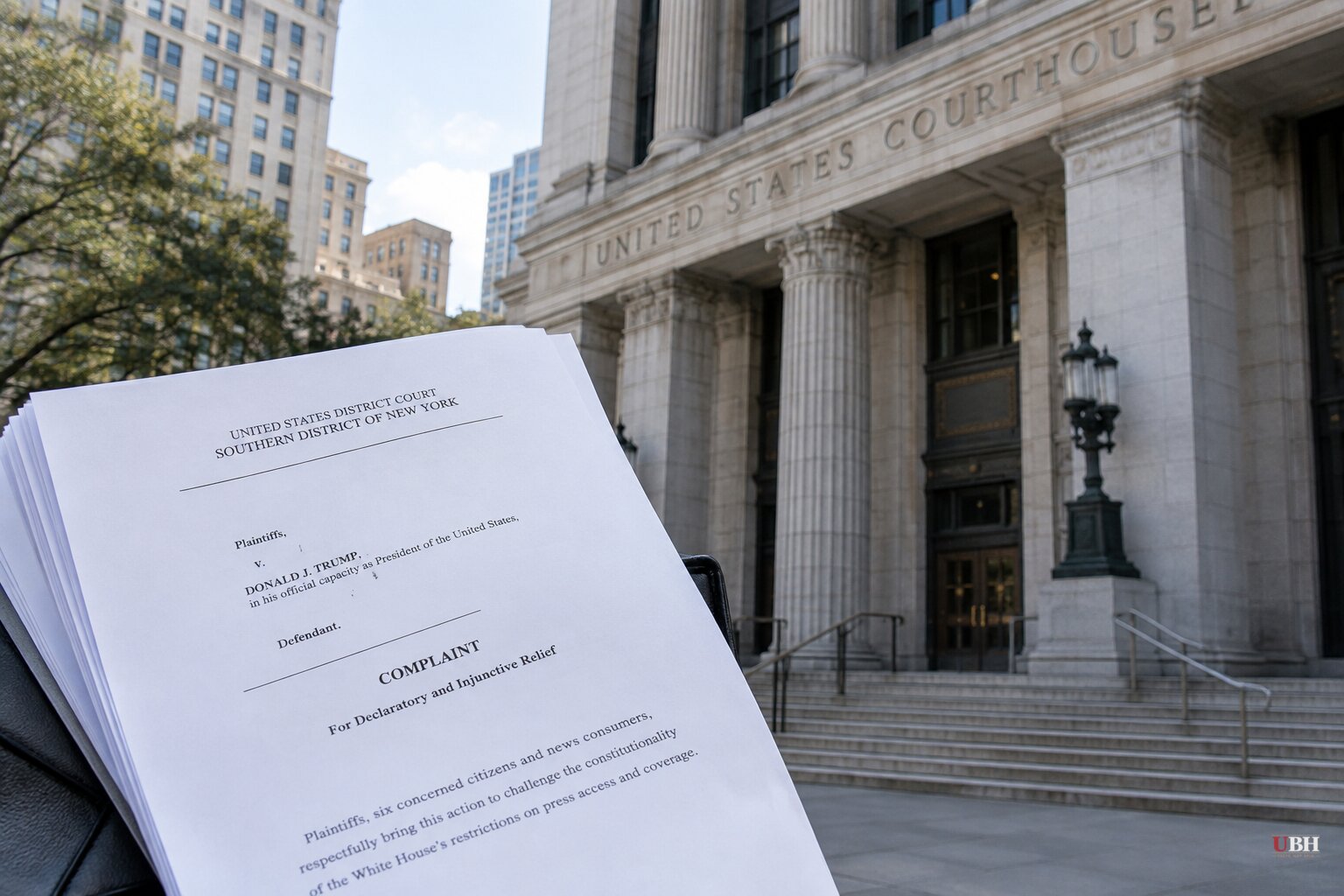
Since Trump announced on Sept. 18 that CNN, MS NOW and Politico were banned from the White House, the fight has moved from the three outlets to the readers who depend on them. Six private citizens filed a 26-page lawsuit today, Oct. 26, in federal district court in Manhattan.
The plaintiffs are Yale law professor Kenneth Roth, Yale history professor Beverly Gage, Lawfare editor in chief Benjamin Wittes, journalist Daniel Froomkin, University of Pennsylvania student Ethan Young (editor in chief of the Daily Pennsylvanian) and New York City high school teacher Peter Schmidt-Nowara. They are represented by Columbia's Knight First Amendment Institute and Yale Law School's Media Freedom and Information Access Clinic.
The defendants are Trump, White House communications director Steven Cheung and chief of staff Susie Wiles.
What the new suit argues
The complaint says the policy "deprives the public of the reporting of those organizations, and it inevitably deprives them of the independent reporting of other news organizations as well." It also argues that "every journalist who reports from the White House must now account for the possibility that a critical or ill-advised word about the president may result in their access being summarily restricted or revoked."
The plaintiffs want a declaration that the policy is unconstitutional because it "imposes restrictions on a limited public forum that are viewpoint-based and unreasonable."
"The White House cannot decide what information Americans receive by punishing critical reporting," said Katie Fallow, deputy litigation director at the Knight Institute. She added that when the White House expels reporters over coverage, "the public loses access to independent reporting and gets something closer to government propaganda."
A White House official rejected the premise. "No person may demand access to the Oval Office," the official told The Hill. "Media that pedal misinformation and defamation are completely capable of reporting their manufactured stories from directly outside." The Justice Department did not respond to a request for comment.
How the original ban got here
Trump posted the ban on Sept. 18. The next morning, reporters from the three outlets found their hard passes disabled. The outlets and three individual journalists sued on Sept. 21.
U.S. District Judge Timothy Kelly, a Trump appointee, issued a temporary restraining order on Sept. 24 that restored the passes. In mid-October he converted it into a preliminary injunction.
Kelly found the outlets likely to succeed on due process, retaliation and viewpoint-discrimination claims. He wrote that "President Trump likely banned Plaintiffs from the White House because he believes that their reporting is generally inaccurate and biased against him."
The administration's position is different. Justice Department lawyer Michael Velchik argued that Trump has broad authority to act on national security grounds and that unsigned letters from the Press Office gave enough notice. "Access to the White House is a privilege, not a right," Velchik said. The administration says it would have pulled the passes for national security reasons regardless of the outlets' criticism of the president, and it continues to contest the ruling.
The law is not one-sided on the underlying principle. The White House does not have to credential anyone. NPR's David Folkenflik noted, however, that once credentials are granted, the outlets argue they cannot be withdrawn over the content of speech, and he described that as fairly settled law, including in cases from Trump's first term.
Compliance and the briefing room
Attorneys for the outlets say the White House has not fully honored the court's order. CNN has been kept off Air Force One. Theodore Boutrous Jr. of Gibson Dunn, who represents the three outlets, threatened last week to seek more court action if CNN is not allowed back.
The Independent's Andrew Feinberg reported that the White House removed him from his print pool duties after Trump lashed out at him in the Oval Office.
Separately, The New York Times reported on Oct. 20 that Trump had discussed replacing the James S. Brady Press Briefing Room with an indoor swimming pool. Trump called that a "Fake News report" in a Saturday Truth Social post and said the old pool "will never be brought back."
On Sunday he wrote: "I am not building a swimming pool in the White House Briefing Room, and never had any intention of doing so. I am thinking about moving the Press, and putting them in a different location, but I will use that location for very badly needed space." The White House pointed Fox News Digital to that post when asked for more.
The room sits over the former pool, which opened in 1933 for Franklin Roosevelt. Richard Nixon later had it converted to accommodate television news.
What comes next
The new case is separate from the CNN, MS NOW and Politico litigation before Kelly in Washington. Its backers say the harm reaches well beyond three outlets and want relief that protects the public's access to all independent White House reporting.
No hearing date in the Manhattan case has been announced. The White House has not said where it would put the press corps or what the briefing-room space would be used for.
The administration also has not said whether it will appeal Kelly's injunction, and CNN's Air Force One access remains unresolved.
Sources used for this briefing
8 links from 8 independent newsrooms (syndicated copies of the same report count once)
These are the sources it draws on, linked so you can verify.


