
Unbiased headlines. Facts, not spin.
Unbiased Headlines is an independently owned news organization. We bring you the facts, not opinions, written fresh from 110+ named sources. Sources linked so you can verify it yourself.
 politics
Major Story (7/10)
DOJ Survey: Serious Violent Crime Victimization Fell 25% in 2025, Largest One-Year Drop Since 1973
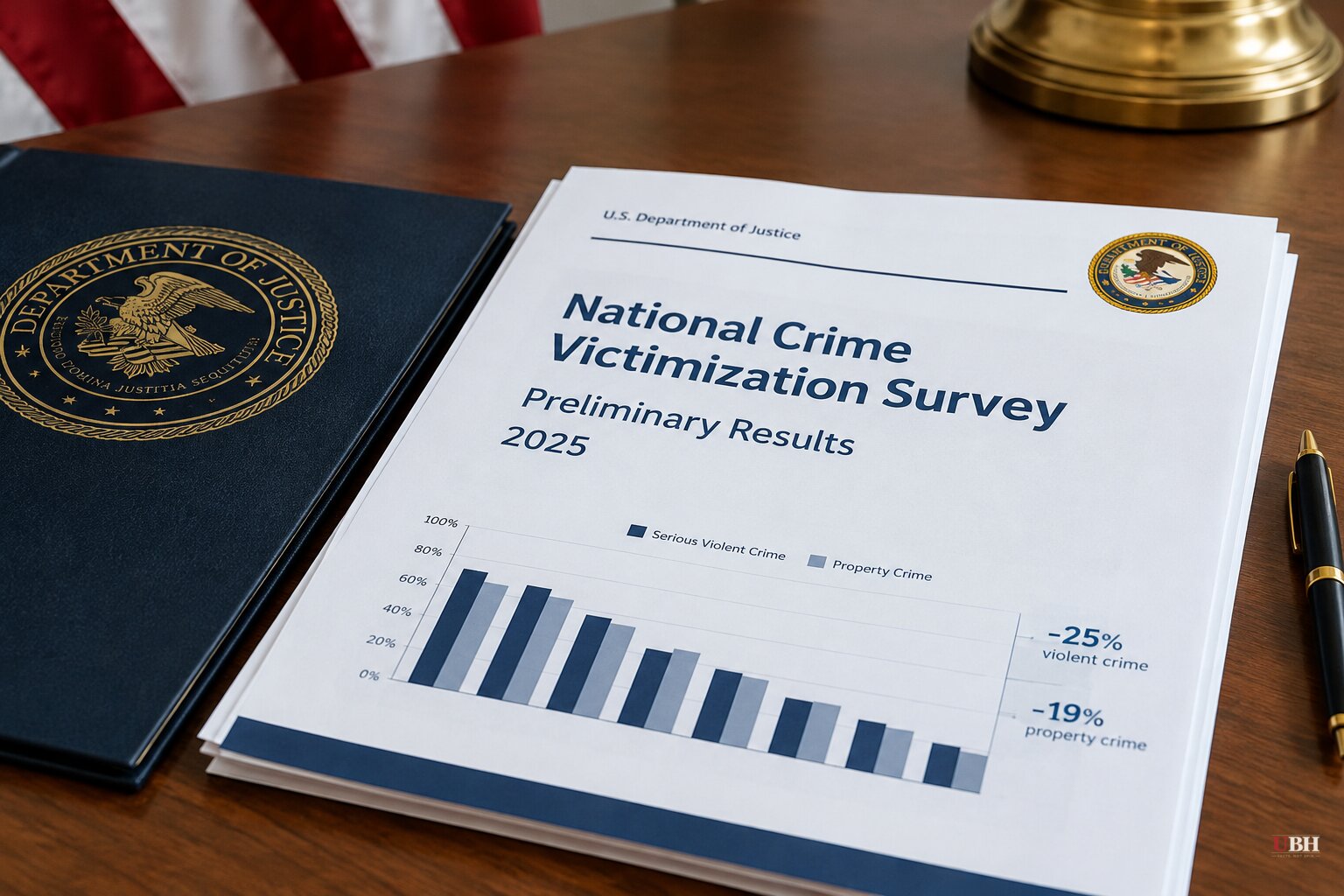
The Justice Department released preliminary 2025 data from the National Crime Victimization Survey today, Oct. 26, and the headline numbers are big. The department says they are the largest single-year declines since the survey started in 1973.
The survey is run by the Census Bureau and published by the Bureau of Justice Statistics. It samples about 240,000 people in roughly 150,000 households. It counts crimes against Americans 12 and older, including ones never reported to police.
What the survey found
The rate of violent victimization excluding simple assault fell 25%, from 9.9 to 7.4 per 1,000 residents. The estimated number of those incidents dropped from about 2.83 million to 2.16 million, roughly 669,000 fewer.
Aggravated assault fell 31%, from about 1.30 million incidents to 907,000. Robbery dropped 27%, from 626,420 to 453,870.
Property crime fell 19%, from 18.37 million victimizations to 14.89 million. The household rate went from 138 to 111.2 per 1,000 households.
Burglary and trespassing fell 25%, to 1.41 million. Motor vehicle theft fell about 30%, from 1.19 million to 841,130, which is 349,000 fewer stolen vehicles.
The number that did not move as much
The 25% figure applies to serious violent crime. Add simple assault, which makes up most violent incidents at 5.33 million cases, and the picture changes. Total violent victimizations fell from about 8.2 million to 7.5 million, and the rate went from 28.7 to 25.7 per 1,000.
The report flags that broader change as statistically non-significant.
The survey also excludes homicide, since it relies on interviews with victims. For murder, the FBI estimated a 2025 rate of 4.1 per 100,000 people, the lowest in more than half a century.
Survey versus police data
The survey's declines are steeper than what police recorded. FBI figures released in May showed violent crime down about 9.3% and police-reported aggravated assault down about 7.2%. The survey put aggravated assault victimization down 31%.
The DOJ report says the two systems measure crime differently, so the gap does not by itself establish a change in how often victims report. The department's own argument is that more effective policing encourages victims to come forward.
What the administration says caused it
Associate Attorney General Stanley Woodward called the report "proof that President Trump's 'Make America Safe Again' agenda is working." Attorney General Todd Blanche said: "This is what happens when you have an administration who prioritizes the safety and security of Americans and our communities."
DOJ also points to border enforcement, citing the removal of more than 400,000 illegal immigrants previously charged or convicted of crimes. It cites a reported 25% increase in fentanyl seizures as well.
The department and allied accounts also highlight the federal surges in Memphis, Washington, D.C., and New Orleans. U.S. Marshals Service data shows that a year after the Memphis deployment, murders fell 37%, robberies 47%, aggravated assaults 29% and sexual assaults 30%. The Memphis task force made 13,000 arrests and seized more than 2,200 firearms. The D.C. task force reported 6,000 arrests, including 35 murder suspects and 100 gang members, plus 25 missing children located.
Those are agency-reported figures. The national survey does not break out results by city or isolate any single policy, so it cannot show how much of the national drop came from the deployments, border enforcement or something else.
The arrest side of the ledger
Not everyone reads the trend as a pure success story. FWD.us, a criminal justice and immigration reform group, analyzed federal arrest data and found arrests for low-level offenses rose from 2024 to 2025 even as serious crime fell.
Vagrancy arrests rose 44%, from 22,769 to 32,728. Marijuana possession arrests rose 6%, from 190,182 to 201,273. Arrests for possession of other drugs rose 3%, from 508,087 to 523,520.
FWD.us executive director Zoë Towns told NPR the increase "signals a really troubling return to some of the extreme law and order policies that defined the American criminal justice system during the 80s and the 90s." She added that "an arrest has life-changing consequences for the person involved and for their family."
The FWD.us analysis does not say whether charges were dropped or whether anyone served time. An FBI representative had not responded to NPR's request for comment on it.
What comes next
The 2025 numbers are preliminary. The Bureau of Justice Statistics plans to publish final estimates in 2027, and the question for that release is whether the record declines hold once the data is finalized.
Sources used for this briefing
8 links from 8 independent newsrooms (syndicated copies of the same report count once)
These are the sources it draws on, linked so you can verify.


