
Unbiased headlines. Facts, not spin.
Unbiased Headlines is an independently owned news organization. We bring you the facts, not opinions, written fresh from 110+ named sources. Sources linked so you can verify it yourself.
 energy
Major Story (7/10)
Event date: October 23, 2026 ·
Singapore Ship Fuel Now Costs More Than the Crude It Is Made From as Gulf and Russian Supply Shrinks
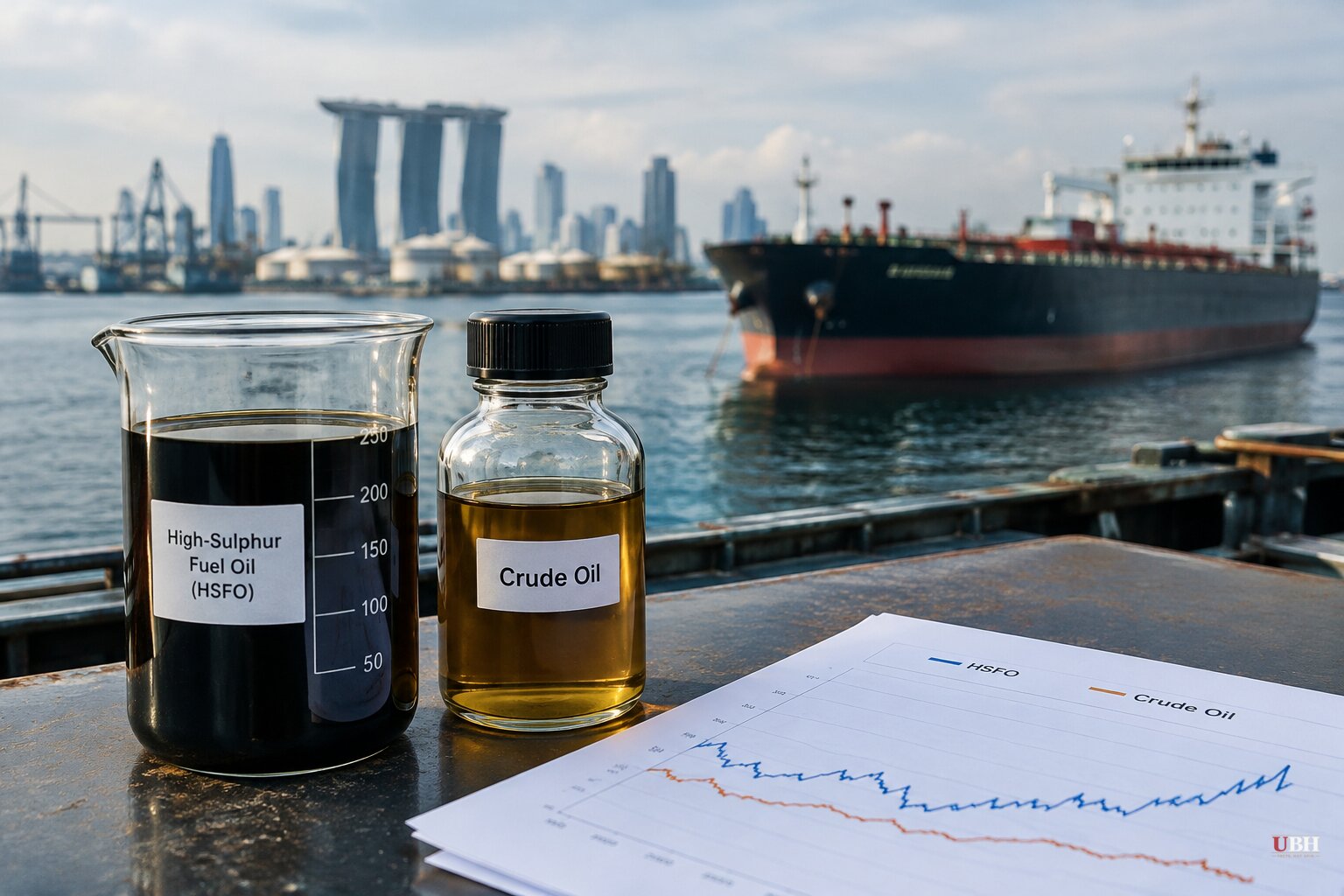
Fuel oil is supposed to be the cheap end of the barrel. In Singapore, the world's biggest bunkering hub, it is not.
Singapore's November high-sulphur fuel oil (HSFO) crack against Dubai crude rose above $10 a barrel in mid-October. In February, before the Iran war, it was a discount of about $5. That is a swing of more than $15 a barrel for a product that normally sells for less than the crude used to make it.
Ship operators are therefore paying for more than higher oil prices. The fuel itself has become scarce.
Two suppliers vanish at once
Middle Eastern shipments of HSFO and very-low-sulphur fuel oil (VLSFO) to Singapore averaged about 100,000 barrels a day in 2025. They disappeared in April and May after Hormuz shipping was disrupted. They recovered briefly to 130,000 b/d in July, then fell back to roughly 40,000 to 50,000 b/d in recent months.
Russia stepped in at first. Its HSFO shipments to Singapore hit about 180,000 b/d in April, above the 100,000 to 150,000 b/d typical of 2025. By September they were down to 25,000 b/d, as Ukrainian drone attacks on Russian refineries cut residue exports.
The result is a regional squeeze. The Singapore-Rotterdam HSFO swap spread reached a record $95 a tonne on October 7, about $15 a barrel, before easing to $88. European HSFO trades about $10 a barrel below Brent. The U.S. Gulf Coast is more than $20 below. The shortage is an Asian problem.
Demand has not given way. Singapore sold 4.7 million tonnes of bunker fuel in September, about 1% below a year earlier.
Cargoes are hard to find
Bunker buyers in Singapore are placing orders up to two weeks ahead. "Very few suppliers are able to offer cargoes in Singapore this month, and the ones they can are offering cargoes at insane premiums," a bunker trading executive told Lloyd's List.
China is not helping. Synergy Asia Bunkering director Steven Low told Lloyd's List there have been "no availabilities from China lately." Bunker players cite two reasons: Chinese refineries have been short of crude, though arrivals are approaching pre-crisis levels, and Typhoon Shampi halted port operations and bunkering at Zhoushan. The executive added that Far East Russia is now importing oil products from China and South Korea rather than exporting them.
Freight is the other half of the bill
Replacement barrels have to travel farther, and tankers cost a fortune. The Baltic Exchange rate for U.S. Gulf Coast to China reached $79.6 million earlier this month, an unprecedented level against an average below $8 million over the previous five years. It stood near $60 million as of October 22.
Randy Hawkins, Valero Energy's head of oil trading, told analysts that refiners are spending $30 to $35 to move each barrel of crude from the Gulf Coast to Asia, as much as seven times last year's cost. "The main story right now in the market is freight rates," he said.
Asian refinery orders for U.S. crude for November delivery fell roughly 50% month on month to 24 million to 26 million barrels, according to traders who asked not to be named. At that pace it would be a seven-year low, based on Kpler and Vortexa ship-tracking data. One anonymous market participant said post-cycle trades could lift November cargoes to as much as 40 million barrels. Vortexa senior analyst Rohit Rathod said the firm does not "currently see evidence of a near-term surge."
U.S. export grades are feeling it. Permian crude at Magellan East Houston traded 25 cents over futures on October 21, down from more than $3 six weeks earlier. The premium on Mars, a medium sour grade similar to Middle Eastern crude, fell to $6 from $17.50 in late March.
Refiners and shippers take the hit
Higher product prices have not translated into healthy refining profits. The International Energy Agency said in its October 19 oil market report that margins for Asian refiners running high-sulfur Middle Eastern crude turned negative in September. Hyro Analytics estimated the October average at just over $7 a barrel after freight.
The Asian low-sulfur diesel crack topped $87 a barrel last month, beating the previous record of $85.6 set in late March. By mid-October, gasoline, jet fuel and diesel cracks had all weakened. Commodities analytics firm Sparta put December margins for medium-complexity Asian refineries near break-even, at about negative $1.03 a barrel on UAE Murban crude.
South Korean and Japanese airlines and shippers are reporting revenue growth that does not reach the bottom line, or outright losses. In Vietnam, Bui Huy Son of the Ministry of Industry and Trade's planning and finance department said Middle East conflict pushed oil prices higher in September and raised fuel and logistics costs. Businesses there say price volatility makes quotes hard to hold.
How long it lasts
The crude price picture is disputed. Bloomberg's reporting put oil at around $100 a barrel. On Friday, October 23, Financial Sense host Jim Puplava said Brent was approaching $120 amid fears of renewed escalation. Puplava argues the supply shock is only now fully arriving, citing inventory draws of more than 200 million barrels outside the Gulf in the first months of the conflict and what he calls "phantom inventories." He says energy equities remain attractive.
Others see some easing. Bunker traders told Lloyd's List that fuel oil prices began to correct as buyers held back and crude futures dipped, though levels remain above pre-conflict norms. OilPrice.com's analysis says seasonal relief from Gulf producers and added Chinese export allowances could ease the squeeze toward year-end, particularly for VLSFO. It adds that expensive replacement cargoes and vulnerable Russian supply make a return to pre-war price relationships harder.
The next test is whether Chinese export quotas and winter Gulf supply arrive before more Russian refineries go down. Access to Gulf fuel oil is still blocked, according to bunker traders, and recent attacks have dashed hopes of a near-term return to normal.
Sources used for this briefing
7 links from 7 independent newsrooms (syndicated copies of the same report count once)
These are the sources it draws on, linked so you can verify.


