
Unbiased headlines. Facts, not spin.
Unbiased Headlines is an independently owned news organization. We bring you the facts, not opinions, written fresh from 110+ named sources. Sources linked so you can verify it yourself.
 energy
Notable (5/10)
Dead Sea Dropping About 4 Feet a Year as Jordan River Inflow Falls More Than 90%
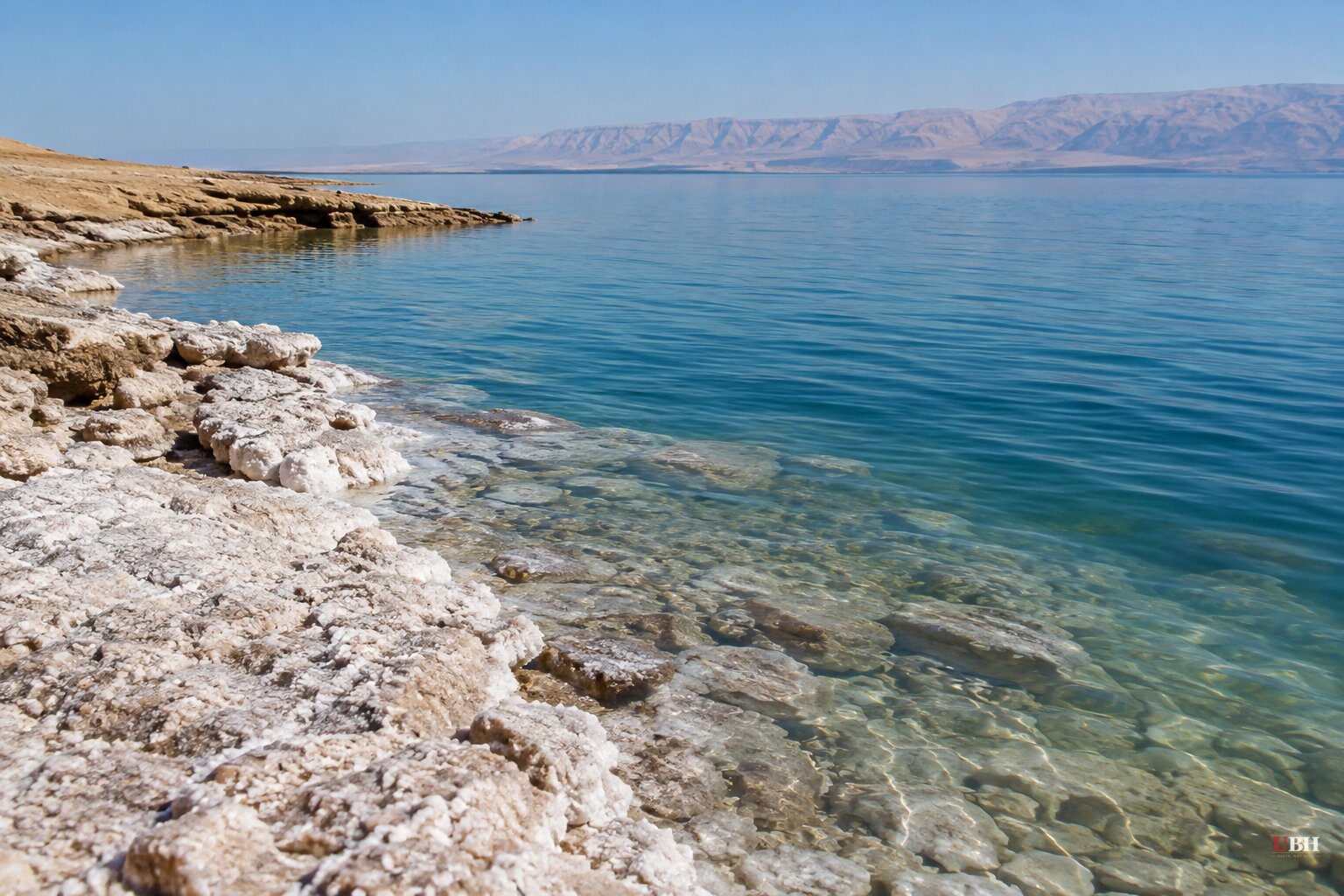
The lowest place on Earth is still sinking.
At around 1,400 feet (429 meters) below sea level, the Dead Sea is dropping by roughly 4 feet a year. Over the past five decades its surface area has shrunk by about a third.
The water left behind is nearly 10 times saltier than the ocean. The ground it leaves exposed is salt-encrusted shoreline and sinkholes, striking to look at and increasingly risky to walk on.
A lake that depends on one river
Technically, the Dead Sea is a lake. It is landlocked, and its water arrives mainly through the Jordan River, which starts on the Syria-Lebanon border, passes through the Sea of Galilee in northern Israel, and runs south between Jordan on one side and Israel and the West Bank on the other.
A landlocked lake has no backup supply. When the inflow is cut, the level falls.
The Jordan and its main tributary, the Yarmouk, have been dammed and diverted by Israel, Syria and Jordan. The water goes to people, crops and livestock, the most basic demands in a dry region.
The numbers are stark. The river once carried 1.3 billion cubic meters of water a year to the Dead Sea. That is now roughly 100 million cubic meters, a drop of more than 90 percent.
No single diversion explains it. Each one serves a real need, and together they have starved the lake at its source.
Mining takes its share
Mineral extraction is the other major driver of decline. In the late 1970s the Dead Sea split into two basins, now separated by a strip of dry land. The deeper northern basin is the natural remnant of the sea. The southern basin is artificially maintained, made up of a series of industrial evaporation pools.
Companies on the Israeli and Jordanian sides, the Dead Sea Works and the Arab Potash Company, pump water from the northern basin into those pools. The sun evaporates the water and leaves behind a mineral-rich brine, from which potash and magnesium are extracted for fertilizers and other industrial products.
The lake is squeezed from both ends: very little coming in from the river, and a steady draw going out to the pools in the south.
The lake is heating itself
A new modeling study adds a harder-to-see problem. Led by Emmanuel Guillerm of Germany's GFZ Helmholtz Centre for Geosciences and Binghamton University in the US, the team built a model linking water loss, salt concentration and heat exchange.
The measured record: between 1979 and 2019 the lake level dropped by about 34 meters. Deep waters warmed by 2.8°C and the upper layer by about 1.7°C.
The mechanism is physical. Evaporation carries heat away and cools the remaining water. Dissolved salt reduces water's tendency to evaporate, so as the brine concentrates, that cooling weakens and the water gets warmer.
Water that is warmer than the air above it can keep evaporation going despite the high salt concentration. Less water means a saltier lake, which means a warmer lake, which sustains further evaporation and water loss. It is a feedback loop.
Heat also travels down. In summer, warmer, saltier water sits over cooler, slightly fresher water, and sinking streams carry heat and salt into the deep layer through a process called salt fingering. Winter mixing is a second route.
Air temperature versus water diversion
The team calibrated the model on 2012 to 2015 measurements. It then reproduced the observed 1979 to 2019 warming trend and seasonal temperature patterns.
Then they separated the causes, holding air temperature constant in one run and lake level constant in another. By the 2010s, rising air temperatures accounted for about 1.3°C of deep-water warming. Declining water levels accounted for about 1.5°C.
So the water loss contributed slightly more than the warmer air did, in the model's results.
Guillerm put it this way to ScienceAlert: "This part of water warming is thus due to water diversion, and adds on top of water warming due to anthropogenic air warming."
That is a direct challenge to the idea that the lake's troubles are only a story about a hotter climate. By the study's numbers, human decisions about where the water goes are driving part of the heating.
The authors also suggest the same mechanism could explain how ancient seas produced vast salt deposits without requiring the surrounding climate to have been exceptionally hot and dry.
What the projection assumes
The study also looked ahead under two warming scenarios. It assumed all inflows stop, industrial extraction ceases, and the lake keeps mixing once a year.
Under those conditions it projects roughly 85 meters of further water-level decline by 2100, and around 5 to 8°C of water warming, depending on greenhouse gas emissions.
That is a scenario, not a forecast of what will happen. It also contains a quirk: it assumes mining stops while the river gives nothing. Neither is a current policy. The researchers note that excluding inflow tends to overestimate decline and warming, while excluding industrial extraction tends to underestimate water loss, and Guillerm thinks these effects balance.
The study also says restoring historical freshwater inflow would stop lake-level decline. "Warming due to increasing salinity would stop," Guillerm explains.
Climate adds to the pressure
Climate change is a third force. Droughts are becoming fiercer and more prolonged, and rainfall is rarer. There is evidence that climate change would cause the Dead Sea to shrink even without the river diversions and the mineral industry, though on its own the effect would be far slower. Treating climate as the sole cause would let the other drivers off the hook.
The people living on the edge
The shoreline is still a commercial asset. An Israeli hotel chain plans to add more than 2,000 rooms by 2030, including a NYX hotel with a water park at the Dead Sea. The mud on the shore is prized by believers in its curative powers.
Meanwhile, at Ein Gedi, a once-popular Dead Sea beach resort that is now permanently closed, a sign reads "no entry for pedestrians," and the road toward the shore has been carved up by huge, circular sinkholes.
Building on a receding, sinkhole-prone coast is a bet that the lake and its beaches stay put. The measured record says the shoreline has been moving for decades.
The open question is the Jordan River. Its remaining flow of roughly 100 million cubic meters is the variable the study's 85-meter figure rests on, and the three governments that divert it hold the decision on whether that number grows or shrinks.
Sources used for this briefing
3 links from 3 independent newsrooms (syndicated copies of the same report count once)
These are the sources it draws on, linked so you can verify.


