
Unbiased headlines. Facts, not spin.
Unbiased Headlines is an independently owned news organization. We bring you the facts, not opinions, written fresh from 110+ named sources. Sources linked so you can verify it yourself.
 energy
Major Story (7/10)
Event date: October 19, 2026 ·
Data Centers Split Ohio Senate Race as Poll Finds 75% Oppose One in Their Community
Ohio's Senate race has a new dividing line, and it is not a traditional one. Data centers, the physical backbone of artificial intelligence, are dominating the contest between Republican Sen. Jon Husted and Democratic former Sen. Sherrod Brown.
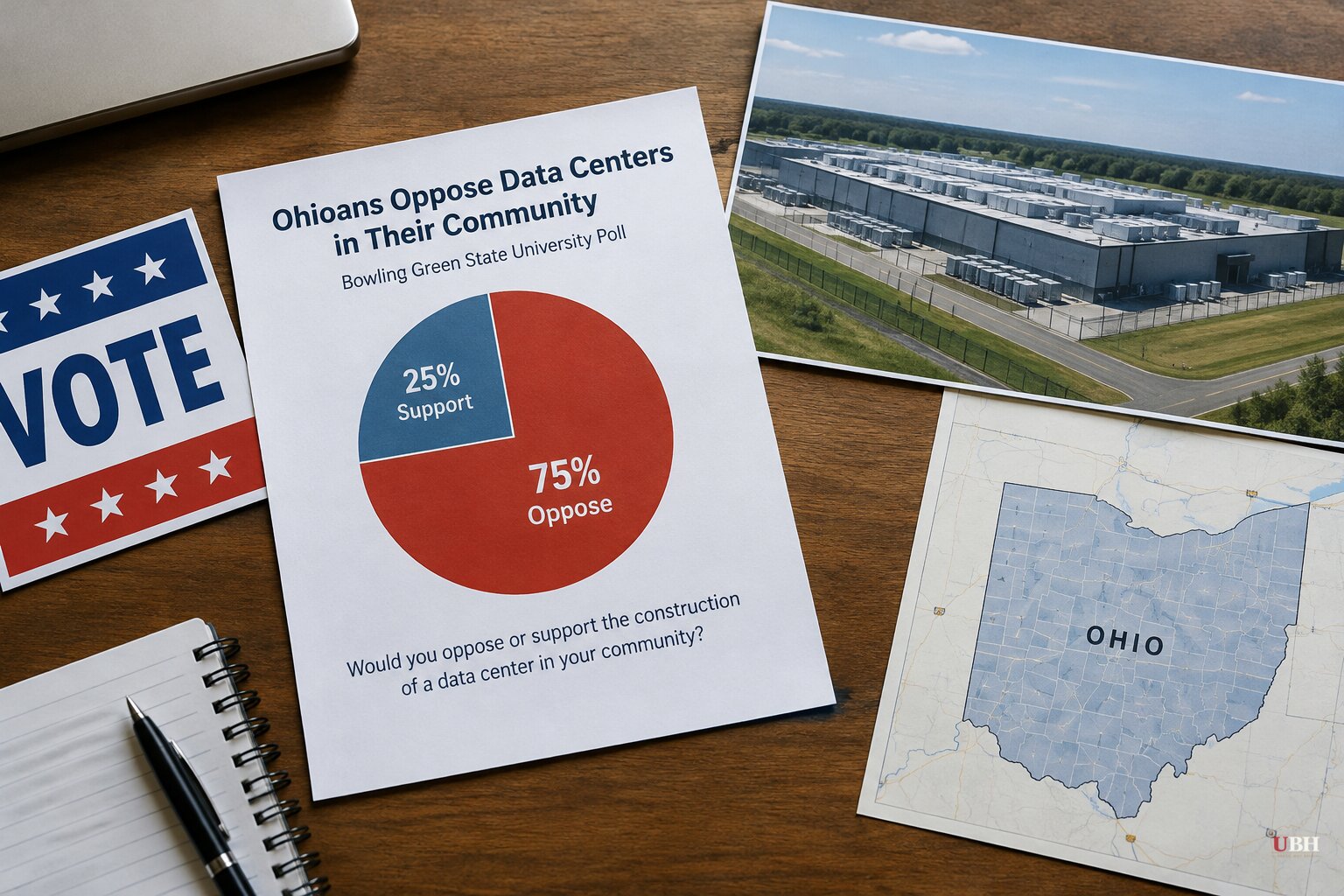
The public mood is lopsided. A Bowling Green State University poll released in September found 75% of Ohioans would oppose a data center being built in their community. Only 25% would support one. Sixty-three percent said they would oppose data centers anywhere in Ohio. Seventy-eight percent said they support a temporary ban on data center construction until more information can be gathered about their effects. The poll surveyed 1,000 Ohio likely voters from Sept. 1 to 10, with a margin of error of plus or minus 4 percentage points.
Opposition to data centers is stronger in Ohio than elsewhere. In a recent New York Times/Siena poll, 3% of Ohio voters said artificial intelligence and data centers were their top issue in the election, the most of any state with a competitive U.S. Senate race.
Who built the boom
Brown has made Husted's record the centerpiece of his attack. "I've made clear from the beginning that Jon Husted is the point man for these 230 or 240 new data centers in Ohio," Brown told the Statehouse News Bureau in August. He has called Husted "the face of data centers in Ohio." Brown also announced his campaign was behind billboards declaring Husted "The Face of Data Centers," citing the state government's use of tax breaks to attract the projects. "Ohioans shouldn't be forced to subsidize these costs and Ohioans—not Jon Husted and his billionaire friends—should get to decide if data centers are built in their community," Brown said in a statement.
The record gives Brown material. As lieutenant governor from 2019 to 2025, Husted publicly celebrated projects from technology companies including Google and Amazon Web Services. He argued they would help establish Ohio as the "tech capital of the Midwest" and strengthen the state's role in the AI economy. According to the Ohio Capital Journal, he played a role in bringing data centers into the state and supported tax breaks for past projects. In total, Ohio has given at least $2.3 billion in sales tax breaks for data centers, Signal Ohio reported in June.
Husted has shifted emphasis. He introduced the Ratepayer Protection Act, which seeks to ensure large electricity users such as data centers pay for the infrastructure needed to serve them rather than shifting costs onto households and small businesses. The bill fell short of the 60 votes it needed to overcome a filibuster in the Senate. Most Democrats opposed it, saying its requirements were not strong enough to do much good. "Let's rise above the politics that often drag this place down and deliver for the American people and do our jobs," Husted said on the Senate floor on Sept. 30.
Husted's campaign has said he supports thoughtful data center planning, with protections for consumers and respect for local communities. Campaign spokesperson Amy Natoce told Newsweek that Husted believes data centers "are, and should remain, a local decision." Husted has also argued that consumers drive the demand. "When we look in the mirror, we are the problem," he said on a podcast.
Both candidates have pushed for guardrails on the campaign trail and have sought to position themselves as the stronger candidate to take on the issue when Congress convenes in 2027.
Republican ground
University of Cincinnati political scientist David Niven told Newsweek the issue is a "powerful wedge issue for Democrats" because the facilities dot "ruby red rural counties." He said Ohio Republicans "have cheered data center construction and handed them tax breaks."
Paul Beck, professor emeritus of political science at Ohio State University, pointed to process. "I think voters are upset that data centers have been approved and subsidized by tax rebates without much transparency to voters," he said.
Kyle Kondik of Sabato's Crystal Ball described "pitchfork populism about data centers" that has emerged. He said Husted is running in a party led by President Donald Trump, who supports data center companies and criticizes opponents of development, and that Trump has responded to voter anger with "a tin ear."
Trump defended AI data centers at a rally in Vandalia, Ohio, where he campaigned to boost Husted and insisted Republicans will keep their congressional majorities despite steep political headwinds.
Supporters of the industry make an economic case. They say data centers are critical AI infrastructure that can bring good jobs, including union jobs, along with investment and local tax revenue. Critics cite environmental impact, water use, noise, and the risk of higher electricity bills.
Sunbury: a ballot test
The fight is most concrete in Sunbury, a city of about 9,000 in Delaware County, near the northeast edge of Columbus' suburbs. The county has Ohio's highest median household income and a history of supporting Republicans.
Amazon Web Services is proposing to build a data center with electricity demand of several hundred megawatts in a farm field. Under the plan, Sunbury would annex the AWS land and allow it to be developed.
Opponents gathered enough signatures to put a measure on the local ballot that would bar data centers with electricity demand of at least 25 megawatts. It appears on the same ballot as the Senate race.
The backlash has been intense partly because Sunbury residents have watched how data centers transformed the farmland of New Albany, about 15 miles away, which now has some of the densest concentration of data centers in the country.
Local residents describe distrust of both parties. Larry Thode, who voted Republican most of his life and whose property is next to the planned AWS site, said: "I'm very disappointed in both parties' approach to my problem." He blames Republicans more because they are the ones in power. The GOP has controlled Ohio's government for more than a decade and also controls the federal government.
Alicia Doty, Thode's neighbor, has mainly voted for Democrats and feels her party needs to be clearer in opposing large data centers. Of Husted, she said: "I don't believe Jon Husted for a second."
Thode and Doty also said Brown's focus on the issue feels more like political calculation than deeply held belief, though they credit him with responding to public concerns more effectively than Husted.
A national pattern
Ohio is not alone. Ballotpedia counts at least 39 local data center measures in eight states: California, Florida, Illinois, Kansas, Michigan, Nevada, Ohio and Wisconsin. Thirty-five will be decided in the Nov. 3 general election. Four were put to voters earlier in the year.
The measures vary. Some are outright bans. Others are advisory questions supporting development, voter-approval requirements, zoning protections, or conditions on companies receiving tax incentives.
Activist Erin Brockovich has published a map of Ohio data centers. It details dozens of large AI-focused and hyperscale campuses built or under development, and notes that smaller, unannounced facilities are not listed. Hundreds of community-reported pins show smaller facilities across the state.
What comes next
The Senate race is tight, and the outcome may determine whether Democrats take control of the chamber. Sunbury voters will weigh in on the measure barring data centers of at least 25 megawatts, a threshold that would cover the AWS proposal, on the same ballot as the Senate race. Husted and Brown will both face the same test when Congress convenes in 2027: whether either man can deliver protections for ratepayers after a boom that began years earlier.
Sources used for this briefing
7 links from 6 independent newsrooms (syndicated copies of the same report count once)
These are the sources it draws on, linked so you can verify.


