
Original briefings. Zero spin.
Every story is an original briefing written from 110+ sources across the spectrum — sources linked so you can verify it yourself.
 finance
Major Story (7/10)
Event date: August 24, 2026
finance
Major Story (7/10)
Event date: August 24, 2026
Shein Prices Hong Kong IPO at $27 Billion, Down 70% From Its 2022 Peak, as China's AI Listing Boom Hits $54 Billion
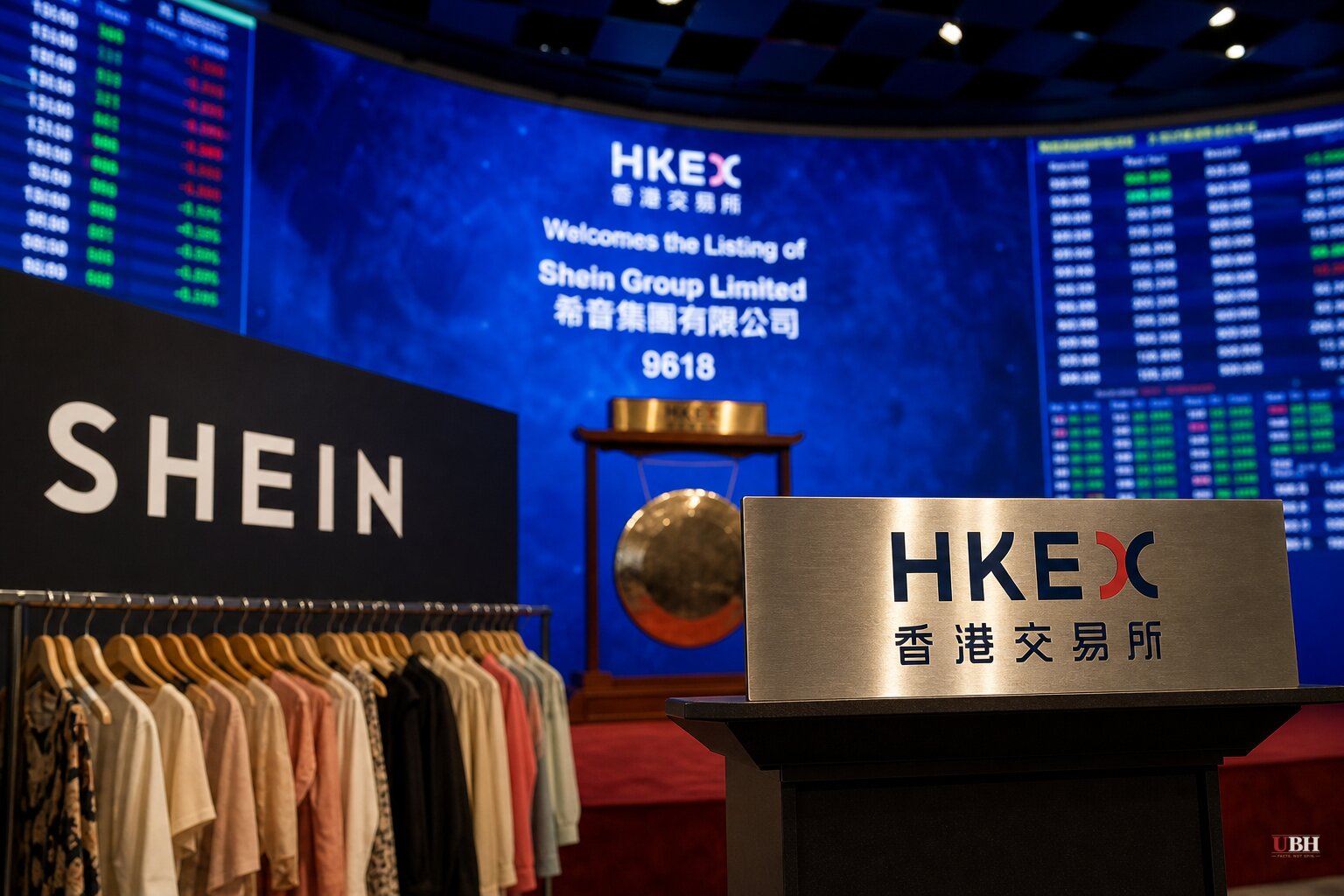
Since the memory chipmaker Longsys unveiled its planned $801 million Hong Kong listing, one more piece of China's 2026 IPO wave has landed: Shein finalized its offer price Monday, August 31, ahead of a scheduled Tuesday, September 1 trading debut on the Hong Kong Stock Exchange.
Shein priced shares between HK$47.60 and HK$49.50, according to the company's prospectus cited by Channel NewsAsia, raising up to $1.77 billion and valuing the company at close to $27 billion at the top of that range. That's a roughly 70% drop from the $98.2 billion private-market valuation Shein commanded in an April 2022 fundraising round, and down from $64 billion valuations in both 2023 and 2024.
A Long, Bumpy Road to Hong Kong
This IPO didn't come easy. The Guardian reports Shein's plans to list in New York were blocked by U.S. regulators over forced-labor concerns, and a subsequent effort to pursue a roughly £50 billion London float ran into the same objections from campaigners, members of Parliament, and investors.
In early 2025, Shein refused to assure British MPs that its products don't contain cotton from China's Xinjiang region, an area U.S. and European governments have linked to forced Uyghur labor. The company shifted its headquarters to Singapore between 2021 and 2022, a move The Guardian says analysts have described as an attempt to distance itself from rising scrutiny of Chinese firms. Shein has not publicly confirmed that motive.
Lawmakers and human-rights advocates on both sides of the Atlantic have raised concerns about the company's supply chain. A company that won't answer direct questions about its sourcing from elected officials invites exactly this kind of scrutiny. At the same time, Shein has never been charged with a violation tied to forced labor, and no regulator has issued a finding against the company on that specific question. The allegation remains unresolved, not proven.
The Numbers Behind the Discount
Shein's financials explain a good chunk of the valuation haircut on their own. The company swung to a $99 million loss in the first quarter of 2026, compared with $395 million in net income a year earlier, after the U.S. eliminated the de minimis import-duty exemption that had let Shein ship low-value packages to American customers largely tax-free, according to The Guardian and baystreet.ca.
Revenue growth slowed to 8% in 2025 from 20% the year before, and Shein said in its prospectus that first-half 2026 growth is tracking close to the 1.1% pace posted in the first quarter, per Channel NewsAsia. Shein also told investors the Iran war has disrupted deliveries in some of its biggest markets and dented consumer demand tied to the broader economic fallout from the conflict, a link the company itself drew in its own filing.
Cornerstone investors including Boyu, Tiger Global and General Atlantic have committed about $383 million, with Tencent, UBS Asset Management and others also taking stakes, Channel NewsAsia reported. Shein plans to use roughly 80% of the proceeds on technology and global brand expansion, and has agreed to pay up to $3.5 billion in cash to early investors who bought special shares in prior funding rounds. Public shareholders will get one-tenth the voting rights of the founders, who will retain 90% control.
Shein Is the Outlier in an AI-Driven Boom
Shein's struggles stand out because almost everything else in this IPO cycle is being fueled by AI mania. IPO and secondary listing proceeds on the Hong Kong and Shanghai exchanges have topped $54 billion so far in 2026, already surpassing last year's full-year total of $46 billion, according to data from LSEG cited by Fortune and the Associated Press.
Memory chipmaker CXMT raised more than $8.6 billion in its July Shanghai listing and jumped 466% on its first trading day. Humanoid robot maker Unitree debuted in Shanghai in August and rose 460% on day one. Ruiying Zhao of S&P Global Market Intelligence called it an appetite for "AI and robotics" driven heavily by retail traders. Perris Lee of ION Analytics said CXMT's listing reflects China's "tech self-sufficiency ambitions."
That self-sufficiency push has real limits, though. The Epoch Times reported that China's dependence on foreign chip sources fell from 90% in 2021 to 60% in 2025, according to the Wall Street Journal, with Morgan Stanley projecting a further drop to 25% within five years. But Nvidia's top AI chip still carries roughly four times the computing power of Huawei's best offering, the Ascend 950, and China holds only about 15% of global computing capacity. Beijing's chip-independence campaign is real progress, not proof of parity.
Shein's shares begin trading Tuesday, September 1. Analysts have already flagged the risk that investor interest could be lukewarm given the crowded field of AI and chip names competing for capital in Hong Kong right now. Whether Shein's discounted $27 billion price finds buyers, or gets treated as a discount-rack leftover next to CXMT and Unitree, will be the first real test of how much the forced-labor questions and shrinking margins actually weigh on the stock.
Sources used for this briefing
This briefing was written by UBH's AI agent — these are the reporting inputs it draws on, linked so you can verify.


