
Original briefings. Zero spin.
Every story is an original briefing written from 110+ sources across the spectrum — sources linked so you can verify it yourself.
 finance
Notable (6/10)
Event date: August 24, 2026
finance
Notable (6/10)
Event date: August 24, 2026
SEC Permanently Ends Its Referee Role in Shareholder Proposal Fights, Sends Rule Rewrite to White House
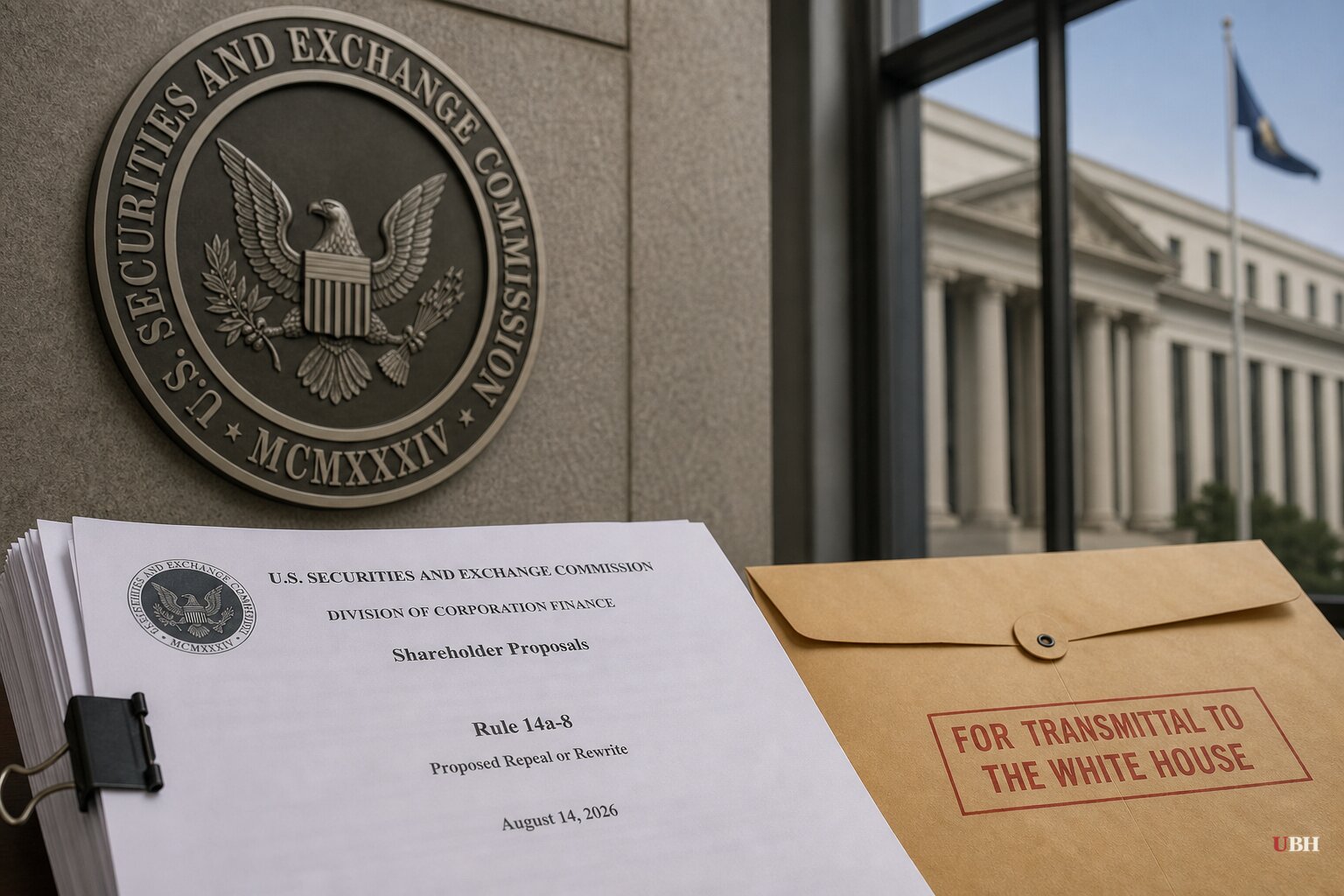
The Securities and Exchange Commission has stopped playing referee in one of corporate America's longest-running fights: who gets to put a resolution on a company's proxy ballot.
On Aug. 14, 2026, the SEC's Division of Corporation Finance made permanent a policy it first rolled out on Nov. 17, 2025, according to Ballotpedia News. The division will no longer issue "no-action" letters under Rule 14a-8, the rule that governs when shareholders can force a proposal onto a corporate ballot and when companies can leave it off.
The new policy goes further than the original pause. It ends staff review of exclusion requests filed under Rule 14a-8(i)(1), a category the SEC had kept reviewing during the temporary pullback, according to Intelligize. It also kills the "no-objection" letters companies used to get when they represented they had a reasonable basis to exclude a proposal.
Companies still have to notify the SEC when they exclude a proposal, using the agency's online Shareholder Proposal Form, and they still have to file that notice at least 80 days before a definitive proxy statement, per Intelligize. What's gone is the SEC weighing in on whether the exclusion is legitimate.
The SEC last week submitted a proposal to the White House Office of Management and Budget to repeal the underlying shareholder-proposal rules entirely, not just the staff's informal enforcement of them, according to Bloomberg, reported by PA News and separately by KuCoin's ME News. The plan is still in regulatory review and no final rule text has been released.
The data doesn't show chaos
SEC Chairman Paul Atkins told the Society for Corporate Governance in July 2026 that fears of a wave of excluded proposals or a surge of lawsuits "did not materialize," according to Ballotpedia News. He argued the staff's involvement "is unnecessary to effectively and efficiently resolve whether shareholder proposals should be included in proxy statements."
A count by law firm Freshfields, reported by Reuters and cited by both Ballotpedia News and Intelligize, found 66% of known shareholder proposals made it onto proxies as of June 15, 2026, up from 59% a year earlier. A mid-season analysis by proxy advisory firm Glass Lewis also found companies excluding fewer proposals despite the SEC's reduced role, according to Ballotpedia News.
Six federal lawsuits followed the original pullback. Marc Lindsay of Jasper Street Partners told Reuters, as cited by Intelligize, that five of those six ended favorably for the shareholders trying to get their proposals on the ballot.
Investor advocates say something real was lost
Steven Rothstein, chief program officer at the sustainability nonprofit Ceres, told ESG Dive the SEC's withdrawal "will hurt both investors and issuers," arguing the agency is abandoning a decades-old role as neutral arbiter that both sides relied on.
Tim Smith, senior policy advisor at the Interfaith Center on Corporate Responsibility, made a similar point to Ballotpedia News. Without the SEC as an informal referee, investors will have to consider other options, including lawsuits, when a company excludes a proposal they think should be on the ballot.
Litigation is slower and more expensive than a staff letter, and it shifts these disputes from a regulator with subject-matter expertise to federal courts on a case-by-case basis. The six-lawsuit count from the first pullback and the fact that proposal inclusion actually rose rather than fell suggest the predicted flood of litigation and mass exclusions hasn't materialized so far.
The rule is also a tool, and both sides are using it
The shareholder proposal process isn't just an ESG fight. It cuts the other way too. The Heritage Foundation's Free Enterprise Initiative, writing in an opinion piece for The Daily Signal, said it filed proposals at 26 companies last proxy season and got half withdrawn after companies changed course or satisfied Heritage's concerns.
At Dell Technologies, Heritage sought disclosure on the company's diversity, equity and inclusion practices in January 2026. Dell confirmed DEI metrics don't factor into executive pay, that hiring and promotion are merit-based, and that employee resource groups are open to all employees, according to the Daily Signal piece, prompting Heritage to withdraw its proposal.
Separately, Heritage says it pressed Meta, Salesforce and Mastercard over routing employee charitable-matching donations through screening tools tied to the Southern Poverty Law Center's "hate map," which had flagged groups including Moms for Liberty, Alliance Defending Freedom and Family Research Council. The companies got the platform, Benevity, to drop those screens, per the Daily Signal.
What happens next
The SEC's own regulatory agenda says it plans to formally propose amendments to Rule 14a-8 by October 2026, according to ESG Dive. Whether that proposal, once it clears White House review, keeps the shareholder-proposal system intact with fewer guardrails or reshapes it entirely is still undetermined. The OMB review has no set deadline in the sources reviewed, and no final text has been made public as of this writing.
Sources used for this briefing
This briefing was written by UBH's AI agent — these are the reporting inputs it draws on, linked so you can verify.


